Three Generations, One Chair: What a Family-Run Dental Practice Knows That a New One Cannot

Most dental practices are younger than the patients they treat.
A practice opens, runs for a decade or two, and the dentist sells or retires. The building changes hands, the records get boxed up or migrated to a new system, and the relationship starts over. For patients, dental care becomes a series of fresh starts, each new dentist meeting your mouth for the first time with no history to draw on.
Then there is the other kind of practice. The one that has been on the same corner since your grandparents were young, run by the grandson of the dentist who first opened the door.
That continuity is rarer than it sounds, and it is worth understanding what it actually gives you.
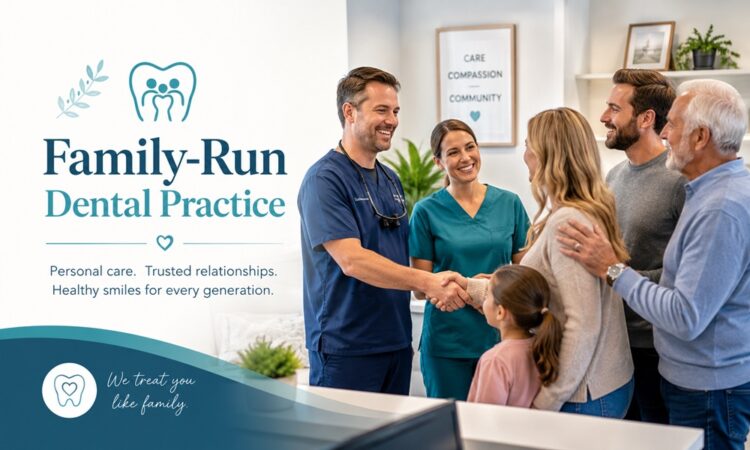
In Monterey Park, this is not hypothetical. Dr. Kevin Sekiguchi is a third-generation dentist. His grandfather opened the practice in the late 1950s. His father ran it for decades and eventually retired. Dr. Kevin took over the family business, and today offers general, restorative, and cosmetic care, including crowns and bridges, implant restorations, and clear aligners, from the same community roots. For anyone looking for a dentist in Monterey Park CA, that lineage is not a marketing footnote. It is the whole story.
Why does continuity matter in dentistry specifically?
Dentistry is unusual among health fields in how much it depends on the long view.
Most dental problems are not events. They are slow trends measured over years and decades:
- Gum recession creeps a fraction of a millimeter at a time.
- A crack in a tooth propagates over a decade.
- Enamel wear from grinding deepens imperceptibly.
- A filling ages, then fails, then gets replaced with something larger.
- Bone loss around a tooth advances silently.
None of these is visible in a single snapshot. All of them are obvious in a series of snapshots taken over time.
A dentist with your twenty-year history can see the trend. A dentist meeting you today sees only the current frame. They can be an excellent clinician and still be working with a fraction of the information.
The records question nobody thinks about
Here is a scenario that plays out constantly.
You move, or your dentist retires, and you start with someone new. They ask for your records. The old office sends over your most recent set of X-rays, maybe two years old. That is it. Two decades of dental history compressed into a single image.
Your new dentist now knows what your teeth look like today. They do not know:
- Which teeth have been filled, when, and how many times
- Whether that shadow on the X-ray is new or has been stable for fifteen years
- How your gums have trended
- How you respond to anesthesia
- Which restorations are original and which are replacements
- What your dentist a generation ago noted and chose to watch
A practice with deep continuity never loses this thread. The chart goes back decades, sometimes to a previous generation of the same family holding the same instruments. The comparison is built in.
Seeing the whole family, across the whole lifespan
A long-established family practice often treats several generations of the same household at once.
| Family member | What the practice tracks |
|---|---|
| Grandparent | Decades of restorative history, now managing tooth retention |
| Parent | Mid-life restorations, wear patterns, the start of the restorative cycle |
| Child | Prevention, sealants, orthodontic timing, permanent teeth erupting |
This matters more than convenience. Many dental tendencies run in families, from enamel quality to jaw structure to grinding to gum disease susceptibility. A dentist who has treated the grandparent and the parent has real, observed context when the child sits down. They are not guessing at family patterns. They have watched them.
There is also a trust dimension. A child who grows up going to the same practice their parent trusted, in a place that feels familiar rather than clinical, is a child who does not develop dental anxiety. That single fact shapes a lifetime of dental care.
What “modern dentistry in an old practice” looks like
There is a fair worry here. Does a practice that has been around since the 1950s mean 1950s dentistry?
No, and the distinction matters. Longevity is about the relationship and the records. The tools update continuously.
A well-run multi-generational practice pairs deep history with current technology:
- Digital records and imaging that preserve and extend the historical chart rather than replacing it.
- Modern restorative options like implant restorations, which let a patient replace missing teeth with something that looks and functions naturally.
- Clear aligners as a discreet, removable alternative to braces for suitable cases.
- Contemporary crowns and bridges using current materials.
The philosophy stays consistent across generations. The equipment does not. A patient gets the benefit of both: a practice that remembers their family and a practice that uses today’s methods.
The continuity of philosophy
This is subtle but real. When a practice passes from parent to child within the same family, a way of practicing tends to pass with it.
A grandfather who believed in conservative treatment, honest recommendations, and treating patients like neighbors rather than transactions tends to raise a child who absorbs those values, who then does the same. The result is a consistency of approach that a corporately owned, frequently changing practice struggles to match.
This shows up in the small things:
- Whether you feel pressured toward expensive treatment or offered the conservative option first
- Whether the dentist explains or just prescribes
- Whether you are treated as a long-term relationship or a single visit
- Whether “we’ll watch that” is something they are comfortable saying
None of this is guaranteed by lineage. But a practice that has kept the same family and the same patients for over sixty years has, almost by definition, been doing something right for a very long time. Practices that treat people poorly do not last three generations.
Accessibility still matters
Continuity is not worth much if you cannot get an appointment. A good long-standing practice pairs its history with practical access.
Offering some Saturday availability, for instance, matters for working patients who cannot take weekday time. It signals that the practice is adapting to how people actually live, not just resting on its history.
When you evaluate a family practice, the questions are:
- Can I actually get in at a time that works for my schedule?
- Do they take my insurance or help me use my benefits?
- Do they see my whole family, across ages?
- Do they keep and use long-term records?
- Do they offer current treatment options?
What to bring to a first visit at an established practice
Even at a practice with deep roots, if you are new to them, help them build your thread:
- Any prior X-rays you can obtain, as digital files
- A full medication list, including supplements
- Your dental history as you remember it, including past problem teeth
- Your insurance details, the specific plan name
- A note on any dental anxiety or past bad experiences
From that first visit forward, if you stay, the thread grows. And a growing thread is the entire point.
Frequently asked questions
Is an older, established practice behind on technology? Not necessarily. Longevity is about relationships and records. Equipment and materials update continuously regardless of how long a practice has existed. A well-run established practice pairs deep history with current methods.
Why do long-term dental records matter so much? Because most dental problems are slow trends visible only across time. A dentist with your twenty-year history can distinguish a new problem from a stable one, which a single recent X-ray cannot show. That comparison changes diagnoses and treatment decisions.
Can one practice really treat my whole family? Yes, and there is a specific benefit. A practice that sees grandparents, parents, and children has observed context for family dental patterns, from enamel quality to grinding to gum disease risk, which many conditions follow.
Does a family-run practice cost more? Not inherently. What it tends to offer is consistency of philosophy and care. Ask about insurance, financing, and transparent estimates the same way you would with any practice.
What happens to the relationship if the dentist retires? In a multi-generational practice, the answer has historically been that the next generation continues it. That is the defining feature, care and records passing forward rather than starting over.
I have dental anxiety. Does continuity help? Considerably. Seeing the same familiar practice over years, especially from childhood, is one of the strongest protections against developing or worsening dental anxiety. Familiarity is calming.
Should I switch to an established practice if I already have a dentist? Not automatically. If you have a good relationship and continuous records where you are, that continuity is what matters. The principle is the value of the long thread, wherever you hold it.