You might have started noticing it in photos first. Your smile looks a little dull, that one chipped tooth keeps drawing your eye, or your teeth seem more uneven than you remember. Maybe you are suddenly very aware of how much you hide your smile at work, in family pictures, or even on a first date. A visit to a dentist in Torrance CA could help you feel more confident about your smile. You are not being vain. You are simply noticing something that has been quietly bothering you for a while.end
Because of this tension, you might wonder if it is finally time to look at cosmetic options like whitening, bonding, or veneers, or if you are overthinking it. The short answer is that your feelings are usually the best early sign. If your smile is holding you back, there is a good chance there is a safe, realistic way to improve it.
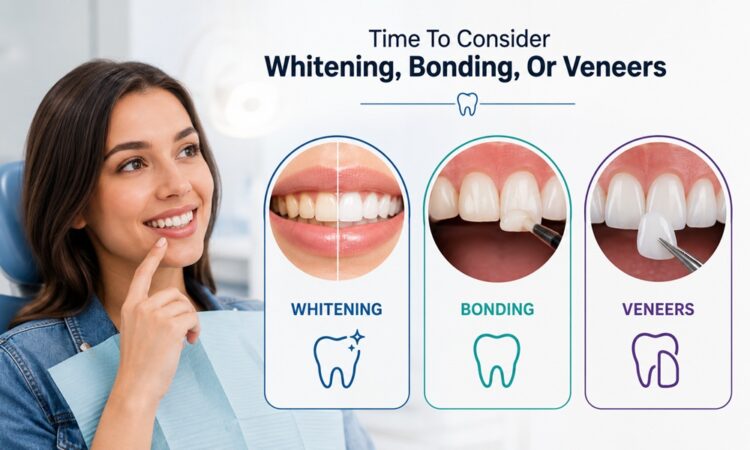
Here is the simple overview. Whitening can brighten stained teeth. Bonding can reshape or repair small flaws. Veneers can create a more dramatic, longer lasting change for multiple teeth. You do not need to know which one is right for you yet. What you really need to know is whether it is time to talk with a family and cosmetic dentist about your options.
Are stains and discoloration making you hide your smile?
Maybe it started with coffee or tea in the morning, then red wine on weekends, and now your teeth look more yellow than they used to. You brush, you floss, you might even use whitening toothpaste, but the color does not really change. You catch yourself covering your mouth when you laugh. You smile with your lips closed in photos. It feels small, but it chips away at your confidence.
This is one of the clearest signs that it may be time for professional whitening or other cosmetic treatment. Everyday products often cannot lift deeper stains that sit below the surface of the enamel. That is why so many people feel disappointed after trying multiple over the counter strips and gels.
Professional whitening uses stronger, carefully controlled formulas that can reach those deeper stains more effectively. If you want a simple, noninvasive way to refresh your smile, whitening is usually the first option a family and cosmetic dentist will discuss. You can read more about how whitening works and when it is safe through the American Dental Association’s overview of professional teeth whitening.
Do chips, cracks, or uneven edges bother you every time you look in the mirror?
Maybe you remember the exact moment it happened. You bit down on something hard and chipped a front tooth. Or you had an accident years ago and the edge of a tooth has been uneven ever since. It might be a tiny flaw, but your eye goes straight to it. You may feel that people notice it when you talk, even if they are too polite to say anything.
That small chip can feel like a big deal emotionally. You might worry that it makes you look older or less polished, especially in professional settings. If you feel yourself hesitating to speak up in meetings or on video calls because of how your teeth look, that is a sign the issue is affecting more than just your appearance.
For these kinds of concerns, bonding is often a gentle, cost effective option. A tooth colored resin is applied to the tooth, then shaped and polished to blend in. It can smooth sharp edges, repair chips, and even improve the shape of slightly misshapen teeth. When several front teeth are uneven, veneers might be discussed as a more durable and uniform solution.
Are gaps, uneven shapes, or worn teeth affecting how you feel about your smile?
Some people are born with small gaps or teeth that are slightly rotated or irregular in shape. Others notice that as they age, their teeth wear down, making them look shorter or more uneven. You may still have healthy teeth, yet you feel that your smile no longer matches how you see yourself.
If you find yourself thinking, “My teeth look tired,” every time you see a close up photo, you are not imagining it. Wear, minor alignment issues, or multiple small flaws across several teeth can create an overall look that bothers you, even if no single tooth is “bad enough” on its own.
This is often when people start considering porcelain veneers or other cosmetic dentistry. Veneers are thin shells that cover the front of the teeth. They can improve color, shape, and alignment all at once. They are especially helpful when you want a more uniform smile rather than fixing one tooth at a time. For a deeper explanation of what veneers are and how they are placed, you can explore this guide on dental veneers from MouthHealthy.
Do you feel stuck after trying every DIY whitening trick you can find?
You might already have a drawer full of whitening strips, pens, and pastes. You follow the directions, you avoid coffee for a week, and still, the change is small or fades quickly. At some point you start to wonder if stronger products would help, or if you might actually harm your enamel.
That frustration and confusion is very common. There is a lot of marketing around teeth whitening, and it can be hard to tell what is safe and what is wishful thinking. If you feel you are guessing, that is usually the moment to pause and talk to a professional. A family and cosmetic dentist can look at the type of staining you have, your existing dental work, and your sensitivity level, then recommend what is both effective and safe.
If you want an evidence based overview of options and safety, MouthHealthy has a clear guide to teeth whitening choices and risks that can help you frame questions for your dentist.
Whitening, bonding, or veneers: how do they actually compare?
Once you recognize that your smile is bothering you, the next question is practical. Which treatment makes sense for your situation, your budget, and your tolerance for maintenance and change. It can help to see the big picture side by side.
| Treatment | Best for | Typical longevity | Cost level (relative) | Reversibility | Common example |
|---|---|---|---|---|---|
| Professional Whitening | Yellow or brown stains on otherwise healthy teeth | Several months to a few years, with touch ups | Low to moderate | Fully reversible, no permanent change to tooth shape | Brightening teeth that have darkened from coffee, tea, or age |
| Bonding | Small chips, cracks, gaps, or minor shape issues | About 3 to 10 years, depending on care and location | Moderate | Partially reversible, minimal tooth preparation | Repairing a chipped front tooth after biting something hard |
| Veneers | Multiple flaws in color, shape, size, or minor alignment | Often 10 to 15 years or longer with good care | Higher | Not reversible, requires permanent change to tooth surface | Creating a more uniform, “picture ready” smile across several front teeth |
This comparison is not meant to push you toward any one option. It is meant to show that there is usually a spectrum of choices. A thoughtful family and cosmetic dentist will walk through these trade offs with you, including whether doing nothing for now is also a reasonable path.
Three steps you can take right now
- Get clear on what actually bothers you
Stand in front of a mirror in good light and simply look at your smile. Ask yourself what draws your eye first. Color. Shape. Gaps. Chips. Wear. Sometimes writing down the top two or three things that bother you helps you feel more focused and less overwhelmed. This list will also help your dentist understand your priorities quickly.
- Gather a few “goal” photos
These do not have to be celebrity smiles. Old photos of yourself before staining or wear can be even more powerful. They show what feels natural and “like you.” Bring these photos to your appointment. They give your family and cosmetic dentist a clearer picture of your style, whether you want a subtle refresh or a more noticeable change.
- Schedule a cosmetic consultation, even if you are unsure
You do not have to decide on whitening, bonding, or veneers before you walk in. A consultation is simply a conversation about what is possible with your teeth, your bite, and your budget. Ask about the pros and cons of each option for your specific situation. Ask what your smile might look like with the most conservative treatment and with a more involved one. A good dentist will respect your pace and will not pressure you.
Moving from self-conscious to confident
If you have read this far, there is a good chance your smile has been bothering you for a while. You may have talked yourself out of doing anything because it felt unnecessary, or you worried it would be too expensive or too “fake.” Those are understandable fears. At the same time, your smile is part of how you connect with people every single day. Feeling comfortable when you laugh, speak, and show your teeth is not a luxury. It is part of feeling like yourself.
Whether you end up choosing simple whitening, a bit of bonding, or a more involved veneer treatment, the goal is the same. You should be able to smile without thinking twice. Reaching out to a trusted family and cosmetic dentist is the first real step toward that kind of ease.
You do not need all the answers before you start. You only need the willingness to ask the right questions and to sit down with someone who can guide you through the options, one thoughtful step at a time.