The Hooked Finger Bone Explained: Hook of the Hamate, Its Injuries, and Recovery

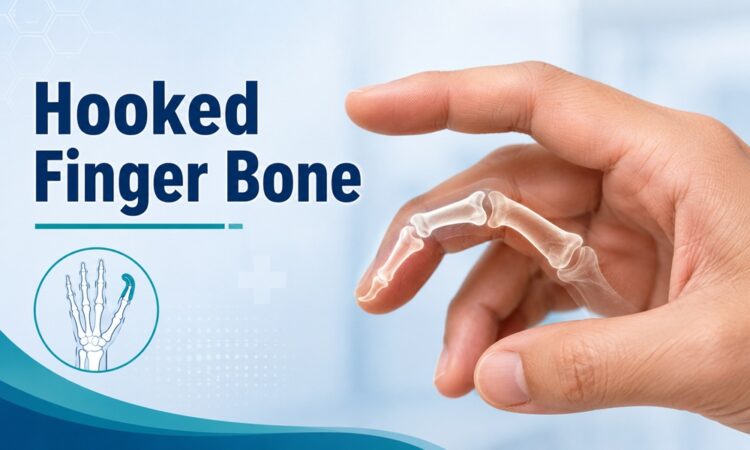
Quick answer: The “hooked finger bone” is the hook of the hamate (the hamulus), a small, hook-shaped spur that juts out from the hamate carpal bone in your wrist. It sits deep in the palm on the pinky side, anchors key ligaments and tendons, and acts as a pulley for the ring and little fingers. Its exposed shape makes it prone to breaking in grip sports like golf, baseball, and tennis. Most fractures heal with a cast or, more often for athletes, surgery to remove the broken piece, with a return to activity in roughly 6 to 8 weeks.
That hook is easy to overlook. It is smaller than a fingernail. Yet it recently sidelined three Major League Baseball stars in a single week of spring training. Below is everything worth knowing, from anatomy to recovery.
What is the hooked finger bone in your hand?
The hooked finger bone is not a finger bone at all. It is a part of the hamate, one of eight small wrist bones called the carpal bones.
The name gives it away. “Hamate” comes from the Latin hamatus, meaning “hooked.” An older name, the unciform bone, comes from uncus, also meaning “hook.”
The hamate has two parts:
- The body: the larger, wedge-shaped mass of bone.
- The hook (hamulus): a curved, beak-like spur that projects from the palm side of the body.
People often call it a “finger bone” because the hamate sits right at the base of the ring and little fingers and supports their long bones (the metacarpals). So the everyday label sticks, even if the anatomy is technically wrist, not finger.
Where is the hook of the hamate located?
Press into the fleshy pad at the base of your palm, on the pinky side, just past the wrist crease. The hook sits underneath, angled slightly toward the center of the palm.
It is tucked between two important structures:
| Structure | Relationship to the hook |
|---|---|
| Carpal tunnel | The hook forms the inner (medial) wall of the carpal tunnel. |
| Guyon’s canal (ulnar canal) | The hook forms the outer wall of this canal, which carries the ulnar nerve and artery. |
| Pisiform bone | Sits just above and to the pinky side of the hook. |
| Ring & little finger metacarpals | The hamate body connects directly to these two hand bones. |
This crowded neighborhood matters. When the hook breaks, nearby nerves, arteries, and tendons can be affected too.
What does the hook of the hamate actually do?
For such a tiny structure, it earns its keep. The hook has three main jobs.
1. It is an anchor. Several soft-tissue structures attach here, including the transverse carpal ligament (the roof of the carpal tunnel), the flexor carpi ulnaris tendon, and the pisohamate ligament.
2. It is a muscle origin. Two muscles that move the little finger, the flexor digiti minimi brevis and the opponens digiti minimi, start from the hook.
3. It works as a pulley. This is the underrated part. The flexor tendons that curl your ring and little fingers wrap around the hook. It redirects their pull, much like a rope running around a post. This gives you a stronger, more controlled power grip, especially when your wrist bends toward the pinky side.
That pulley role is exactly why gripping a bat, club, or racket handle can put so much stress on such a small piece of bone.
Why does the hooked bone break so easily?
Three factors combine to make the hook vulnerable.
- It sticks out. Unlike most carpal bones, which are buried and protected, the hook projects into an exposed part of the palm. The handle of any gripped tool presses right against it.
- It has a poor blood supply. Blood flow to the hook is limited. That makes healing slow and unreliable once it cracks.
- It takes concentrated force. During a swing, the full impact of a bat or club can travel straight down the handle and into the hook.
The break can happen two ways. A stress fracture builds up gradually from thousands of repetitive swings. An acute fracture happens in one violent moment, like a checked swing, a foul tip, a jammed hit, or grounding a golf club into hard turf.
There is also a telling pattern. The injury lands almost always in the non-dominant, lower hand on the bat or club, the hand that absorbs the shock during follow-through. Studies of athletes have found this pattern in the vast majority of baseball and golf cases.
What are the symptoms of a hook of hamate fracture?
The symptoms are easy to dismiss as a simple sprain, which is why so many cases go undiagnosed for weeks or months.
Watch for these signs:
- Aching pain on the pinky side of the palm, just past the wrist.
- Weak grip. Objects feel harder to hold, and gripping hurts.
- Pain when curling the ring and little fingers.
- Point tenderness when you press into that spot in the palm.
- Pain during the swing in a bat, racket, or club sport.
- Tingling or numbness in the ring and little fingers, if the nearby ulnar nerve is irritated.
- Minimal swelling or bruising in many cases, which is part of why it slips under the radar.
A useful clinical clue is the pull test. A clinician has you actively bend the tips of your ring and little fingers against resistance. If that reproduces the deep palm pain, a hook fracture becomes far more likely, because the flexor tendons tug directly on the fracture site.
Which sports and activities cause a hook of hamate fracture?
This injury has a signature list of causes. It clusters around anything that drives a handle into the palm.
- Baseball and softball (batters and catchers)
- Golf (especially grounding the club on a swing)
- Tennis, squash, and racquet sports
- Hockey and lacrosse (stick sports)
- Falls onto an outstretched palm
- Crush injuries and direct blows
The 2026 MLB “hamate” cluster
The bone jumped into headlines when spring training opened in February 2026. Within days, three high-profile players, Francisco Lindor of the Mets, Corbin Carroll of the Diamondbacks, and Jackson Holliday of the Orioles, were all sidelined by hamate injuries and headed for surgery. The clustering was so unusual that fans, and even some players, admitted they had never heard of the bone before.
Baseball has a long history here. Giancarlo Stanton fractured his hamate in 2015, and Bryce Harper had hamate surgery in 2022. Both returned, but both spoke about how long it took to get their power back. That detail is important: surgery fixes the bone quickly, but grip-driven power can be the last thing to return.
How is a hook of hamate fracture diagnosed?
Diagnosis is genuinely tricky, and standard imaging often misses the break. This is a key reason patients bounce between appointments before getting answers.
A doctor starts with your history and a hands-on exam, including the pull test and pressing directly over the hook. Then imaging confirms it, but the choice of scan makes a huge difference.
| Imaging test | Approximate sensitivity | Notes |
|---|---|---|
| Standard X-ray | 10% – 40% | Frequently misses the hook. A special “carpal tunnel” or oblique view improves the odds. |
| CT scan | ~92% | Far more reliable and often the go-to confirmation test. |
| MRI | ~100% | Most accurate; also shows soft-tissue and marrow changes. |
The takeaway for readers: a normal X-ray does not rule out a hook fracture. If pain persists, a CT or MRI is usually the next step. Delayed diagnosis is one of the biggest risk factors for a fracture that never heals.
The look-alike that fools doctors: os hamuli proprium
Here is an insight most articles skip entirely, and it can change how a “fracture” is managed.
In a small share of people, the hook of the hamate never fuses to the body during childhood. It stays as a separate little bone, called an os hamuli proprium (an unfused or “bipartite” hamate). It is found in less than 1% of people and is often discovered by accident.
The problem is that on a scan it can look exactly like a fractured or non-healing hook. Doctors distinguish the two using a few clues:
- Rounded, smooth, well-corticated edges suggest the harmless ossicle, not a fresh break.
- No history of trauma points toward the variant.
- The same finding in both wrists strongly favors the ossicle, since a coincidental identical fracture on both sides is unlikely.
Why it matters: an incidental os hamuli proprium in someone with no symptoms usually needs nothing at all. Recognizing it before a carpal tunnel or ulnar tunnel operation is also important, so surgeons avoid confusion and protect the nearby nerve. Rarely, the ossicle itself can fracture, which is well documented but uncommon.
How is a broken hook of the hamate treated?
Treatment depends on how bad the break is, how long it has been there, and how quickly you need to get back to sport. There are three main paths.
| Approach | What it involves | Best suited for |
|---|---|---|
| Immobilization | An ulnar gutter cast or splint for several weeks, plus rest from gripping, pushing, and pulling. A bone stimulator is sometimes added. | Early, non-displaced fractures in patients not racing back to sport. |
| Excision (removal) | Surgery to remove the broken hook fragment entirely. | Most athletes, displaced fractures, and fractures that failed to heal. |
| Fixation (ORIF) | Pins or screws to hold the pieces together, preserving the bone. | Large fragments where keeping the bone is worthwhile; involves longer recovery. |
A few realities worth knowing:
- Casts often fail to heal the hook. Because of the weak blood supply, up to half of casted hook fractures end in a nonunion (the bone never knits). Interestingly, many of those people are still pain-free and fully functional.
- Excision is the athlete’s default. Removing the fragment reverses symptoms, avoids the wait for bone healing, and lets players return once the skin incision heals. It does not meaningfully harm hand function.
- Conservative care can still work for the right person. A case series of 16 patients (average age around 50) who wanted to avoid surgery achieved bone union with about four weeks of casting followed by splinting. So surgery is not the only option, especially for non-athletes.
- Smoking slows healing. Quitting is routinely advised for anyone trying to heal the bone without surgery.
How long does recovery take
Recovery time swings widely based on the treatment. Here is a realistic timeline.
| Path | Immobilization | Return to sport | Full strength / power |
|---|---|---|---|
| Non-surgical cast | 6 – 8 weeks | After healing is confirmed | Several weeks to months more |
| Hook excision | Short (about 1 – 4 weeks) | ~6 weeks (median in studies) | Up to 3 – 6 months |
| Fixation (screw/pin) | Several weeks to months | Longer than excision | Up to 6 months |
In one two-center study of 81 patients, the median return to play after excision was about 6 weeks, though a minority took 12 weeks or longer. Grip strength and pain-free movement should return before any athlete goes back to their sport.
One honest caveat: returning to play is not the same as returning to full power. Grip-dependent explosiveness, the kind a hitter needs, can lag behind for months even after the wound has healed.
Can the hook of the hamate grow back after surgery?
Surprisingly, yes, in rare cases, and this is an insight almost no consumer guide mentions.
Because excision removes the fragment along with its lining, doctors long assumed the hook was gone for good. But documented case reports describe regrowth of the hook years after excision, followed by a refracture through the regenerated bone. In the reported cases, the patients were baseball players who returned to high-level play, then broke the regrown hook again during batting.
The true frequency is unknown, because most patients never get follow-up scans after a successful excision. It is likely relevant only to a small group of athletes who keep loading that hand hard for years. Still, it is a useful thing to know: a past excision does not make you permanently immune to pain in that spot.
What are the complications and long-term risks?
Most people do very well. But because the hook lives in a crowded, high-traffic corner of the wrist, complications are possible.
- Nonunion: the most common issue with casted fractures.
- Ulnar nerve irritation: tingling, numbness, or weakness in the ring and little fingers. After surgery, temporary nerve dysfunction is not rare. In one study, roughly a quarter of patients had a complication, most often transient nerve issues, and the large majority recovered within about five months.
- Reduced grip strength and lingering, dull palm ache.
- Tendon rupture: an untreated, sharp fracture edge can, over time, fray and snap the flexor tendons of the ring and little fingers.
- Post-traumatic arthritis in long-standing cases.
Complications are more likely when diagnosis is delayed, when the fracture has already become a nonunion, or when a long time passes between injury and surgery. Early diagnosis is the single best protective factor.
Can you prevent a hook of hamate injury?
You cannot make the bone bulletproof, but you can lower the load on it.
- Use protective padding. Padded gloves or gel pads can cushion the hook against the handle. They reduce force but do not eliminate the risk.
- Fit the equipment to your hand. A bat, club, or racket sized and gripped correctly spreads force more evenly.
- Refine grip and swing mechanics. A coach can help reduce the jarring impact that concentrates on the hook.
- Build wrist and forearm strength. Stronger supporting muscles share the load.
- Respect early pain. Deep palm pain on the pinky side is a signal, not a nuisance. Backing off early can stop a stress reaction before it becomes a full fracture.
What real patients and athletes say
Beyond the clinical literature, first-hand accounts on forums like GolfWRX and Reddit paint a consistent picture, and it is worth reading before you panic or delay.
Common themes from people who have been through it:
- Many describe months of vague, nagging pain and being told it was “just a sprain” before a CT finally found the break. Delayed diagnosis is the norm, not the exception.
- Golfers frequently report the injury flaring when the club catches the ground, and pain that makes finishing a round impossible.
- Post-excision, most describe a fast, smooth return, often back to swinging within a couple of months, and are relieved they did not spend months in a cast for nothing.
- A recurring piece of advice: push for advanced imaging if pain lingers despite a clean X-ray, and see a hand specialist rather than waiting it out.
These lived experiences line up neatly with the research: this is a small injury that is easy to miss, usually very treatable, and best not ignored.
When should you see a doctor?
See a hand specialist or orthopedic doctor if you have:
- Persistent pain on the pinky side of the palm, especially after a swing sport or a fall.
- A weak or painful grip that is not improving.
- Numbness or tingling in the ring and little fingers.
- A previously “diagnosed sprain” that simply will not settle.
Sooner is better. The faster a hook fracture is caught, the more treatment options you have and the lower your risk of a bone that never heals.
Frequently asked questions
Is the hook of the hamate a finger bone or a wrist bone?
It is technically a wrist bone. The hamate is one of the eight carpal (wrist) bones, but its hook sits at the base of the ring and little fingers, which is why people call it a “finger bone.”
Can you live without your hook of the hamate?
Yes. Surgeons routinely remove the broken hook, and hand and wrist function generally stays normal. This is why excision is the preferred option for many athletes.
Does a hook of hamate fracture show up on X-ray?
Often not. Standard X-rays miss a large share of these fractures. A special carpal tunnel view helps, but a CT scan or MRI is usually needed to confirm the break.
How do I know if my wrist pain is a hamate fracture or just a sprain?
You often cannot tell without imaging. Deep pain on the pinky side of the palm, a weak grip, and pain when bending the ring and little fingers are red flags that warrant a scan.
How long until I can grip normally again after surgery?
Many people return to activity around six weeks after excision, but full grip strength and power can take three to six months to come back.
Do golf or batting gloves prevent it?
Padding can reduce force on the hook, but it cannot fully prevent fractures. Good technique, proper equipment fit, and respecting early pain matter just as much.