Can you wear primer without makeup?
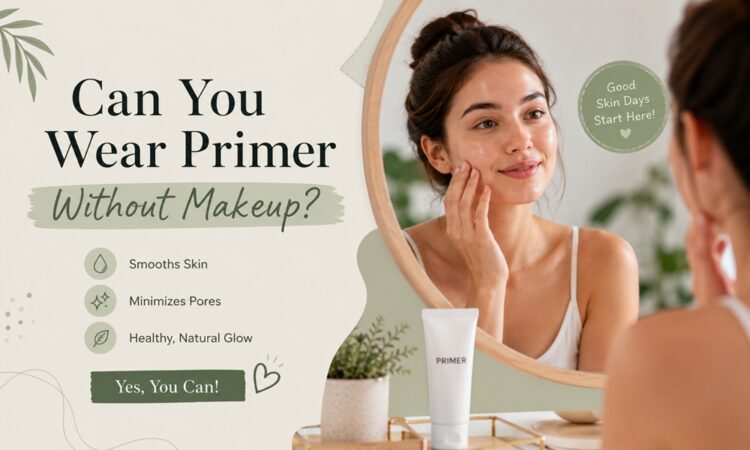
Yes. There is no rule that primer must sit under foundation.
Primer’s original job is to create a smooth base for makeup. But that same job smooths pores, softens texture, and evens tone on bare skin too. So it works on its own.
Think of it as the lightest possible “no-makeup makeup” step. You get a fresh, blurred finish without foundation weight.
Two things decide whether it’s worth it:
- The primer you choose. A primer built only to “grip makeup” gives your bare skin almost nothing.
- Your skin type. What flatters dry skin can slide off oily skin by lunchtime.
We’ll break both down.
What does primer actually do on bare skin?
On its own, a good primer works like a soft-focus filter for real life. Here’s what it delivers:
- Blurs pores and texture with light-diffusing ingredients like dimethicone.
- Evens skin tone if it’s tinted or color-correcting.
- Adds hydration when it’s water- or glycerin-based.
- Controls shine when it’s mattifying or clay-based.
- Boosts glow when it’s illuminating.
What primer does not reliably do: treat acne, fade dark spots long-term, or replace skincare. It sits on top of skin. It’s a finish, not a cure.
Unique insight most guides miss: A “grip” primer designed only to make foundation last will feel pointless alone. Its main feature only activates when makeup is layered on top. If you plan to wear primer solo, choose one with a standalone benefit baked in.
What are the benefits of wearing primer without makeup?
Wearing primer alone hits a sweet spot: more polished than bare skin, lighter than a full base.
| Benefit | What it does | Best for |
|---|---|---|
| Smoother texture | Softens the look of pores and fine lines | Everyone |
| Natural glow | Adds subtle radiance without shimmer overload | Dull or tired skin |
| Shine control | Keeps the T-zone matte for hours | Oily skin |
| Light coverage | Tinted formulas even out redness | Uneven tone, rosacea-prone |
| Simpler routine | One step instead of five | Busy mornings, low-effort days |
| Under-mask comfort | Lightweight, breathable finish | Long days, warm weather |
The appeal is speed and lightness. You look “put together” in one step, with nothing heavy to melt or crease.
Which primer types work best without makeup?
Not all primers earn a spot on bare skin. Match the type to your goal.
| Primer type | Finish alone | Ideal skin type | Wear it solo? |
|---|---|---|---|
| Hydrating / moisturizing | Plump, dewy, fresh | Dry, dehydrated | Yes, excellent |
| Illuminating | Lit-from-within glow | Dull, mature | Yes, excellent |
| Tinted / color-correcting | Even tone, light coverage | Redness, hyperpigmentation | Yes, great |
| Mattifying | Shine-free, smooth | Oily, combination | Yes, good |
| Blurring / pore-filling | Soft-focus, airbrushed | Visible pores, texture | Yes, good |
| “Grip” / long-wear only | Barely visible, no skin payoff | Any | No, waste alone |
Rule of thumb: If the label talks only about “extending makeup wear,” skip it for solo use. If it promises hydration, glow, blur, or color, it’s a fair standalone pick.
Is wearing primer without makeup good for your skin?
For most people, occasional or even daily use is fine. Primer is a cosmetic finish, not an active treatment, so it rarely helps or harms skin health much on its own.
Real-user experience backs this up. On the Sephora Beauty Insider community, people describe wearing a blurring primer alone on no-makeup days to look “a little more put together” and cut shine, often pairing it with a tinted sunscreen or CC cream for a hint of color. On Quora, several makeup artists say they wear primer solo simply because they like how silky their skin feels afterward.
The honest counterpoint also comes from forums. On beauty and acne boards, some users argue a good matte moisturizer does the same job with fewer silicones. Dermatology clinics echo a middle line: any product that sits on skin can potentially clog pores, so the fix isn’t avoiding primer, it’s choosing a non-comedogenic formula and cleansing properly at night.
Bottom line: Good for your skin? Neutral, mostly. Bad for it? Only if you pick a pore-clogging formula or sleep in it.
Can you wear primer alone if you have oily or acne-prone skin?
You can, but manage expectations.
Here’s the part most articles gloss over. Many primers are silicone-based. Silicone is an emollient, so it behaves a little like a very light oil that sits on the surface.
On oily skin, your own sebum can gradually break down that silicone layer. That’s why a “mattifying” silicone primer sometimes fades or goes patchy within an hour or two on very oily faces.
Smarter picks for oily and acne-prone skin:
- Choose clay-based or water-based mattifying primers over heavy silicone ones.
- Look for non-comedogenic and oil-free on the label.
- Avoid added fragrance, a common irritant for breakout-prone skin.
- Apply by gently tapping with fingertips, not rubbing, to avoid irritation.
For acne-prone skin, primer won’t treat breakouts. At best, a blurring formula softens the look of texture. Keep your actual acne care in your skincare step.
Do you still need sunscreen if your primer has SPF?
Yes. This is the single most important point in this article, and it’s missing from most “just wear primer alone!” guides.
An SPF primer is not a stand-in for sunscreen, even when you wear it by itself.
The reason is the amount. To hit the SPF printed on the bottle, you’d need to apply a thick layer no one realistically uses on a primer. Dermatologists point to the “two-finger rule” for real protection: roughly two fingers’ length of dedicated sunscreen for your face. A pea-sized dab of primer can’t match that.
New York dermatologist Dr. Elyse Love has noted that if you’re only using one SPF product, it should be a dedicated sunscreen, not a hybrid, because a product’s purpose dictates how much you actually apply.
The correct order:
- Skincare (cleanser, serum, moisturizer)
- Sunscreen (SPF 30+, applied to bare skin, allowed to absorb 2–3 minutes)
- Primer on top
Sunscreen must touch skin directly to form its even, protective shield. Put primer first and you create a barrier that weakens that shield. So SPF primer is a nice bonus layer, never the main event.
Key takeaway: Wearing primer alone is fine. Wearing SPF primer instead of sunscreen is not. Apply real sunscreen underneath.
How do you apply primer without makeup?
It takes about a minute.
- Cleanse and moisturize. Let your moisturizer absorb.
- Apply sunscreen. Wait 2–3 minutes for it to set.
- Take a pea-sized amount of primer. A little goes a long way.
- Press it into skin with fingertips, starting at the center of the face and blending outward.
- Focus on your T-zone if you’re using a mattifying formula, and your cheeks if it’s a glow formula.
- Optional: dust a light setting or translucent powder over the T-zone for extra shine control and a soft finish.
Give it a minute to settle. You’re done.
Do you need to remove primer at night if you didn’t wear makeup?
Yes, wash it off.
Even without foundation, primer is a product layered on your skin, often silicone-based, sometimes paired with SPF or powder. None of that belongs on your face overnight.
You don’t need heavy makeup remover for primer alone. Your regular cleanser is enough. A gentle face wash removes primer, sunscreen, oil, and daily grime in one step.
The habit matters more than the product: cleanse every night, whether or not you wore makeup. Skin repairs while you sleep, and it does that best when it’s clean.
Primer vs. moisturizer vs. skin tint: what should you wear on bare skin?
If your goal is a fresh, low-effort face, primer isn’t your only option. Here’s how the popular “bare skin” choices compare.
| Product | Coverage | Main payoff | Sun protection | Best when you want |
|---|---|---|---|---|
| Primer alone | None | Blur, glow, or matte finish | No (SPF versions insufficient) | Smooth texture, no color |
| Tinted moisturizer | Sheer | Hydration + light evening | Often built-in, still top up | Hydration with a hint of tone |
| Skin tint | Sheer–light | Natural, “skin-like” coverage | Many include SPF | Even tone that still looks like skin |
| Moisturizer only | None | Hydration + soft glow | No | The simplest possible base |
There’s no single winner. Primer wins on blur and finish. A skin tint wins if you want a touch of color. Many people layer sunscreen, then primer, then a skin tint for the full effect.
Layering tip most guides skip: Don’t put a silicone-heavy primer under a water-based skin tint. Oil-and-water formulas fight each other and can pill or roll off. Match textures, water-based with water-based, for a clean finish.
Why “primer only” fits the skinimalism trend
This isn’t a random hack. It sits at the center of where beauty is heading.
The dominant look right now is skinimalism, also called “barely-there skin” or the evolved clean-girl aesthetic. The idea: fewer, smarter products that enhance real skin instead of masking it. Texture, freckles, and pores are treated as features, not flaws.
Industry trackers note the shift is now technical, not lazy. People still want polish, they just want it in one light step. That’s exactly what wearing primer alone delivers: a soft-focus finish with no foundation weight.
Brands have followed. Hybrid formulas now blur the line between skincare and makeup, moisturizers that prime, sunscreens that grip like primer, tints that treat. Wearing “just primer” is simply the minimalist version of that same skin-first philosophy.
So if you’ve wondered whether wearing primer without makeup is “allowed,” the trend answer is a firm yes. It’s one of the most on-trend low-effort looks available.
Common mistakes to avoid
A few quick pitfalls when wearing primer solo:
- Using a grip-only primer. No skin payoff without makeup on top. Choose one with a benefit.
- Skipping sunscreen because your primer says SPF. It won’t protect you at the amount you apply.
- Overapplying. Too much primer can pill, look greasy, or emphasize texture. Pea-sized is plenty.
- Rubbing it in hard. Press and pat instead, especially on acne-prone skin.
- Sleeping in it. Always cleanse at night.
- Mismatching textures. Silicone primer under a water-based tint equals pilling.
Frequently asked questions
Is primer considered makeup? It’s a gray area. Primer isn’t a color cosmetic like foundation, but it’s a cosmetic product, not skincare. When you wear it alone, treat it like a light makeup step: apply it after sunscreen and wash it off at night.
Can you wear primer alone every day? Yes, as long as you use a non-comedogenic formula and cleanse each night. Daily use is fine for most skin types.
Does primer make your skin look better without foundation? It can. Blurring, tinted, or illuminating primers smooth texture and even tone enough to look “your-skin-but-better.” Grip-only primers won’t do much alone.
Can you put concealer over primer without foundation? Absolutely. Primer, then spot concealer on a few areas, then setting powder is a classic light look that skips full foundation entirely.
Will wearing primer without makeup clog pores? It can if the formula is comedogenic or you don’t cleanse at night. Choose oil-free, non-comedogenic primers and always wash your face before bed.
Is it better to wear primer or moisturizer alone? Different goals. Moisturizer hydrates. Primer blurs and finishes. For bare-skin days, a hydrating primer can do both, or you can layer moisturizer then primer.
Can you wear just primer and sunscreen? Yes, and it’s a great minimal routine. Sunscreen first on bare skin, then primer on top. That gives you protection plus a smooth finish with no makeup.
Does primer need to be removed with makeup remover? No special remover needed. A regular gentle cleanser removes primer and sunscreen together.