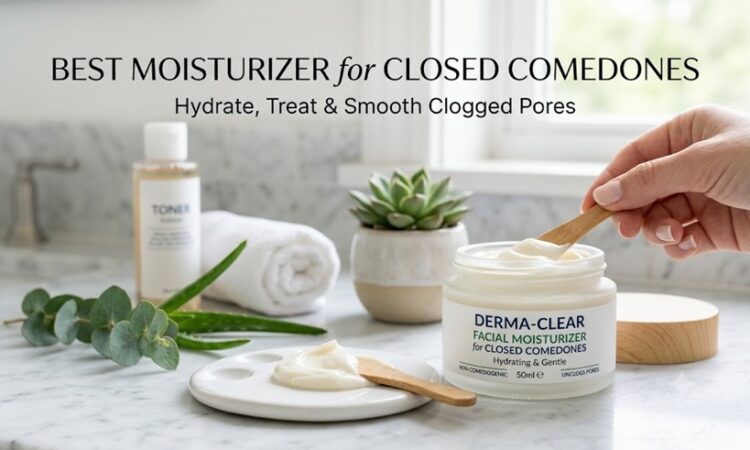
Quick answer: The best moisturizer for closed comedones is lightweight, oil-free or gel-based, and built on hydrators that do not clog pores, mainly hyaluronic acid, glycerin, ceramides, niacinamide, panthenol, and squalane. Skip heavy occlusives, comedogenic oils (coconut, cocoa butter), and esters like isopropyl myristate. A moisturizer does not clear comedones by itself. Its real job is keeping your barrier strong so exfoliants and retinoids can do the clearing without wrecking your skin.
Closed comedones are the small, flesh-colored or white bumps that sit under the skin on the forehead, chin, cheeks, and jawline. They feel like sandpaper but rarely turn red or hurt. Most people reach for actives to clear them, then quietly panic about which moisturizer is “safe.”
That panic is fair. The wrong cream can absolutely make these bumps worse. But going without moisturizer is a bigger mistake, and one of the most common reasons closed comedones stick around for months.
Here is what actually works, what to avoid, and how to choose one for your skin.
What are closed comedones, and why does moisturizer matter?
A closed comedone forms when a pore gets plugged with sebum (oil) and dead skin cells, then a thin layer of skin seals over the top. Because the plug is not exposed to air, it stays pale instead of oxidizing into a blackhead. No opening means squeezing does nothing except risk scarring.
They are the mildest, non-inflammatory form of comedonal acne. Left alone, though, they can tip into inflamed pimples. The Cleveland Clinic notes that comedonal acne can take 8 to 12 weeks of consistent care to improve, and sometimes many months to fully clear.
So where does moisturizer fit in? Two ways:
- It keeps the barrier intact so your skin can shed dead cells normally instead of letting them clump and re-clog pores.
- It makes strong treatments tolerable. Retinoids and acids are what dissolve the plug. Moisturizer is what lets you keep using them without flaking, stinging, and quitting.
Think of moisturizer as the support act, not the headliner.
Can moisturizer cause closed comedones?
Yes, and this is the part most guides gloss over.
A moisturizer can trigger or worsen closed comedones in three ways:
- Comedogenic ingredients. Certain oils, butters, and esters physically plug pores in clog-prone skin.
- Heavy occlusives on already-congested skin. Sealing a thick layer over a pore that is already blocked traps more oil and debris underneath.
- Too much, too rich, too often. Even a “good” cream applied in a thick layer on oily skin can be too much.
Here is the nuance that top articles rarely mention. The famous “comedogenic ratings” scale (0 to 5) comes from lab studies done in the 1970s, where ingredients were applied at high concentration to rabbit ears under occlusion. That is nothing like how you use a finished moisturizer. What breaks you out depends on the full formula, the concentration, and your own skin, not one scary word on a list.
The word “non-comedogenic” is also unregulated. No agency defines or enforces it. A brand can print it on a jar that still contains pore-clogging ingredients. Treat the label as a hint, not a guarantee, and always patch test.
Do you still need a moisturizer if you have oily, clog-prone skin?
Yes. Skipping it is the single most common self-sabotage.
When oily skin gets dehydrated (oily and dehydrated are not the same thing), two things happen:
- Dead skin cells do not shed cleanly. They stick together and form more plugs.
- The skin reads the dryness as a signal to pump out even more oil.
That is a feedback loop that feeds closed comedones directly. Estheticians and dermatologists consistently flag “I skip moisturizer because I’m oily” as the mistake behind stubborn congestion. The fix is not to skip hydration. It is to switch to a lightweight, water-based gel that hydrates without heaviness.
Oily skin still needs water. It just does not need a rich, waxy cream to get it.
What ingredients should a moisturizer for closed comedones have?
Look for hydrators and barrier-support ingredients that hold water without sealing the pore. These are the green flags.
| Ingredient | What it does | Why it suits closed comedones |
|---|---|---|
| Hyaluronic acid | Pulls water into the skin | Deep hydration, zero clogging risk |
| Glycerin | Humectant that draws and holds moisture | Lightweight, well tolerated |
| Niacinamide | Regulates oil, calms redness, supports the barrier | Improves resilience so actives are gentler |
| Ceramides | Rebuild the skin barrier | Reduce water loss without heavy oils |
| Panthenol (pro-vitamin B5) | Soothes and hydrates | Calms irritation from exfoliants |
| Squalane | Lightweight emollient that mimics skin’s own lipids | Non-clogging, also Malassezia-safe |
| Centella asiatica | Calms and supports barrier repair | Good for reactive, retinoid-using skin |
| Allantoin / colloidal oat | Soothing agents | Reduce redness and tightness |
A useful rule: niacinamide plus hyaluronic acid plus ceramides plus glycerin is the boring, reliable backbone of almost every moisturizer that works for this skin type.
One honest caveat: niacinamide supports the skin but does not “treat” a comedone. It makes your skin sturdier and less reactive, which is valuable, but it is not the ingredient dissolving the plug.
Which ingredients should you avoid in a moisturizer?
These are the red flags for clog-prone skin. Scan the ingredient list, especially the first two-thirds where concentrations are highest.
| Avoid / use caution | Why |
|---|---|
| Coconut oil (Cocos nucifera) | High on the comedogenic scale, clogs pores in most acne-prone skin |
| Isopropyl myristate | One of the most pore-clogging esters in skincare |
| Isopropyl palmitate | Rated high; sneaks into “non-comedogenic” tinted formulas |
| Cocoa butter and shea butter (rich %) | Heavy emollients that can occlude follicles |
| Algae and seaweed extracts | Commonly comedogenic for pore-prone skin |
| Lanolin and acetylated lanolin | Occlusive, breaks out many people |
| Heavy petrolatum layers on acne zones | Very occlusive; fine as spot slugging, risky over congested areas |
| Fatty alcohols in high concentration (cetearyl, stearyl) | Can contribute to clogs in sensitive, clog-prone skin |
| Added fragrance and essential oils | Irritation trigger that can push comedones toward inflammation |
The trap: several of these show up in products marketed as gentle or “for acne.” Isopropyl palmitate in a tinted moisturizer is the classic example. Read past the front of the label.
Is a fungal-acne-safe moisturizer the same as a closed-comedone-safe one?
No, and this distinction is where a lot of people go wrong. Most articles treat them as one thing. They are not.
- Fungal acne (Malassezia folliculitis) is caused by a yeast that feeds on specific fatty acids and esters. It shows up as itchy, uniform bumps, often along the hairline, chest, and back.
- Closed comedones are a mechanical blockage of oil and dead skin. They are not itchy and vary slightly in size.
The blacklists are different:
| Concern | Feeds / worsens it | Considered safe |
|---|---|---|
| Fungal acne | Most fatty acids, esters, many oils, some ferments | Squalane, mineral oil, dimethicone, niacinamide |
| Closed comedones | Comedogenic oils and esters, heavy occlusives (incl. some fungal-safe ones like mineral oil in rich form) | Water-based gels, hyaluronic acid, glycerin, ceramides, niacinamide |
Notice the overlap and the conflict. Mineral oil is fungal-acne-safe but can feel heavy and occlusive on congested, comedone-prone skin. Squalane and niacinamide are the rare ingredients friendly to both. If you are unsure which condition you have (they get confused constantly on the forehead), a lightweight, fragrance-free gel with squalane and niacinamide is the safest bet while you figure it out.
How do you match moisturizer texture to your skin type?
Texture matters as much as the ingredient list. Pick the lightest format that still leaves your skin comfortable.
| Skin type | Best texture | What to look for |
|---|---|---|
| Oily, clog-prone | Water gel or gel-cream | Oil-free, hyaluronic acid, niacinamide |
| Combination | Light gel-cream or lotion | Balanced hydration, non-comedogenic |
| Dry but clog-prone | Gel-cream, richer but still non-comedogenic | Ceramides, glycerin, squalane |
| Sensitive + comedones | Minimal, fragrance-free cream | Short ingredient list, centella, panthenol |
| On retinoids | Barrier cream with ceramides | Ceramides, cholesterol, fatty acids |
A quick self-check: apply your moisturizer, wait 20 minutes, and run a clean finger across your forehead. If it feels greasy or slick, the formula is too rich. If it feels soft and hydrated with no film, you have the right weight.
Can a moisturizer clear closed comedones on its own?
No. This is the expectation to reset.
A moisturizer prevents new clogs and keeps skin healthy. It does not break down an existing plug. The ingredients that actually clear closed comedones are:
- Retinoids (adapalene over the counter, tretinoin by prescription) to speed cell turnover and stop plugs from forming.
- Salicylic acid (BHA), oil-soluble, gets inside the pore to dissolve the plug.
- AHAs (glycolic, lactic, mandelic) to exfoliate the surface so cells do not build up.
- Azelaic acid to unclog and calm at the same time.
Here is the clarifying table:
| Product | Role | Clears the plug? |
|---|---|---|
| Moisturizer | Hydrates, protects barrier, prevents new clogs | No |
| Retinoid | Speeds turnover, dissolves and prevents plugs | Yes |
| BHA (salicylic acid) | Exfoliates inside the pore | Yes |
| Niacinamide | Regulates oil, supports barrier | Indirectly |
| Benzoyl peroxide | Kills acne bacteria | Not really (better for inflamed acne) |
The insight most people miss: benzoyl peroxide is a hero for red, inflamed pimples but underwhelming for closed comedones, because there is little bacterial component. Reaching for it here is a common wasted step.
How do you layer moisturizer with retinoids and acids?
This is where moisturizer earns its keep. A controlled split-face study found that applying a moisturizing cream twice daily for about two weeks meaningfully reduced the dryness and roughness caused by topical tretinoin. Less irritation means you stay consistent, and consistency is what clears comedones.
Two dermatologist-backed techniques:
The buffer method (moisturizer first)
- Cleanse and wait until skin is fully dry (about 15 to 20 minutes).
- Apply a thin layer of moisturizer.
- Apply your retinoid on top.
- This softens the retinoid’s hit for sensitive skin, with a small trade-off in strength.
The sandwich method
- Thin layer of moisturizer.
- Retinoid.
- Second layer of moisturizer.
- Best for very reactive skin during the adjustment phase.
A few rules that prevent trouble:
- Layer thinnest to thickest: water-based first, richer last.
- Do not stack a retinoid with AHAs, BHA, and vitamin C on the same night. Alternate them.
- Avoid heavy “slugging” (a thick occlusive on top) directly over comedone-prone zones. Reserve occlusives for dry patches only.
- Never combine two retinoids. It is pure irritation with no bonus.
- Sunscreen every morning is non-negotiable once you use any of these actives.
How long until you see results
Set the timeline honestly, because impatience causes people to give up right before it works.
| Milestone | Rough timeframe |
|---|---|
| Barrier feels calmer, less tight | 1 to 2 weeks |
| Possible purge (bumps surface faster) | Weeks 2 to 6 with retinoids |
| Visible reduction in bumps | 8 to 12 weeks |
| Deep, stubborn comedones clear | Often several months |
The “purge” catches people off guard. As a retinoid speeds up turnover, plugs already forming under the skin rise to the surface at once, so it can briefly look worse. That is the backlog clearing, not the product failing. It usually settles within 4 to 6 weeks.
What do dermatologists and real users say?
From dermatologists and clinics: The consensus is consistent. Use a gentle cleanser, a lightweight non-comedogenic moisturizer, and daily SPF, then let retinoids or BHA handle the actual clearing. Board-certified dermatologists quoted in recent roundups favor hydration-boosting ingredients like hyaluronic acid, glycerin, ceramides, and niacinamide, and warn specifically against comedogenic oils like coconut and heavy occlusives like petrolatum on acne zones.
From community forums (Reddit, Quora, TikTok): Real-world sentiment lines up with the science, with a few extra patterns worth knowing:
- Lightweight gel-cream formats come up again and again as the “safe” category people land on after breaking out from richer creams.
- A recurring theme on Quora threads about barrier repair while using Retin-A: reduce actives, simplify to a fragrance-free ceramide moisturizer, and rebuild before pushing harder. People who slowed down recovered faster than those who “powered through.”
- The most repeated regret across communities is going too fast: too many actives, too soon, on a barrier that was already compromised.
- Skin-type matching beats brand hype. The same cult-favorite cream that cleared one person clogged another. This is why patch testing keeps getting recommended over chasing viral products.
The through-line from experts and users alike: simplicity and consistency win. Fewer products, applied reliably, outperform a shelf full of actives used chaotically.
When should you see a professional?
Home care handles most closed comedones, but not all. Book a dermatologist or licensed esthetician when:
- Bumps are hard, “fixed,” and unchanged after roughly 3 months of a consistent routine.
- Skin becomes very red, peeling, or painful.
- Comedones are turning into inflamed, cystic breakouts.
- You simply want faster results.
Professional options that outperform home care for deep congestion include sterile comedone extraction, chemical peels, and microdermabrasion. Some comedones sit too deep for topicals alone and need a professional to kickstart clearing. Never attempt extractions yourself, as unsterile pressure on a sealed comedone is a straight path to inflammation and scarring.
Frequently asked questions
Is gel or cream moisturizer better for closed comedones? Gel or gel-cream, in most cases. It hydrates without the heavy, potentially pore-clogging oils found in richer creams. Only move to a richer (still non-comedogenic) format if a gel leaves your skin tight.
Can I use hyaluronic acid if I have closed comedones? Yes. Hyaluronic acid is a water-binding humectant with essentially no clogging risk. It is one of the safest hydrators for this skin type.
Does niacinamide help closed comedones? It helps indirectly. Niacinamide regulates oil, calms the skin, and strengthens the barrier, which makes your skin more resilient to the exfoliants that actually clear the plug. It is a supporting player, not the treatment.
Should oily skin skip moisturizer to avoid clogs? No. Dehydrated skin cells do not shed properly and stick together into more clogs, and dryness signals the skin to make more oil. Use a lightweight, oil-free gel instead of skipping.
Is coconut oil bad for closed comedones? For most clog-prone skin, yes. Coconut oil rates high on the comedogenic scale and commonly triggers whiteheads on the face, even though it works fine on hair and body.
Can moisturizer alone get rid of closed comedones? No. It prevents new ones and protects your barrier, but you need a retinoid, salicylic acid, or another exfoliating active to clear existing plugs.
Is “non-comedogenic” a reliable label? Only partly. The term is unregulated, so brands define it themselves. Use it as a starting filter, then check the ingredient list and patch test before committing.
Can a moisturizer trigger fungal acne instead? It can. Fungal acne is fed by certain fatty acids and esters, a different blacklist from comedogenic ingredients. If your bumps are itchy and uniform, suspect fungal acne and choose squalane, dimethicone, or niacinamide-based formulas.