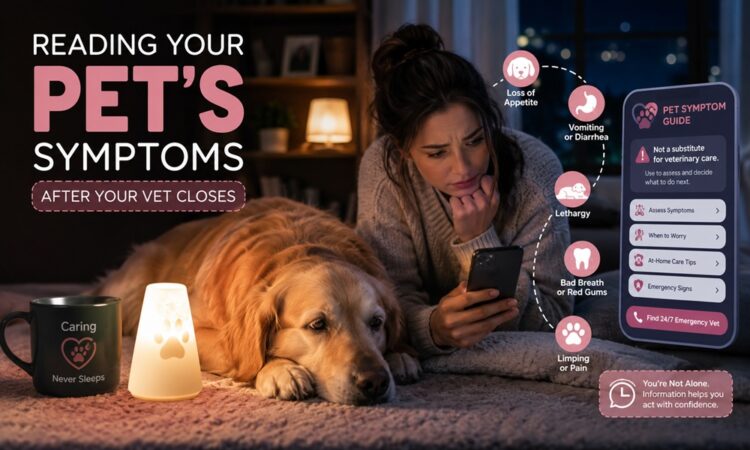
Your regular vet closes at five. It is 8:40 p.m. Something is wrong.
That gap, roughly 5 p.m. to 8 a.m. plus every weekend and holiday, is where most pet owners make their worst decisions. Not because they do not care. Because nobody ever explained the sorting logic.
This is the sorting logic.
Start here: the four-question filter
Before anything else, answer these:
- Can it breathe normally?
- Can it stand and walk?
- Is it responsive to you?
- Is there uncontrolled bleeding?
If the answer to any of those is no, stop reading and go. Everything below is for the cases where all four answers are yes.
Tier 1: Go now, do not wait, do not call first
These are the presentations where minutes matter and a wait-and-see approach has a body count.
- Difficulty breathing. Open-mouth breathing in a cat is always an emergency. Extended neck, elbows out, blue or grey gums, abdominal effort.
- Distended, hard abdomen with unproductive retching. This is gastric dilatation and volvulus, bloat. Deep-chested dogs. Hours matter.
- Straining to urinate and producing nothing, especially a male cat. Urethral obstruction is fatal within a day or two and is intensely painful.
- Seizure lasting more than 3 to 5 minutes, or multiple seizures without full recovery in between.
- Collapse or sudden inability to stand.
- Pale white or grey gums.
- Known toxin ingestion. Antifreeze, xylitol, rodenticide, grapes or raisins, lilies for cats, human medications, marijuana edibles.
- Trauma. Hit by a car, dog fight, fall from height, even if the animal seems fine. Internal bleeding and diaphragmatic hernia present late.
- Whelping or queening that has stalled for more than 30 minutes of active straining.
- Heat stroke. Gulf Coast summers make this a genuine seasonal risk.
- Uncontrolled bleeding after five minutes of direct pressure.
- Eye trauma or a suddenly bulging eye. Eyes are time-critical in a way owners consistently underestimate.
Animal Emergency Care operates as a purpose-built emergency hospital serving the Gulf Coast from Nantahala Beach Road in Gulf Breeze. As a Pensacola animal hospital alternative for after-hours needs, it covers evenings during the week and runs continuously through weekends, with triage on arrival and coordination back to your primary veterinarian for continuity.
Tier 2: Should be seen tonight, but you can call first
Serious, not immediately life-threatening. A phone call gets you a real answer.
- Vomiting more than three or four times in a few hours
- Diarrhea with blood, in a dog that is otherwise alert
- Sudden lameness where the leg is not bearing weight
- A laceration that has stopped bleeding but is deep or gaping
- An abscess that has burst
- Ear infection with obvious pain and head tilt
- Sudden onset of severe itching and facial swelling, which may be an allergic reaction
- Not eating for more than 24 hours in a dog, or more than 24 hours in a cat, which is more urgent because of hepatic lipidosis risk
- Suspected foreign body ingestion where the animal is currently stable
- Porcupine quills, fish hooks, foxtails
Tier 3: Can usually wait for your regular vet
- Mild intermittent vomiting, once, in a bright and hungry animal
- Soft stool without blood
- A small skin lump you noticed today that has probably been there a month
- Mild itching
- A broken nail that has stopped bleeding
- Bad breath
- One episode of coughing
- Limping that resolves within an hour
Being honest about Tier 3 is not being a bad owner. It is what allows the hospital to attend to Tier 1.
Why the waiting room feels unfair
Emergency medicine, human and veterinary, does not run first come first served. It runs on triage, from a French word meaning “to sort.”
A triage technician or veterinarian assesses every arrival and assigns priority based on medical urgency. That means a dog with mild vomiting who arrived at 7:00 will be seen after a dog with a collapsed airway who arrived at 7:35.
Two things owners rarely realize:
- The empty lobby is misleading. There are often many more patients in the treatment area than in the waiting room.
- Wait times can change instantaneously based on what comes through the door.
Realistic expectations: at a full 24-hour emergency room, waits often exceed four hours. At a dedicated urgent care operation, waits are usually under two hours. Some hospitals publish live triage status codes so you can decide before you drive.
The middle tier almost nobody knows exists
Here is a fact that reframes the whole question.
Urgent care was not introduced as a concept in human medicine until the 1970s. In veterinary medicine it is newer still, having gained popularity only in roughly the last decade. The first dedicated veterinary urgent care clinic in the United States opened in North Carolina about ten years ago.
So if you feel like you were never told this option existed, that is because for most of your life it did not.
| Primary care | Urgent care | Emergency | |
|---|---|---|---|
| Handles | Wellness, chronic disease, planned surgery | Non-life-threatening sudden problems | Life-threatening, critical care |
| Hours | Business hours | Evenings, weekends | Overnight, continuous |
| Typical wait | Appointment | Often under 2 hours | Often over 4 hours |
| Relative cost | Lowest | Middle | Highest |
| Access to your records | Full | Limited | Limited |
The disadvantage of both urgent and emergency care is the same: limited access to your pet’s medical history. Which is the single strongest argument for the section below.
What to bring, and why it changes the outcome
Emergency and urgent care teams are working without your pet’s chart. Every gap you fill saves diagnostic time and money.
Bring:
- Medication list. Names and doses. A photo of the bottles is better than your memory.
- The packaging of anything ingested. The concentration on a rodenticide box changes the entire treatment plan.
- A sample. Vomit or stool, in a bag. Unpleasant, diagnostically valuable.
- Vaccine records if you have them.
- A timeline. When did it start, what changed, what did they eat, what have you already given.
- Video. If your dog had a seizure or a strange gait, footage is worth more than a description.
- A carrier for cats. Not your arms.
- A payment method and a number you are prepared to say out loud.
Do not:
- Give human medication. Ibuprofen and acetaminophen are toxic to pets, and acetaminophen is lethal to cats at small doses.
- Induce vomiting without instruction. It is contraindicated for caustics and for any animal that is not fully alert.
- Delay to “see how the night goes” for anything in Tier 1.
The money conversation, in plain terms
Nobody wants to talk about this. Not talking about it produces worse decisions.
| Line item | Typical range |
|---|---|
| Emergency exam fee | $100 to $300 |
| After-hours or weekend surcharge | $50 to $150 on top |
| Urgent care exam fee | $100 to $200 |
| Bloodwork | $100 to $300 |
| Radiographs | $150 to $400 |
| Ultrasound | $300 to $600+ |
| Medications | $20 to $200 |
| Overnight hospitalization | $600 to $2,500 |
| Emergency surgery | $1,500 to $5,000+ |
A moderate emergency visit typically totals $800 to $1,500. Serious cases involving bloat, blockage, trauma, or poisoning commonly land between $1,000 and $8,000 once imaging, surgery, and hospitalization stack up.
The variance is enormous. Data from real invoices shows the bottom tenth of bills under roughly $227 and the top tenth above $3,000.
What to do about it:
- Ask for a written estimate before treatment begins. Most states require one, and final bills often land below the initial quote.
- Ask whether there is a less expensive diagnostic path that still answers the question.
- Ask about staged treatment: stabilize now, diagnose in daylight at your regular vet.
- Expect a deposit request, often 50% to 100% of the low estimate.
- Financing exists. CareCredit, Scratchpay, payment plans, and charitable funds are real options, not last resorts.
- Pet insurance covers emergencies at 70% to 90% after deductible, but only if purchased before the problem. It does nothing tonight.
If your pet is stable enough for urgent care during its open hours, you may save several hundred dollars over a full overnight emergency stay. If it is not stable, that calculation is irrelevant.
Gulf Coast specifics
Hurricane season. Build the pet part of your plan before the cone appears:
- Vaccine records and a photo of your pet in a waterproof bag
- Two weeks of medication
- A carrier per animal, labeled
- Microchip registration current, with a number you can actually be reached at
- Know which shelters accept pets, in advance
- Understand that after a storm, emergency capacity is reduced exactly when demand spikes
Heat. Brachycephalic breeds, French Bulldogs, Pugs, Boxers, Bostons, cannot thermoregulate normally. Gulf humidity removes the evaporative cooling panting depends on. Heat stroke here is a Tier 1 emergency.
Water. Saltwater ingestion causes hypernatremia. Jellyfish, stingrays, and fish hooks are all routine presentations. Blue-green algae in warm standing freshwater can be rapidly fatal.
Toads. Cane toads are established across parts of Florida. Bufo toxicity presents as intense drooling, bright red gums, and neurological signs. Rinse the mouth sideways with a hose, do not point water down the throat, and go.
Frequently asked questions
Should I call first or just drive? For Tier 1, drive, and have someone call en route so they can prepare. For Tier 2, call. A triage nurse on the phone is free and gives you a real answer.
Will they turn me away if I cannot pay? Policies vary by hospital and by state. Have the conversation openly and immediately rather than after diagnostics have run. Ask what stabilization is possible within your budget.
Is it worth going if my pet seems better now? For trauma, toxin exposure, bloat signs, or urinary obstruction, yes. Several of the most dangerous presentations have a deceptive quiet phase.
My pet ate something six hours ago. Is it too late? Depends entirely on what. Call. Do not decide this yourself.
Why can’t I just wait for my regular vet in the morning? For most of Tier 3, you should. For Tier 1, morning is a decision, not a delay.