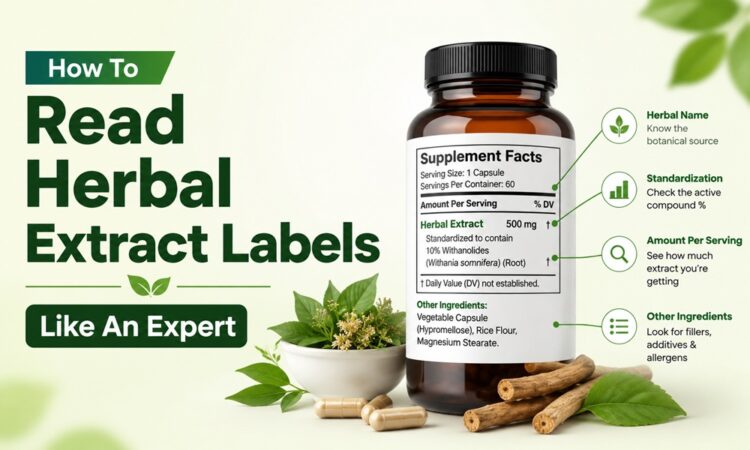
Most herbal extract labels look reassuring at a glance, with clean fonts, leafy graphics, words like “premium” and “potent.” None of that tells you what’s actually in the bottle. Reading a label like an expert means knowing exactly where to look and what each piece of information is actually telling you.
Start With the Botanical Name
Common names get reused across completely different plants, which is exactly why a proper label leads with the Latin binomial. “Skullcap” alone could mean an entirely different species depending on origin, but “Scutellaria lateriflora” leaves no room for confusion. If a label skips the botanical name entirely, that’s worth noticing.
Decode the Extraction Ratio
Numbers like 1:4 or 1:5 describe how much plant material went into how much solvent, one part herb to four or five parts liquid. A lower ratio generally means a more concentrated extract, though the ideal ratio varies by herb and extraction method. Maceration typically produces a 1:4 or 1:5 ratio, while percolation under pressure can reach a stronger 1:2 or 1:1.
Check the Solvent and the Percentage
This is where tinctures and glycerites part ways. A tincture label should state its ethanol percentage, since that number determines which compounds actually got extracted. Lower percentages favor water-soluble compounds, while higher percentages pull out resins and alkaloids more effectively. Glycerite labels should specify the glycerin-to-water ratio instead, something close to 60/40.
Look for Plant Part and Origin
A label should specify exactly which part of the plant was used, leaf, root, flower, bark, since different parts of the same plant can carry entirely different compounds. Origin matters too. Hawaii Pharm’s labels, for example, list the specific country or region the raw material came from for each herb, a level of detail that signals genuine sourcing transparency rather than a vague “natural ingredients” claim. Check more details at hawaiipharm.com.
Find the Testing and Manufacturing Standards
This is the section most people skip, and it’s the most important one. A trustworthy label, or the brand’s accompanying documentation, should reference identity testing methods like HPTLC or FTIR, confirmation of a GMP-certified, FDA-registered manufacturing facility, and availability of a certificate of analysis on request. If none of that information exists anywhere on the label or the brand’s site, that’s a gap.
A Few Label Red Flags
- No botanical name, only a common name
- No extraction ratio or solvent percentage is listed anywhere
- Vague country-of-origin language like “globally sourced”
- No mention of lab testing or manufacturing facility standards
- Proprietary blends that hide individual herb amounts
Quick Facts Worth Remembering
The botanical name is non-negotiable for verifying you’re getting the right plant. Extraction ratios and solvent percentages tell you more about potency than any front-label claim. Testing and manufacturing standards belong somewhere on the label or are readily available from the brand.
The Bottom Line
A well-made label isn’t trying to sell you on adjectives but handing you the information needed to make an informed comparison. Once you know to look past the front-of-bottle language and check the botanical name, ratio, solvent, and testing standards, reading herbal extract labels stops feeling like guesswork.