Losing a tooth changes more than your smile. It affects how you chew, speak, and feel about your appearance. Left alone, a gap can shift neighboring teeth and shrink the jawbone over time. The good news is that you have three proven ways to fix it.
Dental implants, bridges, and dentures each solve the problem differently. There is no universal winner. The right choice depends on your mouth, your budget, and your long-term goals. Here is an honest, jargon-free comparison.
The Three Options in Plain Terms
Start with what each one actually is.
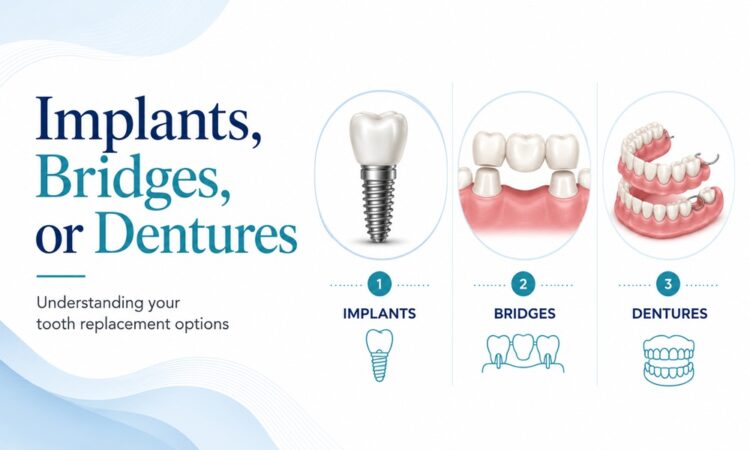
- Dental implants. A titanium post replaces the tooth root and is topped with a crown. The most durable, natural-feeling option.
- Dental bridges. A false tooth anchored to the teeth on either side of the gap. Fixed in place, but dependent on those neighboring teeth.
- Dentures. Removable appliances that replace several or all teeth. The most affordable starting point.
Side-by-Side Comparison
| Factor | Implants | Bridges | Dentures |
|---|---|---|---|
| How it works | Post fused to jawbone | Anchored to adjacent teeth | Rests on gums |
| Lifespan | 20+ years, often lifetime | 5–15 years | 7–10 years |
| Affects other teeth? | No | Yes, they’re filed down | No |
| Protects jawbone? | Yes | No | No |
| Upfront cost | Highest | Moderate | Lowest |
| Feel | Closest to natural | Fixed, slightly bulkier | Removable |
What Each One Costs
Prices vary with the clinic, materials, and complexity of your case. In Canada, a single implant, including the post, abutment, and crown, generally runs $3,000–$6,000. In downtown Toronto, fees often sit at the higher end of that range.
- Single implant: roughly $3,500–$6,000 in the Toronto area.
- Traditional bridge: around $2,500–$4,500.
- Full or partial dentures: the lowest upfront cost of the three.
Be cautious with “implant-only” quotes. They frequently exclude the crown, abutment, or imaging. Always ask for an itemized, all-in estimate so you can compare offers fairly.
Patients researching dental implants in Downtown Toronto should compare complete treatment costs, not just headline prices, when weighing their options.
The Middle Ground: Implant-Supported Dentures
There is a fourth option worth knowing about. Implant-supported dentures snap onto two or more implants, combining the affordability of dentures with much of the stability of implants. For people missing many teeth, they often hit a sweet spot: a secure bite without the cost of replacing every tooth individually.
Which Option Fits You?
A few simple scenarios make the decision easier.
- Choose an implant if you want the longest-lasting result and have healthy bone.
- Choose a bridge if the neighboring teeth already need crowns, or you want a faster fix without surgery.
- Choose dentures if you are missing many teeth or need the most affordable solution.
- Consider implant-supported dentures for denture-level coverage with far better stability.
Thinking Long Term
Upfront cost isn’t the whole story. Bridges and dentures often need repair or replacement every 5–15 years. Implants can last decades, sometimes a lifetime. Over time, the pricier option can become the more economical one. Implants also preserve the jawbone, which neither bridges nor dentures do. Once a tooth is lost, that bone stimulation matters more than most people realize.
A Note on Insurance and Financing
In Canada, government plans rarely cover implants, though some private insurance helps with parts of treatment, often the crown. Many clinics offer financing or payment plans to spread the cost. It is also worth asking whether a treatment can be staged across two calendar years to make the most of annual insurance maximums.
Questions to Ask at Your Consultation
Bring these to any tooth-replacement conversation.
- What is the full, itemized cost, including any grafting or imaging?
- How long should this option last in my case?
- Will it affect my healthy teeth?
- What happens if it fails or needs repair?
- What are my financing options?
Frequently Asked Questions
Are implants always the best choice? They are the most advanced, but not right for everyone. Bone health, budget, and medical conditions all factor in.
Can I switch from dentures to implants later? Often, yes. Many people start with a denture or bridge and move to implants down the road.
Do implants hurt more than a bridge? Implants involve minor surgery, but most patients manage with basic pain relief. A bridge avoids surgery but requires reshaping healthy teeth.
How do I compare quotes fairly? Get itemized estimates. A low headline price that excludes the crown or bone graft isn’t truly cheaper.
Which lasts the longest? Implants, by a wide margin. The post can last a lifetime, while bridges and dentures typically need replacing within 5–15 years.