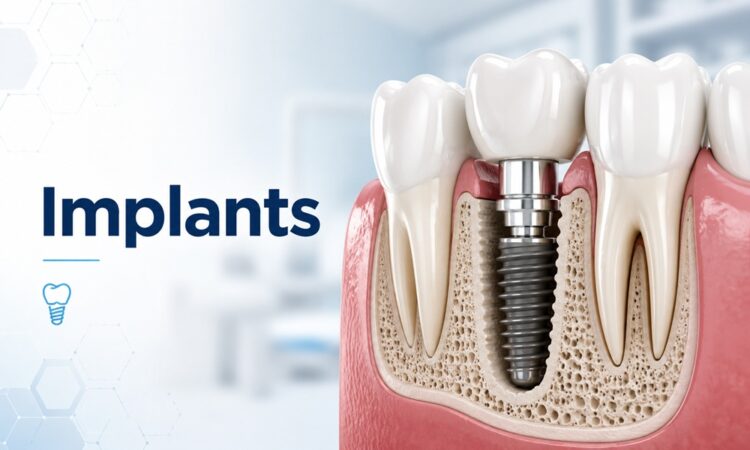
The marketing shows a titanium screw. The clinical reality is about what surrounds it.
An implant works because living bone grows directly onto the implant surface — a phenomenon called osseointegration. No ligament. No cement. A direct structural bond between bone and metal.
Which means the question that determines your outcome isn’t “which implant brand?”. It’s “how much healthy bone do you have, where is it, and what shape is it in?”
Everything else follows from that.
The Clock That Starts the Day a Tooth Leaves
Alveolar bone exists for one reason: to hold teeth. Remove the tooth and the bone loses its purpose.
Resorption begins immediately.
| Time since extraction | Typical change |
| First 3 months | The most rapid phase of ridge resorption |
| 6 months | Substantial width lost, particularly on the outer (buccal) plate |
| 12 months | Ridge width commonly reduced by roughly half |
| Years 2–10 | Slower, continuous vertical loss |
| Long-term, full arch | Facial collapse, shortened lower face, changed lip support |
This is why the phrase “I’ll deal with it later” is expensive. It converts a straightforward implant into an implant plus grafting.
Ridge preservation — grafting the socket at the moment of extraction — is the single most cost-effective intervention in the entire sequence. It costs a fraction of what reconstructing lost bone costs later.
Osseointegration, Plainly
Place a titanium implant into prepared bone. Then wait.
Week 1. A blood clot forms around the implant. Inflammatory cells arrive. This is a wound, and it behaves like one.
Weeks 2–4. Woven bone — fast, disorganized, immature — forms on the implant surface. Primary stability, which came from the mechanical threads, begins to hand off to biological stability.
Weeks 4–8. This is the stability dip, the trough where mechanical stability has decreased and biological stability hasn’t fully arrived. It’s the period of highest vulnerability. Excessive load here is how early failures happen.
Weeks 8–16. Woven bone remodels into lamellar bone — organized, load-bearing, mature.
Months 4–12. Continued remodelling. The bone-to-implant contact percentage rises.
Modern surface treatments — micro-roughened, chemically modified — accelerate this considerably. Implants that once needed six months now often integrate in six to twelve weeks. The biology hasn’t changed. The surface area available to it has.
The Numbers
Implant dentistry has one of the best documented success records in surgery.
In native, healthy bone:
- One large 10-year retrospective study reported a cumulative implant success rate of 95.6% for implants placed in pristine bone
In grafted bone:
- The same study reported 90.2% for implants placed in sites augmented with staged autogenous bone blocks — statistically indistinguishable from native bone
- Within the augmented group, however, the split matters enormously: 98.9% success in horizontally augmented sites versus 65% in vertically augmented sites
That gap deserves emphasis. Widening a ridge is predictable. Making one taller is not.
With sinus augmentation:
- A 15-year retrospective study of 472 lateral-window sinus grafts supporting 757 implants reported 98.3% graft success and 97.2% implant success
- Graft material — autogenous, bovine xenograft, or synthetic — showed no statistically significant difference in outcome
- Residual bone height mattered: success improved when at least 4 mm of native bone remained
- Even when the sinus membrane was perforated during surgery, success remained high
Without added graft material:
- Osteotome sinus floor elevation without grafting showed 98.3% implant survival at five years, with short implants performing comparably to conventional-length ones
When implants fail:
- Large-scale data indicates roughly 70% of failures occur within the first year — early, during or shortly after integration
- Independent risk factors include immediate placement (about 3.08% failure vs 2.07% for delayed), maxillary location, and male gender
The takeaway: grafted bone is not inferior bone. The old concern that augmented sites integrate poorly has been substantially refuted. What matters is execution, defect geometry, and case selection.
The Grafting Menu
| Type | Source | Key property | Common use |
| Autograft | Your own bone (chin, ramus, hip) | Osteogenic — contains living cells | Large defects, vertical augmentation |
| Allograft | Processed human donor bone | Osteoinductive scaffold | Sockets, ridges, sinus |
| Xenograft | Bovine or porcine, deproteinized | Slow-resorbing scaffold, excellent volume maintenance | Sinus lifts, ridge preservation |
| Alloplast | Synthetic (hydroxyapatite, β-TCP, bioglass) | Predictable, no donor site, no biological source | Sockets, sinus, combinations |
Autograft was long called the gold standard because it’s the only material with living osteogenic cells. But the sinus data above showed no significant outcome difference by material. And autograft implies a second surgical site with its own morbidity.
The interesting nuance in the literature: implants placed in autogenous bone grafts sometimes show a slightly higher loss rate — likely reflecting that autograft gets reserved for the hardest cases in the first place.
Adjuncts. Platelet-rich fibrin (L-PRF), platelet-rich plasma, and growth factors are used to accelerate soft tissue healing and graft consolidation. One case series combining hydroxyapatite with L-PRF in atrophic maxillae reported 98.5% implant success at three years.
The Sinus Lift, Demystified
Upper back teeth sit beneath the maxillary sinus — an air-filled cavity lined with a thin membrane. When those teeth are lost, the sinus tends to expand downward while the ridge resorbs upward.
Eventually there isn’t enough vertical bone to house an implant.
Two approaches:
Crestal (osteotome / internal) lift. Performed through the implant osteotomy itself. The sinus floor is gently pushed upward a few millimetres. Minimally invasive. Suitable when 5 mm or more of native bone remains. Often done with simultaneous implant placement.
Lateral window (external) lift. A small window is opened in the side wall of the sinus. The membrane is elevated under direct vision. Graft material fills the space created. Used when residual bone is minimal.
Healing takes roughly 4 to 9 months before implants can be placed or loaded, depending on approach and material.
Membrane perforation is the most common intraoperative event. It is not a disaster. The 15-year data showed success above 96% for both grafts and implants even in perforated cases, when properly repaired.
The Full Timeline
| Phase | Duration | What happens |
| Consultation & CBCT | 1 visit | 3D imaging maps bone volume, density, nerve position, sinus anatomy |
| Extraction ± ridge preservation | 1 visit | Socket grafted at extraction to limit resorption |
| Graft healing | 3–6 months | Ridge preservation. Longer for larger reconstructions |
| Sinus augmentation, if needed | 4–9 months | Lateral window cases need the longer end |
| Implant placement | 1–2 hours | Often under local anesthesia with sedation |
| Osseointegration | 6 weeks – 6 months | Varies with bone quality, surface, and graft |
| Uncovery / healing abutment | 1 short visit | Shapes the gum tissue emergence profile |
| Impression / scan | 1 visit | Digital or conventional |
| Crown delivery | 1 visit | Screw-retained or cement-retained |
| Maintenance | Forever | Peri-implant probing and radiographs, at intervals |
Immediate placement — implant on the same day as extraction — compresses this substantially. It works well in selected cases with intact socket walls and no active infection. The data show a marginally higher failure rate (roughly 3.08% vs 2.07%), so it’s a case-selection decision, not a default.
A surgeon offering oral surgery in New Braunfels, TX should be able to show you your own CBCT and explain, on the screen, exactly why your case falls where it does on that timeline.
Who Struggles, and Why
Smoking. The largest modifiable risk factor. It impairs vascularization at every stage.
Uncontrolled diabetes. Delays healing and raises infection risk. Well-controlled diabetes is not a contraindication.
Untreated periodontitis. The same bacteria that destroyed the bone around natural teeth will attack the bone around implants. Periodontitis must be stabilized before implant placement, not after.
Bruxism. Implants have no periodontal ligament and therefore no proprioceptive feedback. You cannot feel yourself overloading them. Night guards are not optional for grinders.
Bisphosphonates and antiresorptive medication. Particularly IV formulations. Requires careful medical consultation.
Head and neck radiation. Alters bone vascularity and healing capacity.
Peri-implantitis: The Long-Term Risk
Implants don’t get cavities. They get something worse.
Peri-implant mucositis — reversible inflammation of soft tissue around an implant. Peri-implantitis — inflammation with progressive bone loss. Harder to treat than periodontitis around a natural tooth, because the implant surface is roughened and the bone loss pattern is often circumferential.
Prevention is unglamorous and effective:
- Interdental brushes and floss designed for implants
- Professional maintenance with instruments that won’t scratch titanium
- Radiographic bone-level monitoring at intervals
- Not smoking
- Treating gum disease around the remaining natural teeth
What “Doing Nothing” Costs
The invisible alternative always looks free. It isn’t.
- Adjacent teeth drift into the gap, changing the bite
- The opposing tooth over-erupts, seeking contact that isn’t there
- Chewing shifts to the other side; the working side wears faster
- Bone continues to resorb, month after month
- Ten years later, the same site requires vertical augmentation — the least predictable procedure in the entire catalogue
The cheapest implant you will ever place is the one planned at the time of extraction.
Frequently Asked Questions
How long do dental implants last? Long-term studies show implant success in the 90–96% range at ten years, in both native and grafted bone. Many function for decades. The crown on top typically needs replacement before the implant does.
Does a dental implant hurt? Placement is done under local anesthesia, often with sedation. Most patients report less discomfort than an extraction. Grafting procedures involve more soreness, particularly if bone is harvested from a second site.
Do I definitely need a bone graft? Not always. It depends on how long the tooth has been missing, where it sits, and what your CBCT shows. Ridge preservation at extraction often eliminates the need entirely.
Are implants in grafted bone weaker? Ten-year data shows success in augmented sites statistically comparable to native bone — with the caveat that vertical augmentation performs considerably worse than horizontal.
Is a sinus lift dangerous? It’s a routine, well-documented procedure with high success rates even when the membrane is perforated. It requires imaging, planning, and appropriate experience.
Can I get an implant the same day as my extraction? Sometimes. Immediate placement requires intact socket walls, no active infection, and adequate primary stability. Failure rates are modestly higher, so selection matters.
What’s the success rate of dental implants? Broadly 95%+ in healthy native bone at ten years. Around 90% in augmented bone. Around 97% in properly grafted sinus sites. Roughly 70% of all failures occur in the first year.
Will my body reject a titanium implant? True rejection is essentially unheard of. Titanium is biologically inert. Failures result from infection, overload, poor bone quality, or failed integration — not immune rejection.
Can I get an implant if I smoke? Yes, but the failure rate rises meaningfully. Most surgeons ask for cessation before surgery and through the healing period.
The Takeaway
Titanium is the easy part. Bone is the hard part.
Every consequential implant decision — timing, grafting, sinus management, immediate versus delayed loading — is fundamentally a decision about bone volume, bone quality, and how long the site has been sitting empty.
Which means the most valuable appointment in the whole sequence is the one where the tooth is removed, not the one where the implant goes in.