There’s a version of this topic that overpromises. You’ll see headlines suggesting flossing prevents heart attacks.
There’s also a version that dismisses it. Gums are gums; hearts are hearts.
Both are wrong, and the truth in between is more interesting than either. Let’s go through what the research supports, what it merely suggests, and what it doesn’t establish at all.
First, The Scale
Periodontitis is not a fringe condition.
- It affects roughly 35% to 50% of adults globally
- In the United States, prevalence estimates reach up to 45% of adults, with about 42% in moderate form and 7.8% in severe form
- Severe periodontitis affected over 1 billion people worldwide in recent global burden estimates, with projections rising substantially by mid-century
- Between 7.4% and 11.2% of adults globally have severe periodontitis, concentrated in older populations
It is one of the most prevalent chronic inflammatory diseases on earth. And unlike many, it is largely preventable and highly treatable in its early stages.
What Gum Disease Is, Mechanically
Bacteria colonize the tooth surface and form a biofilm — plaque. The immune system responds. That response is the disease.
Gingivitis. Inflammation confined to the gums. Red, swollen, bleeding on brushing. The bone and attachment fibres are intact. Fully reversible.
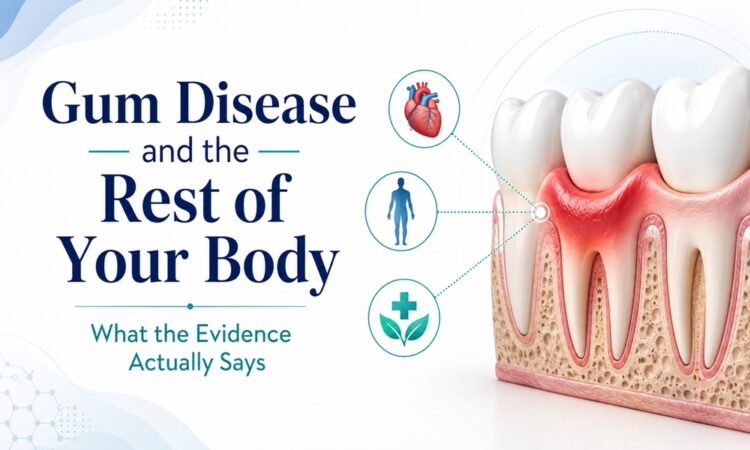
Periodontitis. The inflammation extends below the gumline. The attachment between tooth and bone breaks down. A periodontal pocket forms. Bacteria colonize the pocket, which is now anaerobic and unreachable by a toothbrush. Bone recedes. Not reversible — only arrestable.
That second sentence is the pivot point of the whole disease. Once attachment is lost, you manage. You don’t rewind.
The Staging System
| Stage | Attachment loss | Bone loss | Tooth loss from periodontitis |
| I — Initial | 1–2 mm | Under 15% of root length | None |
| II — Moderate | 3–4 mm | 15–33% | None |
| III — Severe | 5 mm or more | Extending to mid-root and beyond | Up to 4 teeth |
| IV — Advanced | 5 mm or more | Extensive | 5 or more teeth; bite collapse possible |
Grading runs alongside staging and describes rate of progression — slow, moderate, or rapid — factoring in smoking status and diabetic control.
Two patients can share a stage and face completely different futures. Grade is why.
The Systemic Evidence, Sorted by Strength
Here is where precision matters. Association is not causation, and different links carry different evidentiary weight.
Strongest: Diabetes (bidirectional)
This relationship is the best characterized, and it runs both ways.
Poorly controlled diabetes worsens periodontitis. Periodontitis worsens glycemic control. Treating one improves the other.
A nationwide analysis of adults found that when periodontitis and diabetes coexist, systemic inflammation — measured by high-sensitivity C-reactive protein — rises beyond what either condition produces alone. Mean hs-CRP climbed progressively across groups, and the coexistence group had nearly three times the odds of falling into the high cardiovascular-risk hs-CRP category. Neither periodontitis alone nor diabetes alone showed a significant association at that threshold.
That’s a synergy finding, not a coincidence.
Strong association: Cardiovascular disease
Using NHANES data across two survey periods, researchers found moderate-to-severe periodontitis associated with atherosclerotic cardiovascular disease (odds ratio 1.24) and tooth loss similarly associated (OR 1.16), after full adjustment.
Mortality data adds weight. In US adults, severe periodontal disease has been linked to a 59% increased risk of diabetes-related mortality and a 62% increase in mortality from lower respiratory disease, with a 28% increase in malignancy-related mortality. Notably, the same analysis found no significant association with Alzheimer’s or renal disease mortality — which is exactly the kind of null result that makes the positive findings more credible.
Plausible mechanism: chronic systemic inflammation, bacterial translocation into the bloodstream, and endothelial dysfunction.
Important caveat: these are observational associations. Interventional trials showing that treating gum disease reduces cardiac events are not yet definitive. Shared risk factors — smoking, age, socioeconomic status — are adjusted for, but confounding cannot be excluded entirely.
Moderate association: Respiratory disease and pneumonia
Aspiration of oral pathogens is a plausible and well-described route, particularly in hospitalized and elderly patients. Oral care protocols in intensive care settings reduce ventilator-associated pneumonia.
Moderate association: Adverse pregnancy outcomes
Preterm birth and low birth weight show associations with periodontitis. Treatment trials have produced mixed results.
Emerging, mechanistically interesting, not established: Alzheimer’s disease
Porphyromonas gingivalis — a key periodontal pathogen — and its enzymes have been identified in the brains of Alzheimer’s patients. Animal models show suggestive results. Human evidence remains associative, and the mortality data above found no significant link.
Treat this as an active research question, not a clinical fact.
Also under investigation
Rheumatoid arthritis, chronic kidney disease, inflammatory bowel disease, non-alcoholic fatty liver disease, certain cancers, and H. pylori infection all show reported associations in the literature.
The Honest Summary
Established: Periodontitis is a chronic inflammatory disease. It raises systemic inflammatory markers. It has a genuinely bidirectional relationship with diabetes.
Well-supported: People with severe periodontitis have higher cardiovascular risk and higher all-cause mortality than people without.
Not established: That treating gum disease causes a reduction in heart attacks.
Reasonable conclusion: Treat gum disease because it destroys the bone holding your teeth, causes tooth loss, and is a persistent inflammatory burden. The systemic benefits are a plausible bonus, not the headline.
That’s a strong enough reason on its own.
Warning Signs — Ranked by How Often They’re Ignored
People act on these:
- Loose teeth
- Visible pus
- Severe pain
People ignore these, and shouldn’t:
- Bleeding when you brush or floss. This is not normal. Healthy gums do not bleed.
- Persistent bad breath that a toothbrush doesn’t fix
- Gums that look longer, or teeth that look longer
- Sensitivity at the gumline
- A dark triangle appearing between two front teeth
- A tooth that has drifted or now catches food
- A change in how your bite feels
- Gums that pull away from a crown margin
Periodontitis is frequently painless until it’s advanced. Pain is a late signal, not an early one.
Risk Factors You Can and Cannot Change
| Modifiable | Non-modifiable |
| Smoking and vaping | Genetics — a substantial component |
| Glycemic control | Age |
| Plaque control | Certain systemic diseases |
| Stress | Hormonal shifts (pregnancy, menopause) |
| Nutrition, particularly vitamin C | Tooth anatomy and crowding |
| Grinding and clenching | Prior attachment loss |
| Certain medications’ side effects |
Smoking is the single largest modifiable risk factor. It also masks the disease — nicotine constricts blood vessels, so smokers’ gums bleed less while destroying more.
How Treatment Actually Works
Periodontal therapy is a ladder. You climb only as far as necessary.
Step 1 — Non-surgical therapy
Scaling and root planing. Deep cleaning below the gumline, under local anesthesia, quadrant by quadrant. Calculus is removed from root surfaces; the root is smoothed so tissue can reattach.
This resolves the large majority of early and moderate cases.
Step 2 — Reassessment
Six to eight weeks later, pockets are re-probed. Tissue has had time to respond. This appointment determines everything that follows. Skipping it is the most common error in periodontal care.
Step 3 — Adjunctive therapy
Locally delivered antimicrobials placed into residual pockets. Systemic antibiotics in specific presentations. Laser-assisted debridement in selected cases.
Step 4 — Surgical therapy
- Pocket reduction surgery — the gum is reflected, the root is cleaned directly, and the tissue is repositioned to eliminate the pocket
- Regenerative procedures — bone grafts, membranes, and biologic agents where the bony defect shape permits regrowth
- Gum grafting — soft tissue grafted to cover exposed roots
- Crown lengthening — for restorative access
Step 5 — Periodontal maintenance
Not a cleaning. A different procedure, on a different interval — typically every three to four months. Bacteria recolonize pockets within weeks. Maintenance intervals are set by biology, not by insurance schedules.
A general dentist manages many cases well. A periodontist Weston ma becomes appropriate when pockets persist after non-surgical therapy, when bone regeneration is on the table, or when the disease is aggressive or rapidly progressing.
What You Control at Home
The two-minute rule is the wrong metric. Coverage matters more than duration.
- Brush twice daily, angled 45° into the gumline. That angle is the entire point.
- Clean between teeth once daily. Floss, interdental brushes, or a water flosser. Interdental brushes outperform floss where space allows.
- Electric brushes with pressure sensors reduce both plaque and recession from over-brushing.
- Stop smoking. Nothing else on this list comes close in impact.
- Manage blood sugar if diabetic. It is the same fight.
- Address grinding with a night guard if you clench.
You cannot brush away a 6 mm pocket. Home care prevents disease and maintains treatment. It does not treat existing periodontitis.
Frequently Asked Questions
Is bleeding gums serious? It’s the earliest reliable sign of gum inflammation. Healthy gums don’t bleed with normal brushing. Treat bleeding as a signal, not as a normal consequence of flossing.
Can gum disease be reversed? Gingivitis, yes, completely. Periodontitis, no. Once bone and attachment are lost, treatment halts progression rather than restoring the original architecture. Some regenerative procedures recover a portion of lost bone in favourable defects.
Does gum disease cause heart disease? The evidence shows a consistent association, with a plausible inflammatory mechanism. Causation is not established. Treat gum disease for your teeth; regard any cardiovascular benefit as a possible bonus.
Is scaling and root planing painful? It’s performed under local anesthesia. Soreness for a day or two afterward is common. Sensitivity to cold may increase temporarily as roots are exposed.
How often do I need periodontal maintenance? Typically every three to four months once you’ve been treated. The interval is based on how fast your pockets recolonize, not on a standard schedule.
Can gum disease come back after treatment? Yes. It’s a chronic condition. It’s managed, not cured. Maintenance visits and home care are what keep it arrested.
Does vaping cause gum disease? Emerging evidence indicates vaping alters the oral microbiome and impairs gum tissue healing. It is not a safe alternative from a periodontal standpoint.
Why do my teeth look longer? Gum recession, bone loss, or aggressive brushing — often a combination. It warrants evaluation.
The Takeaway
Nearly half of adults have some form of periodontitis. Most don’t know it, because it doesn’t hurt until it’s late.
The systemic research is real and worth watching. But you don’t need it to justify treatment. A disease that silently dissolves the bone holding your teeth in your head is sufficient cause on its own.
Bleeding gums are an early warning. Take them at face value.