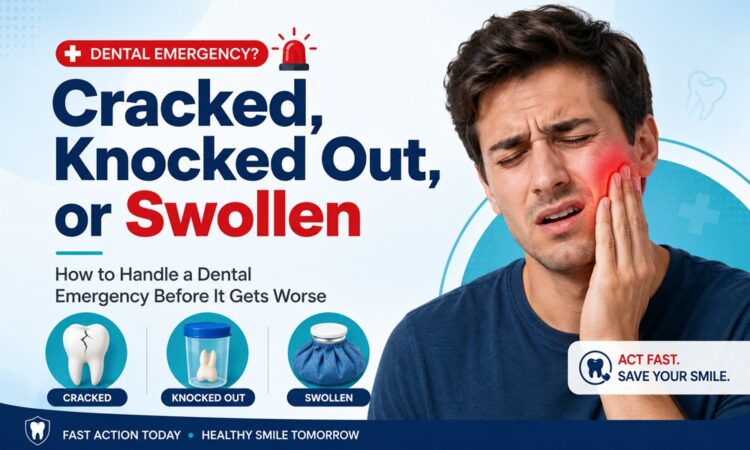
Quick answer: For a knocked-out tooth, keep it moist and get to a dentist within 30 to 60 minutes. For a crack, rinse with warm water and use a cold compress. For swelling, treat it as urgent, since infection can spread fast. In every case, call a dentist the same day.
A dental emergency does not wait for business hours. What you do in the first few minutes can decide whether a tooth is saved or lost. The good news: a handful of simple, calm actions cover almost every situation.
This guide walks you through the most common emergencies, the first-aid steps that matter, and the moment you need professional care.
Is this actually an emergency?
Not every dental problem is urgent. Use this fast triage.
Treat as an emergency (same-day care):
- A tooth knocked completely out
- Bleeding that will not stop
- Severe, unrelenting pain
- Facial or jaw swelling, especially if it is spreading
- A cracked tooth with sharp pain when you bite
Usually can wait a day or two:
- A small chip with no pain
- A dull, mild toothache
- A lost filling with no discomfort
- A minor cut or sore inside the mouth
When in doubt, call your dentist and describe what happened. Let them decide.
Knocked-out tooth (the most time-sensitive)
A knocked-out adult tooth is the clearest race against the clock. The chance of saving it drops every minute it is out of the mouth.
Do this:
- Pick it up by the crown, the white part you normally see. Never touch the root.
- Rinse gently if it is dirty, for no more than 10 seconds. Use cool water only. Do not scrub, and do not use soap or alcohol.
- Try to place it back in the socket. Hold it there by biting softly on clean gauze.
- If you cannot reinsert it, keep it moist. Put it in milk, a tooth-preservation kit, or tuck it between your cheek and gums. Avoid plain tap water for storage, since it can damage the root cells.
- Get to a dentist within 30 to 60 minutes. Call ahead for an emergency slot.
A knocked-out baby tooth is different. Keep it moist, but do not try to reinsert it. Let the dentist decide.
Cracked or broken tooth
Rinse your mouth with warm water to clean the area. Save any broken pieces in a clean container, since your dentist may be able to use them.
Apply a cold compress to your cheek to control swelling. Cover any sharp edge with dental wax or sugar-free gum so it does not cut your tongue. Then book an urgent visit.
Severe toothache
Rinse with warm water and floss gently to remove anything trapped between teeth. A cold compress on the outside of the cheek helps with swelling.
You can take an over-the-counter pain reliever like ibuprofen or acetaminophen. Never place aspirin directly on the gum or tooth. It burns the soft tissue.
Swelling and dental abscess
Swelling is a warning sign, not a wait-and-see problem. An abscess is an infection that can spread to your face, jaw, and beyond if ignored.
Rinse with warm salt water several times a day for short-term relief. Do not apply heat to the area. Seek care quickly. Swelling that moves toward your eye, neck, or the floor of your mouth, or that makes it hard to swallow or breathe, is a medical emergency.
Lost filling or crown
A lost crown or filling leaves the tooth exposed and sensitive. If you have the crown, you can place it back temporarily using dental cement or even toothpaste. Never use household glue.
Avoid chewing on that side and see your dentist within a day or two.
Emergency at a glance
| Problem | First move | How urgent |
|---|---|---|
| Knocked-out tooth | Keep moist, reinsert or store in milk | Within 30 to 60 minutes |
| Cracked tooth | Rinse, save pieces, cold compress | Same day |
| Severe toothache | Rinse, floss, pain reliever, cold compress | Same day |
| Swelling or abscess | Salt-water rinse, no heat | Urgent, can be serious |
| Lost filling or crown | Cover or refit temporarily | Within 1 to 2 days |
| Soft tissue cut | Pressure with gauze, cold compress | If bleeding persists, ER |
What not to do
These common mistakes make things worse:
- Do not put aspirin against your gums.
- Do not scrub the root of a knocked-out tooth.
- Do not store a tooth in plain tap water for long.
- Do not use super glue or any non-dental adhesive.
- Do not apply heat to a swollen, infected area.
- Do not “tough out” spreading swelling or heavy bleeding.
When to go to the ER instead of the dentist
Head to a hospital emergency room if you have:
- Bleeding that will not stop after 15 to 20 minutes of firm pressure
- Swelling that affects your breathing or swallowing
- A suspected broken jaw or facial bones
- Dizziness, loss of consciousness, or signs of concussion after an injury
For everything tooth-related, a dentist is the right call. Even after first aid, every true emergency needs professional follow-up. If you are nearby, seek out Van Nuys emergency dental care as soon as the bleeding and pain are under control. Calling ahead means the team can prepare for your arrival.
Build a small emergency kit
Keep these where you can grab them fast:
- A clean container with a lid (for a knocked-out tooth)
- Gauze and a small bottle of saline
- Dental wax or sugar-free gum
- Over-the-counter pain reliever
- Your dentist’s phone number
Frequently asked questions
How long can a knocked-out tooth survive outside the mouth? The best window is within an hour, and ideally 30 to 60 minutes. Keeping it moist in milk buys you time, but speed still matters most.
Can I use water to store a knocked-out tooth? Only briefly, to rinse off dirt for under 10 seconds. Do not soak or store it in tap water, since the root cells can swell and die.
Is a chipped tooth an emergency? Not always. A small chip with no pain can usually wait. A large break with sharp pain or exposed nerve needs same-day care.
What helps swelling while I wait? A cold compress on the outside of the cheek and a salt-water rinse. Keep your head upright and avoid heat on the area.
Prevention beats first aid
Wear a mouthguard for sports. Skip chewing ice, popcorn kernels, and hard candy. Never use your teeth to open packaging. And keep up regular checkups, since strong, healthy teeth handle accidents better.