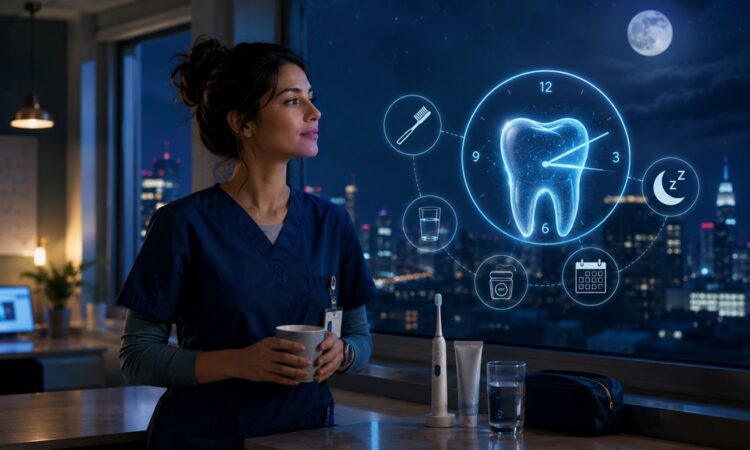
Kokomo runs on shifts. It has for a century. Plants run around the clock, and the people who keep them running sleep on a schedule the rest of the world does not.
Nobody tells those workers that their mouth is running on a different clock too.
This is a guide for anyone in Howard County working nights, rotating shifts, swing, or the kind of overtime that turns a schedule into a rumor.
Part One: What actually changes at night
Saliva
Saliva is not spit. It is a buffering, remineralizing, antimicrobial fluid, and it is the single most important defense your teeth have.
Classic research on circadian rhythms in salivary flow established that secretion is lowest during sleep and highest in the late afternoon. Studies of dental biofilm confirm the pattern and add a second finding: bacterial counts in saliva rise rapidly overnight and are highest on waking.
Follow the logic for a third-shift worker:
- At 2 a.m., your body thinks it should be asleep. Salivary flow drops accordingly.
- At 2 a.m., you are eating from a vending machine.
- Sugar and acid land on enamel with a fraction of the normal buffering capacity.
- Salivary pH also falls, favoring acidogenic bacteria such as S. mutans.
This is why night eating is more damaging than the same food eaten at noon. Same sugar, less defense.
Erosion
There is a specific finding worth knowing: night-shift workers have been reported to be at higher risk of dental erosion. Research on intraoral pH and temperature notes that reduced saliva quantity and quality means less capacity to buffer a drop in pH and protect teeth from acid attack, and points to abnormal expression of clock genes in salivary glands as a possible mechanism.
Erosion is not decay. It is chemical dissolution of enamel with no bacteria required. It looks like thinning, cupping on the chewing surfaces, and increasing translucency at the edges of front teeth. It is irreversible.
Periodontitis
The gum-disease data is the strongest signal in the literature.
| Study | Population | Finding |
|---|---|---|
| Han et al., Scandinavian Journal of Work, Environment & Health | Representative Asian population sample | Periodontitis prevalence 32.3%; shift workers had elevated odds ratio of 1.22 |
| Sato et al., PeerJ | 3,044 permanent employees aged 20 to 64, Japan | Rotating night shift for 1 to 5 years associated with severe periodontitis, prevalence ratio 1.80 (95% CI 1.33 to 2.43) |
| Cross-sectional survey of male workers, PLOS ONE | 180 workers | More years on shift schedule correlated with higher caries and periodontal disease, though the association weakened after adjustment |
The Sato finding is the one to sit with. A prevalence ratio of 1.80 for severe periodontitis among people with one to five years of rotating night work is not a rounding error. Interestingly, the same study did not find a statistically significant association with tooth loss, and the authors were candid that longer-term effects need more research. That honesty is worth respecting rather than overselling.
Why would shift work drive gum disease? Several plausible mechanisms stack:
- Circadian disruption raises inflammatory markers
- Sleep debt impairs immune response
- Stress alters oral health behaviors
- Brushing gets skipped when the routine has no anchor
- Sugary and caffeinated products substitute for sleep
Part Two: The behavior problem nobody names
The PLOS ONE survey of shift workers found something blunt. Very few workers reported brushing at least twice a day or using floss. About two thirds had not had a dental visit. Close to 60% reported eating sugary foods more than once per day.
That is not a character flaw. It is what happens when a routine loses its bookends.
Day workers brush because of two fixed events: getting out of bed and going to bed. Shift workers have neither. “Bedtime” is 9 a.m. on Tuesday and 11 p.m. on Saturday. The trigger disappears, and so does the habit.
The energy drink problem
This deserves its own section because it is the single worst thing on most plant floors.
An energy drink or soda is a dual attack: acid dissolves enamel directly, sugar feeds bacteria. Sipped across an eight-hour shift, it never lets pH recover. One can consumed in five minutes is dramatically safer than the same can consumed over four hours.
| Habit | Damage profile |
|---|---|
| One energy drink, finished in 10 minutes, with water after | Manageable |
| Same drink, sipped over 4 hours | Severe, continuous acid exposure |
| Coffee, black, no sugar | Staining only |
| Coffee with sugar, sipped continuously | Same problem as soda |
| Water | The right answer |
| Sugar-free gum with xylitol after eating | Actively helpful, stimulates saliva |
If you take one thing from this article: stop sipping. Drink it, then drink water.
Part Three: What to actually do
Anchor brushing to shift events, not to clock times
Forget “morning and night.” Those words are meaningless to you.
- Brush before you leave for shift. This is your “night” brush, whenever it happens.
- Brush when you get home, before you sleep. This is the important one, because it is the one immediately preceding your lowest-saliva window.
- Keep a brush and paste in your locker or lunch bag. A mid-shift brush after your meal break is worth more than a perfectly timed one at home.
Manage the mid-shift meal
- Eat in a defined window instead of grazing.
- Rinse with plain water afterward. Do not brush immediately after acidic food, because enamel is temporarily softened. Wait roughly 30 minutes.
- Chew sugar-free gum with xylitol after eating. It stimulates the saliva flow your circadian rhythm has switched off.
Fix the dry mouth
Dry mouth on nights is common and is often compounded by medication.
- Drink water, continuously, in actual amounts
- Ask about high-fluoride prescription toothpaste, typically 5000 ppm
- Consider a saliva substitute for the worst stretches
- Skip alcohol-based mouthwash, it makes dryness worse
Get on the right recall interval
If you work rotating nights, you are not an average-risk patient. Ask to be assessed for a three or four month recall rather than the default six.
Book the appointment your shift can actually keep
This is where a four-day practice with early hours works in your favor rather than against it. A third-shift worker clocking out at 6 a.m. is available at 8 a.m. in a way a day worker never is.
J Jenkins Family Dentistry runs a Kokomo dental office on West Boulevard, led by Air Force veteran Dr. Jordan M. Jenkins, open Monday through Thursday from 8 a.m. to 5 p.m., seeing patients from age two upward, with services also available in Spanish.
For a day worker, 8 a.m. Monday is a problem. For someone coming off nights, it is the most convenient appointment they will ever get. Use that.
Part Four: Warning signs by shift pattern
| Sign | What it usually means | Urgency |
|---|---|---|
| Gums bleed when brushing | Gingivitis, possibly early periodontitis | Book within weeks |
| Sensitivity to cold that stops instantly | Exposed dentin or recession | Routine |
| Sensitivity to cold that lingers a minute | Possible irreversible pulpitis | Book now |
| Front teeth looking translucent at edges | Erosion | Book, and audit your drinks |
| Waking with a sore jaw | Bruxism, common with disrupted sleep | Discuss a nightguard |
| Bad taste that will not clear | Possible periodontal infection | Book now |
| A tooth that hurts to bite on | Possible crack or abscess | Book now |
| Swelling in the face or under the jaw | Spreading infection | Same day, urgent |
That last row is not a dental inconvenience. Facial swelling from a dental infection can compromise the airway. Do not sleep on it, in any shift.
Part Five: Grinding, sleep, and the thing that connects them
Shift work disrupts sleep architecture. Disrupted sleep is associated with bruxism, and bruxism destroys teeth quietly and expensively.
Signs you are grinding:
- Flattened, shiny wear facets on the biting surfaces
- Morning jaw soreness or headaches at the temples
- Scalloped edges on the tongue
- Teeth that ache without a specific cavity
- A partner who has mentioned the noise
The management options are unglamorous and effective: an occlusal guard, addressing sleep quality, cutting caffeine late in the shift, and treating any underlying sleep-disordered breathing.
Research on sleep and caries also flags an evening chronotype as associated with a less healthy lifestyle and higher caries risk than a morning chronotype. Shift work does not just interact with your sleep. Over time it can reshape it.
The honest summary
You cannot fix your circadian rhythm by brushing harder. What you can do:
- Anchor brushing to shift start and shift end, not to clock times
- Stop sipping sugar and acid across the shift
- Water, continuously
- Xylitol gum after eating
- Ask for a shorter recall interval
- Ask about high-fluoride paste if your mouth runs dry
- Book the 8 a.m. appointment your shift actually allows
- Take facial swelling seriously, immediately
Frequently asked questions
Does one week of nights hurt my teeth?
No. The risk is cumulative and behavioral. A rotation is not a crisis. Five years of one is a pattern.
Should I brush right after my shift meal?
Not if it was acidic. Rinse with water, chew xylitol gum, and brush about half an hour later. Brushing softened enamel scrubs it away.
Is mouthwash a substitute for brushing on shift?
No. It does not remove biofilm. A brush in your locker does.
Do I need a different toothpaste?
Possibly. If you have dry mouth or a history of decay, a prescription-strength fluoride paste is a reasonable conversation to have.
My schedule rotates constantly. What is the minimum viable plan?
Two brushes per sleep-wake cycle, no sipping, water instead of energy drinks, and a real dental exam at an interval your dentist sets after actually probing your gums.