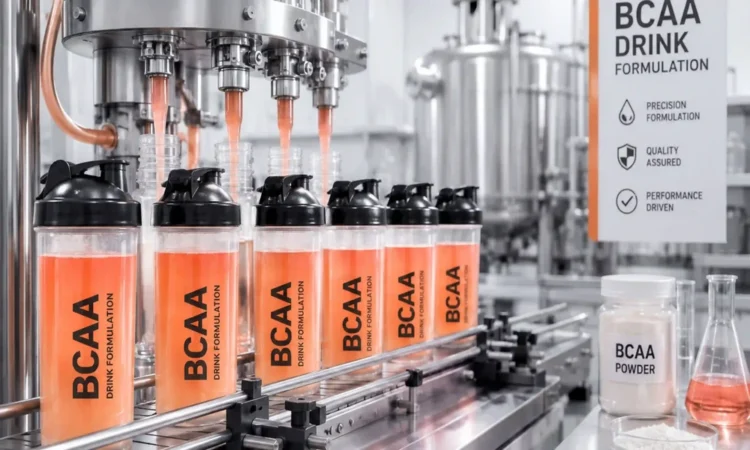
BCAAs are one of the most purchased intra-workout supplements on the market. The category looks straightforward from the outside – leucine, isoleucine, and valine in a flavoured powder – but the differences between products matter more than most labels make obvious.
This piece covers what separates a flavoured BCAA drink from a standard formula, what the ratio means in practice, and how to evaluate both before spending money on either.
What BCAAs Are and Why They’re Used
Branched-chain amino acids are three of the nine essential amino acids your body cannot produce independently: leucine, isoleucine, and valine. They’re found in high concentrations in skeletal muscle and play a direct role in muscle protein synthesis, energy production during exercise, and glucose uptake into working muscle cells.
Leucine is the primary driver. It acts as the trigger that initiates muscle protein synthesis – the process by which your body repairs and rebuilds muscle tissue after training. Isoleucine supports glucose uptake during exercise and plays a role in energy metabolism. Valine contributes to energy production and has evidence for reducing central fatigue during prolonged efforts.
The practical case for BCAA supplementation is strongest during training, when muscle protein breakdown is elevated and fast-absorbing amino acids provide direct support without the digestive load of a full protein shake.
Flavoured BCAA Drinks: What They Add to the Formula
A flavoured BCAA drink combines the three branched-chain amino acids with palatability features that make them easy and enjoyable to consume during training. This matters more than it might seem.
Flavoured BCAA drinks that taste good get used consistently. A product you look forward to drinking during training becomes part of a reliable intra-workout habit rather than something you take intermittently when you remember. Consistency is what produces results with BCAAs, not any single dose.
Quality flavoured BCAA formulas also commonly include electrolytes alongside the amino acids. Sodium, potassium, and magnesium are lost through sweat during training. Electrolyte depletion contributes to cramping, reduced coordination, and accelerated fatigue. A BCAA drink that replaces both amino acids and electrolytes simultaneously covers two recovery-relevant needs in a single product without requiring a separate electrolyte supplement.
What to check in a flavoured BCAA product
Flavour and mixability vary significantly between products. Beyond those practical considerations, the label deserves the same scrutiny as any other supplement.
The individual dose of each BCAA should be disclosed rather than hidden behind a total blend weight. A product listing “BCAA blend 5g” without specifying how much leucine, isoleucine, and valine it contains makes it impossible to assess whether the leucine dose is sufficient to trigger a meaningful muscle protein synthesis response. A useful leucine dose sits at 2 to 3g per serve minimum.
Sugar content is worth noting. Some flavoured BCAA drinks add significant sugar to improve palatability. That’s not disqualifying for people in a muscle-building phase, but it’s worth knowing if you’re managing calorie intake during a fat loss phase.
BCAA 2:1:1: What the Ratio Means
The BCAA 2:1:1 ratio describes the proportion of leucine to isoleucine to valine in the formula. Two parts leucine for every one part isoleucine and one part valine. In a standard 5g serve, that breaks down to approximately 2.5g leucine, 1.25g isoleucine, and 1.25g valine.
This ratio reflects where the research base sits. The majority of studies demonstrating meaningful BCAA benefits used a 2:1:1 ratio or close to it. Leucine is weighted higher because it’s the primary muscle protein synthesis trigger. Isoleucine and valine are weighted equally because their functions, while supportive rather than primary, are complementary rather than duplicative.
Why the ratio matters more than the total dose alone
Some products market higher leucine ratios, 4:1:1 or 8:1:1, on the basis that more leucine means a stronger muscle protein synthesis response. The reasoning is partially correct but incomplete.
Leucine triggers the process. But isoleucine and valine support the broader metabolic environment in which that process runs, including energy availability and glucose uptake. Pushing leucine disproportionately high while reducing isoleucine and valine below meaningful doses doesn’t produce a proportionally stronger outcome. The research base for ratios significantly above 2:1:1 is thinner than the marketing implies.
A well-dosed 2:1:1 product at an adequate total dose outperforms an underdosed high-leucine formula. Check the per-serve amounts for each individual amino acid rather than relying on the ratio alone to assess whether a product is worth buying.
How to Use BCAAs Effectively
The most effective use of BCAAs is intra-workout, sipped through your training session rather than consumed all at once before or after. This maintains elevated amino acid availability during the period when muscle protein breakdown is highest.
Effective doses sit at 5 to 10g per session with a leucine content of at least 2 to 3g. Taking BCAAs on an empty stomach pre-workout or post-workout when a full protein shake isn’t immediately available are secondary use cases that make sense in specific situations.
On rest days, the benefit of standalone BCAA supplementation is minimal. Meeting daily protein targets through whole food and protein supplements covers recovery needs more completely than isolated BCAA intake on non-training days.
FAQs
Is a flavoured BCAA drink better than unflavoured BCAA powder?
Neither is inherently better from a performance standpoint. The amino acid content is what drives the result. Flavoured products improve consistency of use, which is practically significant. If an unflavoured product gets used intermittently because it’s unpleasant to drink, a flavoured alternative that gets used every session produces better outcomes.
Do I need BCAAs if I already take protein powder?
Not necessarily. A complete whey protein already contains all three BCAAs alongside the full essential amino acid profile. Standalone BCAAs are most useful intra-workout when a full protein shake isn’t practical during training, or as a fast-absorbing amino acid top-up for fasted sessions.
What is the best time to take BCAAs?
During training is the most effective window. Sipping a BCAA drink through your session maintains amino acid availability when muscle protein breakdown is elevated. Pre-workout in a fasted state and post-workout before a full meal are secondary options that make sense in specific situations.
Can I take BCAAs every day?
Yes. Daily use at standard doses is safe for healthy adults. The benefit on rest days is modest compared to training days, but there is no harm in daily supplementation if it fits your routine.
How do BCAAs differ from EAAs?
BCAAs cover three of the nine essential amino acids. EAAs cover all nine. If your daily protein intake is consistently adequate, BCAAs fill the intra-workout gap effectively. If protein intake is inconsistent or training happens in a fasted state, EAAs provide more complete amino acid coverage in a single product.