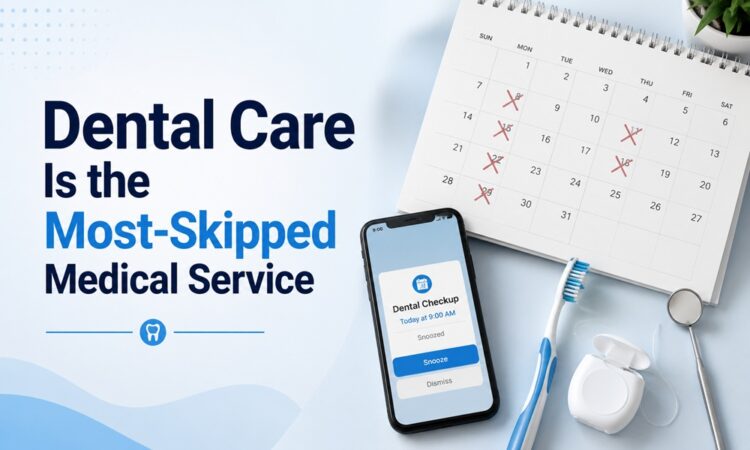
Start with a comparison that should be uncomfortable.
In one federal survey, 18% of American adults skipped dental care because of cost. That was higher than doctor visits (15%), follow-up care (10%), mental health care (10%), and prescription medication (9%).
Dental care is the first thing to go. Every time.
Other data points to the same conclusion from different angles. Around 46% of Americans report delaying or skipping dental care due to cost. Among insured Americans, 48% have skipped a visit or a recommended procedure because of price. Among the uninsured, that figure reaches 65%.
And roughly 76.5 million U.S. adults have no dental insurance at all.
So this isn’t a discipline problem. It’s a structural one. Let’s look at the numbers honestly.
The Escalation Table
Here is the mechanism by which a cheap problem becomes an expensive one. Costs are typical U.S. ranges before insurance.
| Stage | The problem | Typical cost | Time invested |
| 0 | Nothing wrong yet | Cleaning + exam: $75–$200 | 1 hour, twice a year |
| 1 | Early demineralization (white spot) | Fluoride varnish: $25–$60 | 5 minutes |
| 2 | Small cavity | Composite filling: $150–$400 | 30 minutes |
| 3 | Large cavity, cusp undermined | Onlay or crown: $800–$2,000 | 1–2 visits |
| 4 | Decay reaches the pulp | Root canal + crown: $1,500–$3,500 | 2–3 visits |
| 5 | Tooth not restorable | Extraction: $150–$650 | 1 visit |
| 6 | Replacing the missing tooth | Implant + crown: $3,000–$5,000 | 6–12 months |
| 7 | Bone has resorbed | Implant + graft: $4,500–$7,000+ | 9–15 months |
Stage 0 to Stage 7 is roughly a 30-fold cost increase. The clinical distance between them is often five to eight years of not going.
Meanwhile, adults who consistently use preventive services have been shown to spend over 30% less on dental care across a five-year window than those who skip routine care and appear only for emergencies.
Why It Escalates So Fast
Three properties of teeth make delay unusually costly.
Enamel does not heal. Bone repairs itself. Skin closes. Enamel is acellular. A cavity does not resolve, reverse, or stabilize. It only grows.
Pain is a late signal. Decay reaches the dentin painlessly. By the time cold water hurts, the lesion is deep. By the time it throbs at night, the pulp is involved and you’re in root canal territory.
Every restoration has a lifespan. A filling is not permanent. Each replacement removes more tooth structure. Each cycle moves the tooth one step down the escalation table. The dental literature calls this the restorative cycle, and it’s why the best filling is the one you never needed.
How Dental Insurance Actually Works
Most people misunderstand this, and the misunderstanding is expensive.
Dental insurance is not health insurance. Health insurance protects against catastrophe. Dental insurance is a prepaid benefit with a ceiling — it covers the cheap things well and the expensive things poorly.
The standard structure
| Category | Typical coverage |
| Preventive — exams, cleanings, X-rays | 100%, often with no deductible |
| Basic — fillings, simple extractions | 70–80% |
| Major — crowns, bridges, dentures, root canals | 50% |
| Orthodontics | Separate lifetime maximum, if covered |
The parts that catch people
The annual maximum. Commonly $1,000–$2,000 per year. That figure has barely moved in decades while procedure costs have risen 3–5% annually — generally outpacing inflation.
Do the math: one crown can exhaust an entire year’s benefit.
The deductible. Usually $50–$100, waived for preventive.
Waiting periods. Major work is often not covered for 6–12 months after enrollment.
The missing tooth clause. Many plans won’t cover replacing a tooth that was already missing when you enrolled.
Frequency limits. Two cleanings per year, one set of bitewings, a full series every 3–5 years. If your gum disease requires quarterly maintenance, you may be paying out of pocket for half of it.
The uncomfortable conclusion: Dental insurance is designed to make prevention free. That is the product. Use the preventive benefit fully — it is the highest-value component by a wide margin.
Households with dental coverage have been reported to save over $1,000 a year compared with those without.
When Insurance Isn’t the Answer
For many people it isn’t. If your premium is $40/month ($480/year), your annual maximum is $1,000, and you only ever use two cleanings — you’re prepaying for something you could purchase directly.
The alternatives
In-house membership plans. The practice sells a direct subscription: typically two cleanings, exams, X-rays, and a 15–25% discount on other treatment. No annual maximum. No waiting period. No missing tooth clause. No claims.
For uninsured patients who attend regularly, this frequently beats an individual insurance policy on pure arithmetic.
Discount dental plans. Negotiated fee schedules. Not insurance. Cheaper, less coverage.
Dental schools. Substantially reduced fees. Longer appointments, supervised students, excellent oversight.
Community health centers / FQHCs. Sliding scale based on income.
Third-party financing. Useful for large treatment plans. Read the deferred interest terms carefully — retroactive interest on the full balance is the standard trap.
Practice-level payment plans. Ask. Many offer them and don’t advertise them.
The Disparity Nobody Should Ignore
Access is not evenly distributed, and the gaps are stark.
- 38% of low-income adults have no dental insurance — roughly four times the rate among high earners
- 30% of low-income adults skipped needed treatment because they couldn’t afford it
- 20.4% of uninsured children received dental care, versus 63.2% of privately insured children
- 41% of adults have lost at least one tooth to decay or disease
- Around 27% of adults paid over $500 out of pocket for dental care in a single year
- Roughly 40% of total U.S. dental expenditure is paid directly by patients
Meanwhile, community water fluoridation saves an estimated $6.5 billion annually in avoided dental costs in the United States. Prevention at population scale is not a marginal intervention.
A Budget That Works
Think of the mouth like a roof. Small predictable maintenance, or a large unpredictable failure.
Tier 1 — Non-negotiable (~$300–$600/year)
- Two hygiene visits and exams
- Annual bitewing radiographs
- Fluoride varnish if you’re high-risk
This tier is where the 30% five-year saving lives.
Tier 2 — Prevention with outsized returns
- Sealants for children — CDC data shows they prevent 80% of cavities in back teeth over two years; children without them get nearly three times as many first-molar cavities
- A night guard if you grind — hundreds of dollars against thousands in cracked cusps
- A custom sports mouthguard for anyone in contact sport
Tier 3 — Sequence and stage
Treatment doesn’t have to happen all at once.
- Ask for a written, prioritized treatment plan with costs, split into urgent, needed within 12 months, and elective
- Stage major work across two benefit years to use two annual maximums
- Do the cheap preventive work in December, the crown in January
Tier 4 — Emergency reserve
Set aside a small monthly amount. Teeth crack on Friday nights.
What to Ask Before You Agree to Treatment
- What happens if I do nothing? What’s the realistic timeline?
- Is there a less expensive option that’s clinically acceptable?
- Can this wait six months without getting worse?
- What’s urgent, and what’s elective?
- What’s the total, itemized, including lab fees?
- What will my insurance actually pay, and can you pre-authorize it?
- Do you offer a membership plan or payment plan?
A practice offering family dentistry in LaGrange, GA should be able to answer every one of these before you sit in the chair. If cost only appears at checkout, that’s a process failure — not a pricing problem.
Frequently Asked Questions
Is dental insurance worth it?
It depends on your usage. If you only attend for cleanings, an in-house membership plan is often better value. If you anticipate major work, insurance’s 50% coverage — capped at the annual maximum — may pay for itself.
Why is the annual maximum so low?
It’s a legacy of how dental benefits were designed decades ago, and it hasn’t kept pace with procedure costs, which have risen roughly 3–5% per year.
What if I can’t afford treatment right now?
Tell your dentist. Ask for a prioritized plan. Some things genuinely can wait. Others cannot, and the ones that can’t are usually cheaper to address now.
Does skipping cleanings really cost more later?
The evidence points that way. Adults who use preventive services consistently spend over 30% less on dental care across five years than those who present only for emergencies.
Are dental school clinics safe?
Yes. Work is performed by supervised students under faculty oversight. Appointments take longer. Fees are considerably lower.
Is a dental membership plan the same as insurance?
No. It’s a direct subscription with the practice. No claims, no annual maximum, no waiting periods — and no coverage from other providers.
What’s the single cheapest thing I can do for my teeth?
Attend the preventive visits your plan already covers at 100%, and ask for sealants for your children. Those two actions have the best return of anything in dentistry.
Should I get a crown or an extraction if money is tight?
Extraction is cheaper today and more expensive over a decade — replacement, bone loss, drifting teeth. Ask for the ten-year cost, not the today cost.