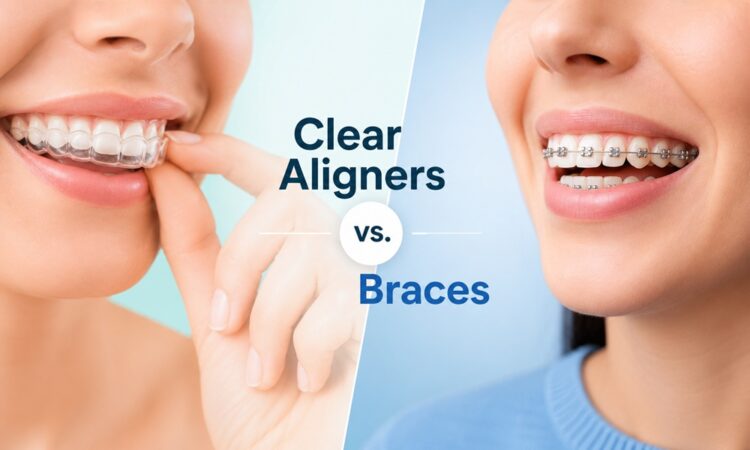
Two treatments. One goal. Almost every online comparison is written by someone selling one of them.
So let’s use the systematic reviews instead — including the ones that don’t flatter aligners.
The short version: both work. They fail in different places. The right question isn’t “which is better” but “which is better for the specific movements my teeth need.”
The Honest Scoreboard
| Dimension | Clear aligners | Fixed braces |
| Aesthetics | Nearly invisible | Visible; ceramic reduces it |
| Comfort | Less pain reported in trials | More soft tissue irritation |
| Removability | Yes — eat and clean normally | No |
| Oral hygiene during treatment | Easier; better periodontal indices | Harder; plaque traps everywhere |
| Treatment duration | Often shorter in simple non-extraction cases | Longer in simple cases; shorter in extraction cases |
| Chair time & appointments | Fewer visits, shorter appointments | More visits |
| Speech | Mild lisp early on | Better than aligners in trials |
| Occlusal contact / final bite settling | Weaker | Stronger |
| Torque control (root angulation) | Weaker | Stronger |
| Complex extraction cases | Predictability drops | More reliable |
| Compliance dependence | Total — 20–22 hrs/day | None |
| Retention after treatment | Reported as less stable in some reviews | More stable |
Note the two rows in bold on the aligner side. They are the crux of everything.
What Systematic Reviews Actually Found
A widely cited systematic review comparing aligners with fixed appliances concluded that both were effective in treating malocclusion. Aligners showed advantages in segmented tooth movement and shortened treatment duration. But they were less effective than braces at producing adequate occlusal contacts, controlling tooth torque, and maintaining retention.
A separate review focused on simple, non-extraction Class I crowding found that aligners reduced treatment duration, chairside time, unscheduled appointments, and finishing-stage appointments.
Yet a meta-analysis restricted to randomized controlled trials found that aligners were not significantly more effective than fixed appliances for simple non-extraction malocclusions — and rated the quality of the available RCT evidence as low. It also found braces performed better on speech during treatment, while aligners performed better on pain, treatment time, and visit count.
For complex cases, the picture sharpens. A review of premolar-extraction cases found:
- Three studies found no difference between aligners and fixed appliances when scored on the American Board of Orthodontists Objective Grading System or the Peer Assessment Rating index
- Two studies found measurable gaps between predicted and achieved tooth movements with aligners
- Treatment duration was shorter with fixed appliances in extraction cases
- Fixed appliances achieved better buccolingual inclination and occlusal contacts
For mild-to-moderate cases overall, systematic reviews report aligner success rates roughly in the 80–96% range, with patient satisfaction consistently above 85%.
Synthesis: aligners win on experience and simple cases. Braces win on precision and hard cases. Nobody’s marketing says this.
The Movements Aligners Struggle With
Aligners deliver force through plastic pressing against a crown. That geometry has consequences.
| Movement | Aligner predictability | Why |
| Tipping | Excellent | Force at the crown naturally tips |
| Simple alignment / crowding | Excellent | The core use case |
| Arch expansion | Good — meta-analysis showed 3.0–3.5 mm | Well documented |
| Distalization | Good | Sequential, predictable |
| Rotation of round teeth (canines, premolars) | Poor | Nothing for the plastic to grip |
| Root torque (bodily movement) | Poor | Requires a couple force system |
| Extrusion | Poor | Plastic can’t pull |
| Intrusion | Fair to poor | Anchorage is difficult |
| Closing extraction spaces | Difficult | Root parallelism and anchorage control |
This is what attachments exist for — small tooth-coloured composite bumps bonded to teeth to give the aligner a surface to push against. And it’s why treatment plans routinely include refinement trays: the initial series gets you most of the way, and additional scans and trays close the gap between predicted and achieved.
If you’re told no attachments and no refinements will be needed, ask more questions.
The Compliance Problem
Braces work whether you like it or not.
Aligners work 20 to 22 hours per day. Anything less and teeth follow the plan more slowly, tray fit degrades, and the sequence falls out of alignment with reality.
Realistically that means:
- Trays out for meals only
- Trays out for anything other than water
- Coffee stains trays; hot drinks warp them
- Every removal is a decision, and there are five or six a day
For a disciplined adult, this is trivial. For a distracted fifteen-year-old, it’s the whole ballgame. Compliance indicators — small blue dots that fade with wear — exist precisely because self-reporting is unreliable.
Decision Matrix
| Your situation | Leaning |
| Mild-to-moderate crowding, no extractions | Aligners |
| Adult in a client-facing role | Aligners |
| Complex extraction case with anchorage demands | Braces |
| Significant rotations of canines or premolars | Braces, or aligners with heavy attachments |
| Severe skeletal discrepancy needing surgery | Either, coordinated with the surgeon |
| Teenager with mixed dentition and low compliance | Braces |
| Periodontally compromised dentition | Aligners — easier hygiene, lighter forces |
| Deep bite requiring incisor intrusion | Braces, generally |
| History of poor appointment attendance | Aligners — fewer visits — but compliance risk cuts both ways |
| Budget is the binding constraint | Braces are typically less expensive |
Time, Cost, and What Nobody Mentions
Duration. Aligner treatment averages around 18 months for suitable cases; fixed braces around 24 months. But the averages hide the split: aligners are faster in simple non-extraction cases and slower in extraction cases.
Part of the aligner time advantage is structural. Braces require a detailing and finishing phase — up to six months of wire bending and adjustment at the end. Aligners largely skip that phase, which is also why their final occlusal contacts score lower.
The speed and the imprecision have the same cause.
Cost. Braces are generally less expensive. Aligners carry lab fabrication costs per tray series and per refinement. Metal braces are the most economical option; ceramic braces sit between; lingual braces are the most expensive of all.
Retention. This is the part people don’t plan for.
Teeth move for the rest of your life. Retainers are permanent. Not for a year. Forever, in some form — typically nightly wear indefinitely, or a bonded lingual wire behind the front teeth.
Some systematic reviews flag aligners as showing less stable retention than fixed appliances. Whatever appliance moved your teeth, the retainer is what keeps them.
Skipping retention undoes two years of work in eighteen months.
Direct-to-Consumer Aligners: A Note
Mail-order aligner services skip the in-person examination, the radiographs, and the periodontal assessment.
That matters because:
- Moving teeth with untreated periodontal disease accelerates bone loss
- Undiagnosed root resorption goes unnoticed without imaging
- Nobody assesses whether a tooth is even suitable for movement
- Course corrections require someone looking in your mouth
Orthodontics is not a product category. It’s the controlled application of force to living bone. A dentist in Turlock evaluating your case in person will take records, look at bone levels, and tell you honestly whether aligners will get you where you want to go — or whether they’ll get you 80% of the way and stall.
Questions to Ask at Your Consultation
- What specific movements does my case require, and how predictable is each with aligners?
- How many attachments will I need, and on which teeth?
- Is refinement included in the quoted price, or billed separately?
- If aligners don’t achieve the finish, what’s the fallback plan and what does it cost?
- What’s the projected treatment time for each option, for my case?
- What retention protocol do you use, and what does it cost long-term?
- Can I see the digital treatment simulation — and understand that it’s a prediction, not a promise?
That last distinction is the important one. The simulation shows the software’s plan. Studies repeatedly document gaps between predicted and achieved movement.
Frequently Asked Questions
Are clear aligners as effective as braces? For mild-to-moderate, non-extraction cases: essentially yes. For complex extraction cases requiring torque control and precise occlusal settling: braces remain more reliable.
How long do clear aligners take? Around 18 months on average for suitable cases, versus roughly 24 months for braces. Extraction cases reverse this, with braces finishing faster.
Do aligners hurt less than braces? Trials consistently report less pain with aligners, though the evidence quality is rated low. Both cause pressure and soreness after each adjustment or new tray.
How many hours a day do I need to wear aligners? 20 to 22. This is not padded advice — the treatment plan is calculated around it.
Can aligners fix an overbite? Mild to moderate, often yes. Deep bites requiring significant incisor intrusion are more predictable with fixed appliances.
Will I need attachments? Almost certainly, for anything beyond very mild crowding. They’re small, tooth-coloured, and removed at the end.
Are mail-order aligners safe? They omit the diagnostic steps that make orthodontics safe — radiographs, periodontal assessment, in-person monitoring. Moving teeth without those steps carries real risk.
Do I have to wear a retainer forever? In some form, yes. Teeth drift throughout life. This applies equally to braces and aligners.
Which is cheaper? Metal braces are typically the most economical. Aligner costs vary with case complexity and the number of refinement series required.