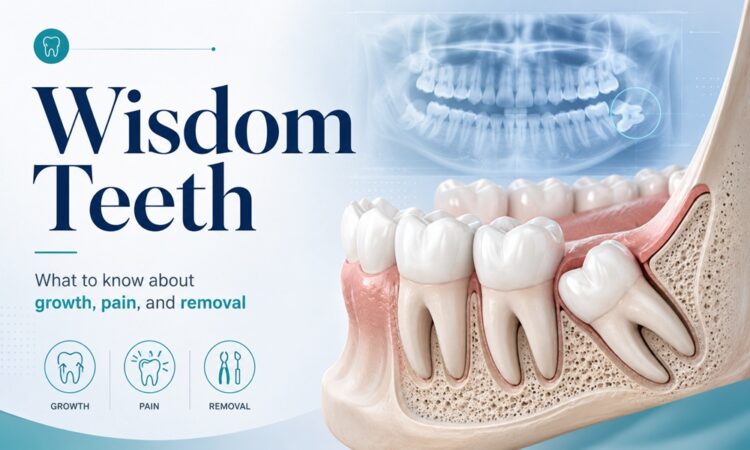
Third molars are the last teeth to arrive and the first to cause trouble.
They erupt between roughly 17 and 25, into a jaw that finished growing years earlier. Human jaws have shortened over evolutionary time. The teeth didn’t get the memo.
The result is predictable. About 85% of people have at least one wisdom tooth that is impacted — meaning it cannot fully erupt into a functional position. Around 10 million wisdom teeth are removed annually in the United States, affecting roughly 5 million people. Insurance claims data suggests about half of privately insured young adults have had at least one removed by age 25.
Common doesn’t mean automatic. Let’s work through it in order.
Stage One: What “Impacted” Actually Means
Impaction isn’t binary. It’s a description of angle, depth, and coverage.
By angle
| Type | Direction the tooth points | Share of cases | Typical problem |
| Mesioangular | Forward, into the second molar | Most common | Traps plaque, decays the neighbour |
| Vertical | Straight up, but blocked | Common | Partial eruption, pericoronitis |
| Horizontal | Sideways, 90° to normal | Roughly 38% of positions | Pressure, root resorption of adjacent tooth |
| Distoangular | Backward, toward the ramus | Least common | Often the most surgically demanding |
By coverage
- Soft tissue impaction — the crown has cleared bone but gum still covers part of it
- Partial bony impaction — the crown is partly encased in bone
- Full bony impaction — the tooth sits entirely within bone
Depth is graded separately, relative to the second molar and the ascending ramus. Deeper positions correlate with higher pathology risk. Roughly 45% of the deepest class develop pathology within four years.
Stage Two: Remove or Monitor?
This is a genuine clinical judgment, not a foregone conclusion. Around 25% of impacted wisdom teeth are asymptomatic and may reasonably be watched.
Reasons that favour removal
- Pericoronitis. Infection of the gum flap over a partially erupted tooth. It affects 10–15% of partially erupted third molars and tends to recur.
- Decay in the wisdom tooth or its neighbour. The area is nearly impossible to clean.
- Periodontal pocketing behind the second molar. Bone loss here is difficult to reverse.
- Root resorption of the adjacent tooth. Reported in roughly 4–10% of impacted cases.
- Cyst or tumour formation. The follicle around an unerupted tooth can develop into a dentigerous cyst — estimated at around 12% of impacted cases.
- Recurrent food packing, pain, or swelling.
- Planned orthodontics or orthognathic surgery.
Reasons that favour monitoring
- Fully erupted, functional, cleanable, and asymptomatic
- Complete bony impaction with no radiographic pathology and no communication with the mouth
- Roots intimately wrapped around the inferior alveolar nerve, where surgical risk outweighs current benefit
- Medical conditions that raise surgical risk disproportionately
The age variable
Younger patients heal faster. Roots are shorter and less developed. Bone is less dense. Surgery is easier and complications are fewer.
That’s the argument for removing a problematic tooth at 19 rather than 39. It is not an argument for removing a healthy, functional tooth at any age.
Stage Three: Imaging and Planning
Panoramic radiograph. The baseline. Shows all four third molars, their angles, and their approximate relationship to the mandibular canal.
Cone beam CT (CBCT). Ordered when the panoramic image suggests the roots may contact the inferior alveolar nerve. Three-dimensional imaging shows whether the canal runs buccal, lingual, or between the roots.
That distinction changes the surgical plan — sometimes to a coronectomy, in which the crown is removed and the roots are deliberately left in place to avoid nerve injury. Coronectomy is performed in roughly 15% of high-risk cases.
Stage Four: The Day of Surgery
Anesthesia. Around 70% of outpatient wisdom tooth removals are performed under local anesthesia, sometimes with nitrous oxide. IV sedation is common for multiple or deeply impacted teeth. General anesthesia is reserved for specific cases.
The sequence, for an impacted lower tooth:
- Profound local anesthesia is confirmed.
- A small flap of gum tissue is reflected to expose the tooth.
- If bone covers the crown, a measured amount is removed.
- The tooth is often sectioned — deliberately cut into pieces — so each piece can be removed through a smaller opening. Sectioning reduces the bone removed. It’s a sign of careful surgery, not difficulty.
- The socket is irrigated and debrided.
- Sutures are placed, usually dissolving.
Duration. Typically 20 to 60 minutes for all four, depending on impaction complexity.
Before you arrive: confirm fasting instructions if sedated, arrange a driver, fill prescriptions in advance, and buy soft food before the appointment. Nobody wants to shop for yogurt with a numb face.
Stage Five: Recovery, Day by Day
| Timeframe | What’s normal | What to do |
| First 30–60 min | Steady gauze pressure, some oozing | Bite firmly. Change gauze when saturated. |
| Hours 2–8 | Numbness fading; discomfort begins | Take the first analgesic before numbness wears off |
| First 24 hours | Light bleeding, swelling begins | Ice 20 min on, 20 off. Head elevated. No rinsing, no spitting, no straws. |
| Day 1 (24 hr mark) | Pain peaks for about 80% of patients | Stay ahead of it. Ibuprofen plus acetaminophen is highly effective. |
| Days 2–3 | Swelling peaks at 48–72 hours | Switch from ice to gentle warm compresses after 48 hours. Begin warm salt-water rinses. |
| Days 3–5 | Swelling and bruising begin to fade | Soft foods. Gentle brushing away from sites. Irrigation syringe if given one. |
| Days 5–7 | Most people feel largely normal | Resume light activity. Still no smoking, still no straws. |
| Days 7–10 | Gum tissue closes over | Swelling resolves in 7–10 days for about 90% of patients |
| Weeks 2–4 | Sockets fill in | Bony impactions take longer. Bone continues remodelling quietly for months. |
Age changes this table. Teenagers commonly return to normal activity within 5 to 7 days. Patients in their thirties and forties often need 10 to 14 days. Cellular regeneration, bone density, and immune response all decline with age.
Impaction type changes it too. Soft tissue impactions heal at the fast end. Bony impactions requiring flap and bone removal can take two to three weeks for comfortable function.
The Complication Everyone Fears: Dry Socket
What it is. Alveolar osteitis. The protective blood clot in the socket dislodges or dissolves before healing tissue replaces it, exposing bare bone.
When it appears. Typically day 2 to day 4 — after you thought you were improving. That timing is the tell.
What it feels like. Deep, throbbing pain that radiates to the ear or temple. Bad taste. Visible empty socket. It does not respond well to over-the-counter analgesics.
How common. The numbers vary by procedure:
| Procedure | Reported incidence |
| Routine tooth extraction | 1–5% |
| All extractions (AAOMS figure) | ~4% |
| Impacted lower wisdom teeth | Substantially higher — reported up to 20–30% in some series |
| Smokers | Roughly 20%, with odds ratios above 6 in prospective studies |
Risk factors, in order of impact: smoking, poor oral hygiene, surgical difficulty, oral contraceptive use, prior dry socket.
Prevention, in order of impact:
- Do not smoke or vape. Nicotine constricts vessels and compromises the clot.
- Do not use a straw. Negative pressure lifts the clot.
- Do not spit forcefully or rinse vigorously for 24 hours.
- Keep the mouth clean, gently.
Treatment. It is treatable. The surgeon irrigates the socket and places a medicated dressing. Relief is usually rapid. It is not dangerous — it is painful.
Other Risks, In Proportion
Serious complications are uncommon, but volume means they still affect many people annually.
- Temporary lower lip or chin numbness — up to roughly 1–3% of cases, depending on impaction depth and surgical experience
- Permanent inferior alveolar nerve injury — under 2%, and generally far lower; most injuries in young patients recover over weeks to months
- Permanent lingual nerve injury — systematic reviews report roughly 0.04–0.6%
- Temporary lingual numbness — higher, up to about 10% in some series, usually resolving within weeks
- Infection — uncommon; presents as increasing pain and swelling after day three, often with fever
- Sinus communication (upper teeth), jaw fracture, TMJ dysfunction — rare
Overall, nerve injury incidence across methods and anatomy is reported between 0.1% and 2%.
An experienced Oral Surgeon in Warren, NJ will discuss which of these apply to your specific anatomy, based on your imaging — not on population averages. Ask to see your scan.
Red Flags: When to Call
Call the surgeon, not the internet, if you have:
- Pain that increases after day three rather than decreasing
- Fever above 100.4°F / 38°C
- Bleeding that won’t stop after 30 minutes of firm gauze pressure
- Swelling that spreads to the eye or down the neck
- Difficulty swallowing or opening the mouth beyond expected stiffness
- Numbness persisting beyond the first day
- A foul taste with severe throbbing pain
What to Eat
Days 0–2: Yogurt, applesauce, blended soup (lukewarm, not hot), pudding, protein shakes — spooned, never through a straw. Ice cream, sensibly.
Days 3–5: Scrambled eggs, mashed potato, oatmeal, soft pasta, refried beans, well-cooked fish.
Days 5–10: Soft bread, pancakes, tender chicken, ripe fruit.
Avoid for at least a week: Nuts, seeds, popcorn, chips, rice, granola, anything that can lodge in a socket. Also avoid alcohol and anything hot enough to dissolve the clot.
Frequently Asked Questions
Do all wisdom teeth need to be removed? No. Fully erupted, functional, cleanable, asymptomatic wisdom teeth can be monitored. Removal is indicated when there’s pathology, or a well-evidenced risk of it.
How long does wisdom teeth removal take? Usually 20 to 60 minutes for all four. Deeply impacted teeth take longer.
Is wisdom tooth removal painful? The surgery isn’t — you’re numb. Recovery involves real discomfort, peaking around 24 hours. Combined ibuprofen and acetaminophen controls it well for most people.
How long until I can go back to work? Most people take 2 to 3 days. Physical jobs and heavy lifting warrant longer, since exertion raises blood pressure and can restart bleeding.
When can I brush my teeth? Brush the rest of your mouth the same night, gently, avoiding the surgical sites. Begin warm salt-water rinses after the first 24 hours.
Why can’t I use a straw? Suction creates negative pressure that can dislodge the blood clot and cause dry socket. Avoid straws for at least a week.
Can I get dry socket after a week? It’s unlikely. Dry socket almost always presents between days 2 and 4.
Will I be swollen? Almost certainly. Swelling peaks at 48 to 72 hours and resolves within 7 to 10 days for the large majority of patients. Bruising along the jaw is normal.
Is it too late to remove them in my forties? No. Recovery is slower and roots are fully formed, but removal remains routine when indicated. Your surgeon will weigh the risk of the procedure against the risk of leaving the tooth.
The Takeaway
Wisdom teeth removal is one of the most common surgical procedures performed on young adults, and one of the most predictable.
The decision to remove should rest on your imaging and your symptoms — not on the calendar. And once you’ve decided, the outcome depends heavily on three unglamorous behaviours: protect the clot, stay ahead of the pain, and don’t smoke.
That’s most of it.