Both lifts pull heavy weight off the floor. Both build serious strength. But they load your body in very different ways, and picking the wrong one for your goal can quietly stall your progress.
This guide breaks down the trap bar deadlift vs barbell deadlift debate using current research and real lifter experience, so you can choose with confidence.
Quick Answer
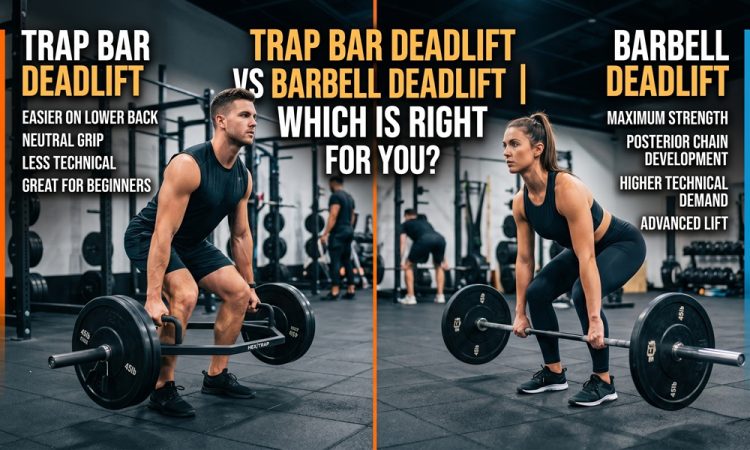
The barbell (conventional) deadlift is more hip-dominant. It loads the hamstrings, glutes, and spinal erectors harder and is the standard in powerlifting.
The trap bar (hex bar) deadlift keeps the load closer to your body. It shifts more work to the quads, lets most people lift heavier, produces more power, and puts less shear stress on the lower back.
In one line: Choose the barbell deadlift to build the posterior chain or compete in powerlifting. Choose the trap bar for athletic power, easier technique, and a back-friendlier pull. Many lifters benefit from using both.
What Most Guides Get Wrong (Fresh Insights First)
Before the basics, here are a few points that most top-ranking articles skip or oversimplify:
- “Upright torso means less back work” is only half true. The trap bar’s real back advantage is reduced shear force on the spine, not necessarily lower back-muscle activity. EMG research on the spinal erectors is actually mixed — some studies show similar erector spinae activation between the two lifts, and at least one found the hex bar working the lower back as hard or harder. So the trap bar is gentler on your spine in terms of load position, not because your back “switches off.”
- It’s a trade, not a free pass. Moving the weight closer to your hips lowers shearing force but tends to increase compressive force. The spine handles compression far better than shear, which is why back-pain lifters often tolerate the trap bar better.
- The trap bar is still a hinge, not a squat. Joint-torque data shows a hip-to-knee moment ratio of roughly 3.68:1 for the barbell deadlift versus about 1.78:1 for the trap bar. The trap bar leans more toward the knees, but the hips still do most of the work.
- Strength is specific. A recent eight-week randomised trial found each group improved most in the exact movement they trained. Translation: a trap bar mostly builds trap-bar strength, and a barbell mostly builds barbell strength. Train the version that matches your goal.
Keep these in mind as you read — they change how you should program both lifts.
What Is a Barbell (Conventional) Deadlift?
The conventional deadlift uses a straight Olympic barbell loaded on the floor in front of your shins.
You stand behind it, hinge at the hips, grip outside your knees, and pull the bar up your legs to a standing lockout.
Because the bar sits in front of your body, your torso angles forward and your hips, hamstrings, and lower back work hard to control the load. It’s the gold standard in powerlifting and a benchmark of raw strength.
What Is a Trap Bar (Hex Bar) Deadlift?
The trap bar deadlift uses a hexagonal bar that you stand inside. You grip handles on either side of your body using a neutral grip (palms facing each other).
Because you’re centred in the bar, the load lines up with your body instead of in front of it. That lets your torso stay more upright and the bar travel in a straighter vertical line.
Most trap bars also have high and low handles, giving you two range-of-motion options from a single piece of equipment.
Trap Bar vs Barbell Deadlift: Key Differences at a Glance
| Feature | Barbell Deadlift | Trap Bar Deadlift |
|---|---|---|
| Bar position | In front of body | Centred around body |
| Grip | Pronated / mixed / hook | Neutral (palms in) |
| Torso angle | More forward lean | More upright |
| Primary emphasis | Hamstrings, glutes, erectors | Quads + posterior chain |
| Range of motion | Longer (fixed) | Adjustable (high/low handles) |
| Load you can lift | Less | ~5–10% more for most lifters |
| Power / bar speed | Lower | Higher |
| Lower-back shear force | Higher | Lower |
| Technical difficulty | Higher | Lower (easier to learn) |
| Powerlifting legal | Yes | No |
| Best for | Posterior chain, competition | Athletes, beginners, back-sensitive |
Muscles Worked: Where the Load Actually Goes
Both lifts are full-body pulls. They hit the legs, hips, back, core, and grip. The difference is emphasis.
Barbell deadlift muscles
- Hamstrings (biceps femoris): worked harder than the trap bar, especially through the pull.
- Glutes: heavily involved at lockout.
- Spinal erectors (lower back): strongly engaged to resist the forward lean.
- Lats, traps, forearms, core: all working to hold position and grip.
Trap bar deadlift muscles
- Quadriceps (vastus lateralis): noticeably higher activation than the barbell version, thanks to more knee bend and a more upright torso.
- Glutes and hamstrings: still involved — this is a real hip hinge, not a leg press.
- Erectors and core: engaged, though research disagrees on whether it’s more or less than the barbell.
EMG comparison (what muscle-activity studies show)
| Muscle | Barbell Deadlift | Trap Bar Deadlift |
|---|---|---|
| Quadriceps (vastus lateralis) | Lower | Higher |
| Hamstrings (biceps femoris) | Higher | Lower |
| Spinal erectors | Mixed findings | Mixed findings |
| Glutes | Similar | Similar |
The honest takeaway: the barbell wins for hamstrings, the trap bar wins for quads, and the lower back is too close to call across studies.
Biomechanics: Why the Two Feel So Different
The whole story comes down to where the weight sits relative to your hips.
In a barbell deadlift, the bar is in front of you. That creates a longer moment arm — the distance between your hips and the line of the load. A longer moment arm means more torque demand on your hips and more shear force on your spine.
In a trap bar deadlift, you’re standing inside the load, so it sits much closer to your centre of mass. Shorter moment arm, less shearing force, more upright posture.
This also explains the range-of-motion difference. The trap bar lets you set up with more knee bend and a taller chest, and the high handles shorten the pull even further.
Hinge vs squat continuum: Movements aren’t strictly “squat” or “deadlift.” The trap bar sits a little further toward the squat side, but with a hip-to-knee torque ratio near 1.78:1, it’s clearly still a hip hinge.
Is the Trap Bar Really Easier on Your Back?
For most people, yes — but for the right reason.
Standing inside the bar puts the load closer to your hips (your axis of rotation), which reduces shear stress on the lumbar spine. Since you don’t have to drag the bar up your thighs to lock out, there’s also less temptation to hyperextend the lower back at the top.
The catch is that the trap bar trades some of that shear for compression, and your spine tolerates compression much better than shear. That’s exactly why coaches so often steer lifters returning from back pain toward the trap bar first.
It is not magic, though. A heavy trap bar deadlift still loads the spine hard. Good bracing and a neutral spine matter just as much here.
Strength and Power: Who Wins the Numbers Game?
If you care about lifting the biggest possible number or moving the bar fastest, the trap bar usually comes out ahead.
Research comparing the two lifts in trained lifters consistently finds that with the trap bar, people:
- Lift a heavier 1-rep max — often around 5–10% more.
- Reach higher peak power at every tested load.
- Produce greater force and bar velocity.
In one well-known study, experienced lifters pulled roughly 11 kg (about 6%) more with the trap bar and accelerated the weight faster.
Why? The shorter moment arm and more vertical bar path make the trap bar simply more efficient to lift. That’s a feature if you want to overload the legs and train explosive strength — and a quirk to remember if you’re comparing your “deadlift number” between bars.
Carryover: Does One Build the Other?
This is where the “strength is specific” point matters most.
A recent randomised training trial pitted trap bar deadlifts against a barbell lower-body lift over eight weeks. Each group made its biggest gains in the specific movement it trained, with comparable changes in lean mass.
What that means for you:
- If your goal is a bigger conventional deadlift (or you compete in powerlifting), the barbell has to be your main lift. The trap bar is a helpful accessory at best.
- If your goal is athletic power, leg strength, or general fitness, the trap bar carries over well and is easier to recover from.
There is real carryover between the two — they’re closely related patterns — but don’t expect a trap bar PR to automatically transfer pound-for-pound to the barbell.
Pros and Cons
Barbell Deadlift
Pros
- Builds the posterior chain (hamstrings, glutes, erectors) hard
- The competition standard for powerlifting
- Teaches bracing, tension, and full-body hip hinging
- No special equipment beyond a bar and plates
Cons
- Higher shear force on the lower back
- Steeper learning curve and form demands
- Tougher for tall or long-limbed lifters and those with limited hip/hamstring mobility
- Grip and lower back often fail before the legs do
Trap Bar Deadlift
Pros
- Lift heavier with more power and speed
- Lower shear stress on the spine; neutral grip is shoulder-friendly
- Easier to learn and keep good form under fatigue
- Adjustable range of motion via high/low handles
- A natural movement that mimics lifting real-world loads at your sides
Cons
- Less posterior-chain emphasis than the barbell
- Not allowed in powerlifting meets
- Requires access to a trap/hex bar
- Lockout can feel less stable since the load floats at your sides rather than resting on your thighs
Which Deadlift Is Right for You?
Use this quick guide to match the lift to the lifter.
| Your Goal or Situation | Better Choice |
|---|---|
| Compete in powerlifting | Barbell |
| Maximise hamstrings & glutes | Barbell |
| Build athletic / explosive power | Trap bar |
| You’re a beginner | Trap bar |
| History of lower-back pain | Trap bar (start light) |
| Tall or long-legged | Trap bar |
| Limited hip / hamstring mobility | Trap bar |
| Quad development | Trap bar |
| Minimal equipment / no hex bar | Barbell |
| General strength & fitness | Either (or both) |
Trap bar: high handles vs low handles
- High handles: shorter range of motion, lets you lift heavier, friendlier for taller lifters or anyone with mobility limits.
- Low handles: deeper range of motion, closer to a true full deadlift, more challenging out of the bottom.
How to Program Both (You Don’t Have to Choose)
These lifts complement each other. A simple approach:
- Powerlifters / strength athletes: keep the barbell deadlift as your main pull. Add trap bar deadlifts as a power or accessory day to overload the legs without thrashing your lower back.
- Athletes / general lifters: make the trap bar your primary heavy pull for power and joint health. Rotate in conventional deadlifts to keep posterior-chain strength.
- Back-sensitive lifters: lead with the trap bar (high handles if needed), and reintroduce the barbell gradually once you’re confident and pain-free.
You can also alternate them by training block for variety and to dodge plateaus.
Common Mistakes to Avoid
Barbell deadlift
- Rounding the lower back under load
- Letting the bar drift away from your shins
- Yanking the slack instead of building tension first
- Hyperextending or leaning back at lockout
Trap bar deadlift
- Turning it into a squat by letting the knees shoot forward and the chest stay vertical (keep the hip hinge)
- “Diving” your arms down at the start and losing back tension
- Slamming the weight down and losing position on the descent
- Always using high handles by default — vary your range of motion
What Real Lifters and Coaches Say
Beyond the lab, the gym-floor consensus adds useful nuance.
- Strength coaches who work with back-pain athletes frequently report that simply moving the load closer to the hips dramatically improves comfort during heavy pulls — and that lifters who rush straight back to conventional pulling after a back tweak often see symptoms return.
- On lifting forums, the recurring debate is about carryover. The traditionalist camp argues that if your goal is a bigger competition deadlift, the trap bar is mostly a detour — useful for variety, not as a replacement. One classic critique even flags the floating lockout as a stability concern.
- The other camp, including coaches who once called themselves “barbell purists,” now argue the trap bar is the better default for most non-competitive lifters because it delivers similar benefits with less risk and an easier learning curve.
- A popular functional argument: in real life you carry heavy loads at your sides (groceries, luggage, kids), not out in front of your thighs — which is exactly how the trap bar loads you.
The pattern across experienced voices is consistent with the research: it’s not “which is better,” it’s “better for what.”
Frequently Asked Questions
Is the trap bar deadlift better than the barbell deadlift?
Neither is universally better. The trap bar is better for power, ease, and back comfort. The barbell is better for posterior-chain strength and powerlifting. The “best” one depends entirely on your goal.
Why can I lift more with a trap bar?
The load sits closer to your hips, creating a shorter moment arm and a more vertical bar path. That makes the lift mechanically more efficient, so most people manage roughly 5–10% more weight.
Does the trap bar deadlift work the same muscles?
Mostly the same muscles, but with different emphasis. The trap bar shifts more work to the quads, while the barbell hits the hamstrings harder. Both work the glutes, back, and core.
Is the trap bar deadlift easier on the lower back?
Generally yes. It reduces shearing force on the lumbar spine by keeping the load close to your hips. It still loads the spine through compression, though, so form and bracing remain essential.
Can the trap bar deadlift replace the conventional deadlift?
For athletic and general-fitness goals, often yes. For powerlifting or maximising your conventional deadlift number, no — strength is specific, so you need to train the barbell.
Is the trap bar deadlift just a squat?
No. It’s slightly “squattier” than a conventional deadlift, but joint-torque data shows the hips still drive the movement. It remains a hip-hinge pattern, not a squat.
Which is better for beginners?
The trap bar. The neutral grip, more upright posture, and forgiving setup make it easier to learn and to keep safe form while you build a base.
Should I do both?
For most lifters, yes. They complement each other well. Use one as your main lift based on your goal and the other as an accessory or variation.