What Is a Torn Bicep?
The biceps muscle runs along the front of your upper arm and is anchored to bone at both ends by tendons. When one of these tendons tears — partially or completely — the result is a torn bicep. This injury can occur near the shoulder (proximal) or near the elbow (distal), and each location carries its own implications for treatment and healing time.
Understanding a torn bicep injury requires knowing how the muscle connects. The biceps attaches to the shoulder via two tendons — the long head and the short head — and to the forearm bone (radius) at the elbow via a single distal tendon. The distal bicep tendon is particularly vulnerable because it bears a significant mechanical load during lifting and rotation activities. When this tendon tears, the muscle is separated from the bone, resulting in immediate weakness and, in complete tears, a visible “Popeye” bulge in the upper arm where the muscle retracts upward.
Torn bicep injuries affect approximately 3 to 5 people per 100,000 each year at the elbow level alone, and are far more common in men over 30, particularly those involved in heavy lifting or overhead sports. Knowing how long recovery takes — and what to do at each stage — is critical for a full return to function.
Types of Torn Bicep Injuries
Not all bicep tears are the same. The severity and location of the tear directly determine how long your recovery will take.
| Type | Location | Severity | Surgery Typically Required? |
|---|---|---|---|
| Proximal Long Head Tear | Near shoulder | Partial or complete | Rarely |
| Proximal Short Head Tear | Near shoulder | Usually partial | Rarely |
| Distal Bicep Tear | Near elbow | Often complete | Frequently |
| Grade 1 Strain | Muscle/tendon | Minor overstretching | No |
| Grade 2 Strain | Muscle/tendon | Moderate tear | Sometimes |
| Grade 3 Rupture | Muscle/tendon | Complete rupture | Usually Yes |
Proximal tears near the shoulder — particularly of the long head tendon — are the most common type and often heal well without surgery, since the short head tendon can compensate. Distal bicep tears near the elbow, however, are considered more serious because once the tendon tears from the bone, it will not reattach on its own and typically requires surgical intervention to restore full strength.
Symptoms of a Torn Bicep
Recognizing a torn bicep early is essential for getting timely treatment. Symptoms can appear suddenly after an acute injury or develop more gradually due to overuse.
Common signs include:
- A sudden, sharp pain in the upper arm or at the elbow
- An audible “pop” or snapping sensation at the time of injury
- Visible bruising and swelling, which can extend from the upper arm down to the elbow
- A noticeable bulge or deformity in the upper arm (the “Popeye” deformity), caused by the retracted muscle
- Weakness when bending the elbow or rotating the forearm palm-upward (supination)
- Deep aching or cramping in the bicep muscle after the initial sharp pain subsides
- Limited range of motion and difficulty fully straightening or bending the elbow
The “Popeye” sign — where the bicep appears to ball up high on the arm — is a classic indicator of a complete distal bicep rupture. If you notice this deformity alongside sudden pain, seek medical evaluation promptly.
Torn Bicep Recovery Time: A Complete Overview
Recovery time varies significantly based on whether the injury is treated surgically or conservatively, the tear’s location and severity, and how diligently rehabilitation is followed.
Non-Surgical (Conservative) Recovery Timeline
For partial tears, especially those near the shoulder, conservative management is often the first approach. This involves rest, ice, anti-inflammatory medications, and structured physical therapy.
Most people with bicep tendon injuries who receive appropriate treatment will begin to see improvement in two to three months. However, the tendon continues healing for several weeks even after pain subsides, so it is important not to rush back to full activity.
| Week/Month | What to Expect |
|---|---|
| Weeks 1–2 | Rest, ice, elevation; significant pain and swelling |
| Weeks 2–6 | Swelling subsides; gentle range-of-motion exercises begin |
| Months 2–3 | Pain reduces noticeably; light strengthening starts |
| Months 3–6 | Gradual return to daily activities; strength improves |
| Month 6+ | Most patients reach near-full function |
One important caveat: people who opt for a conservative approach to biceps tendon rupture need to be informed about the outcomes. These include an up to 50 percent loss of sustained supination strength, an up to 40 percent loss of supination strength in general, an up to 30 percent loss of flexion strength, and an approximately 15 percent loss of grip strength. This trade-off is often acceptable for older or less active individuals, but athletes and manual laborers are generally advised to consider surgery.
Surgical Recovery Timeline
Surgery is the standard recommendation for complete distal bicep tears and for proximal tears in patients who require full arm function. The procedure reattaches the torn tendon back to the bone using surgical anchors or screws.
It’s best to repair a torn bicep tendon within the first 2–3 weeks after the injury. After that, the tendon and muscle start to shorten and form scar tissue, which makes it harder to regain normal arm function.
The post-surgical recovery progresses through clearly defined stages:
| Phase | Timeframe | Key Activity |
|---|---|---|
| Immobilization | Weeks 1–4 | Sling or brace worn; arm protected |
| Passive Range of Motion | Weeks 1–2 | Gentle exercises to prevent stiffness |
| Active Range of Motion | Around Week 4 | Gentle active movement with therapist |
| Early Strengthening | Weeks 6–8 | Light strengthening exercises begin |
| Advanced Strengthening | Around Week 10 | Progressive resistance training |
| Return to Sports/Labor | Months 4–6 | Guided by surgeon’s assessment |
| Full Recovery | Months 6–12 | Complete strength restoration |
Full recovery may take up to a year, though most people regain functional range of motion and strength by four to six months after surgery.
For the distal bicep specifically, patients usually get full motion back in 4–6 weeks, and full recovery can occur within 6 months.
Factors That Affect Torn Bicep Recovery Time
No two recoveries are identical. Several key variables can accelerate or delay healing.
1. Severity of the Tear
A Grade 1 strain or partial tear heals considerably faster than a complete rupture. If your injury is relatively mild, such as a partially torn biceps tendon, recovery can take several weeks to a few months. A complete tear of the biceps tendon is a lot more serious and usually requires surgical intervention to reattach the tendon to the bone.
2. Location of the Tear
Proximal (shoulder) tears often respond well to conservative care, while distal (elbow) tears almost always require surgery for full functional recovery. Once torn off, the biceps tendon at the elbow will not grow back to the bone and heal.
3. Age and Overall Health
As people age, tendons naturally become thinner and less elastic, making them more prone to tearing and slower to heal. Patients with conditions like diabetes or vascular disease may also experience longer healing times.
4. Timing of Surgery
Delaying surgery beyond the 2–3 week window after injury can significantly complicate the repair. Ideally, surgery to repair a torn bicep tendon should be done within 3 weeks. Waiting allows the tendon to retract and develop scar tissue, making reattachment more technically difficult.
5. Adherence to Rehabilitation
Consistent, structured physical therapy is perhaps the single most important factor in recovery quality and speed. Patients who skip sessions or return to heavy activity too early face a markedly higher risk of re-rupture and prolonged disability.
6. Type of Surgery (Open vs. Arthroscopic)
Studies show that people who have open biceps tenodesis may return to sports more quickly than people who have arthroscopic biceps tenodesis. You might have less pain and shorter recovery time if you have arthroscopic surgery instead of open surgery.
Rehabilitation: The Heart of Recovery
Rehabilitation is not optional — it is the mechanism through which healing translates into restored function. A well-structured rehab program addresses range of motion, strength, flexibility, and neuromuscular coordination.
Phase 1: Protection and Rest (Weeks 1–4)
The priority in this phase is protecting the surgical repair. Your shoulder will also be in a sling for about 4 weeks. For 4 weeks, avoid lifting anything with your arm. Gentle pendulum exercises and passive range-of-motion movements can begin early to prevent joint stiffness.
Phase 2: Restoring Range of Motion (Weeks 4–8)
Once the sling comes off, the focus shifts to regaining full elbow and shoulder movement. Physical therapists use manual techniques and guided exercises to loosen the joint without stressing the healing tendon. Rehabilitation programs for distal biceps tendon rupture surgery may last up to three or four months. While your biceps tendon is healing from surgery, your therapist may show you gripping and squeezing exercises for the hand and range of motion exercises for the wrist.
Phase 3: Strengthening (Weeks 8–16)
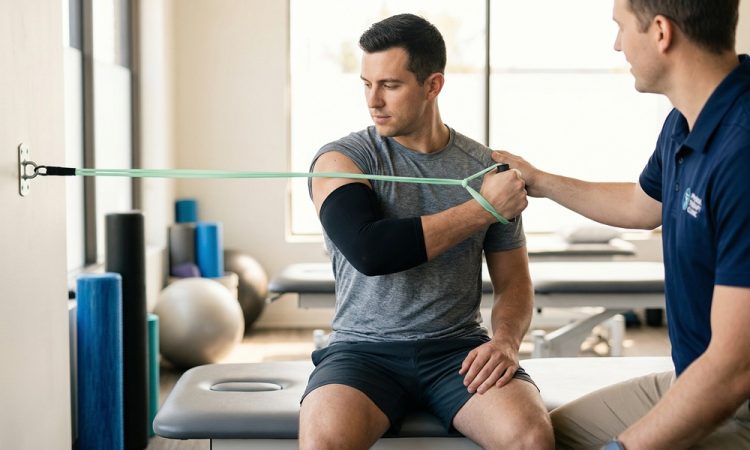
Light resistance work — including bicep curls with bands or light weights — is gradually introduced. The goal is to rebuild muscular endurance before progressing to heavier loads.
Phase 4: Return to Activity (Months 4–6+)
Sport-specific or job-specific movements are reintroduced carefully. About six months after surgery, therapists can help you assess your ability to participate in more strenuous exercise and a return to sports.
At-Home Care Tips to Support Recovery
Effective recovery doesn’t happen only in the clinic. Daily self-care plays a crucial role in healing speed and tissue quality.
- Ice the injury for 10 to 20 minutes every 1 to 2 hours during the first 3 days to reduce swelling. Always place a thin cloth between the ice pack and your skin.
- Elevate the arm above heart level when resting or lying down to minimize swelling.
- Use NSAIDs such as ibuprofen or naproxen as directed by your doctor to manage pain and inflammation — but avoid long-term reliance.
- Eat a healing diet rich in protein, vitamin C, and zinc to support tendon tissue repair. Collagen-rich foods and adequate hydration also aid recovery.
- Avoid smoking, as it significantly impairs blood flow to healing tissues and can delay tendon repair.
- Sleep in a supported position, such as in a reclining chair or with a pillow propped under the elbow, to reduce overnight discomfort.
- Follow all wound care instructions after surgery — clean the incision daily with warm water and pat dry. Do not use hydrogen peroxide or alcohol, as these can slow healing.
Possible Complications to Watch For
While most torn bicep recoveries proceed without major issues, complications can occur and should be identified early.
Other potential complications include infection at the surgical site, stiffness in the elbow or shoulder, decreased strength, and complex regional pain syndrome. In rare cases — about 1–2% of cases — the repaired tendon may re-tear, even after it fully heals. This is more common in patients who return to heavy lifting too quickly or don’t complete their rehabilitation program.
Warning signs that require immediate medical attention:
- Increasing pain that does not respond to pain medication
- Redness, warmth, or pus at the incision site (signs of infection)
- Hand or fingers becoming pale, cool, or numb (possible nerve or vascular issue)
- Sudden sharp pain in the healing arm after returning to activity (possible re-rupture)
- Signs of deep vein thrombosis such as calf pain, swelling, or leg redness
Additionally, a cosmetic concern known as “Popeye syndrome” — an abnormal bulge in the upper arm — can develop, particularly following biceps tenotomy procedures. While it is largely aesthetic, it may also indicate muscle retraction that could affect long-term strength.
Return to Work: What the Timeline Looks Like
Getting back to work depends heavily on the physical demands of your job.
| Occupation Type | Estimated Return to Work |
|---|---|
| Desk/office work | 1 to 2 weeks post-surgery |
| Light physical work | 4 to 6 weeks post-surgery |
| Moderate physical labor | 3 to 4 months post-surgery |
| Heavy labor / overhead lifting | 4 to 6 months post-surgery |
| Competitive athletics | 6 to 9+ months post-surgery |
Return to heavy labor and heavy lifting usually takes two to four months. A return to full, unrestricted function can take from six to nine months.
When to See a Doctor
A torn bicep is not a life-threatening injury, but prompt medical evaluation is important. Delaying diagnosis — especially for a complete distal tear — can complicate surgical repair and reduce the likelihood of a full recovery. You should seek medical attention if:
- You felt or heard a pop in your arm during exertion
- You notice sudden bruising, swelling, or deformity in the upper arm
- You experience significant weakness when bending or rotating the arm
- Pain does not improve with rest and ice after 48 hours
- You suspect you may have injured yourself during heavy lifting or a fall
Early imaging — including MRI or ultrasound — allows physicians to confirm whether the tear is partial or complete, and to plan the most appropriate treatment path.
Key Takeaways
Recovery from a torn bicep is a gradual, staged process that demands patience and consistency. Rushing any phase — whether immobilization, physical therapy, or return to activity — significantly increases the risk of re-injury and prolonged disability.
- Partial tears treated conservatively may heal in 6–10 weeks, with full strength returning around 3–6 months.
- Complete tears requiring surgery carry a recovery window of 4–12 months depending on the location, surgical method, and rehabilitation quality.
- The 2–3 week surgical window after injury is clinically significant — acting early gives the best chance at full tendon reattachment.
- Physical therapy is non-negotiable and is the most reliable predictor of long-term functional outcome.
- Nutrition, rest, and wound care at home directly support tissue healing and should not be underestimated.
Always work closely with an orthopedic specialist or sports medicine physician to design a recovery plan tailored to your injury severity, age, activity level, and health status. The goal is not just pain relief — it is the full restoration of arm strength, rotation, and confidence to return to the activities you value.