Finger injuries happen in the blink of an eye — a missed catch, a slammed drawer, a bad fall. One moment everything is fine, and the next, your finger is throbbing and you are left wondering: Is this broken or just sprained?
It is a surprisingly difficult question to answer on your own. Both injuries share overlapping symptoms — pain, swelling, and stiffness — making self-diagnosis tricky. However, knowing the difference matters. A sprained finger treated like a minor inconvenience is fine. A broken finger ignored like a minor inconvenience can lead to permanent deformity, post-traumatic arthritis, or lasting loss of mobility.
This guide walks you through every key sign, comparison, and decision point so you can respond the right way when it counts.
What Actually Happens in Each Injury?
Before diving into symptoms, it helps to understand what is physically happening inside your finger.
Sprained Finger
A sprain is an injury to the ligaments — the tough, fibrous bands that connect bones to one another at the joints. A sprained finger occurs when the ligaments that connect and support the finger’s joints become damaged, often caused by hyperextension when the finger is bent backward or jammed from hitting something.
There are three grades of sprain based on severity:
| Grade | What Happens | Symptoms |
|---|---|---|
| Grade 1 | Ligaments are stretched but not torn | Mild pain, minor swelling |
| Grade 2 | Ligament is partially torn; joint may be damaged | Moderate pain, significant swelling, limited motion |
| Grade 3 | Ligament is completely torn or ruptured | Severe pain, instability, possible dislocation |
Broken (Fractured) Finger
A fracture means one or more of the bones in the finger has cracked or broken. The hand contains 27 bones in total, and a finger fracture can occur in any of these bones — it can result from direct trauma, twisting or bending in an unnatural way, falls, or any serious amount of force applied to the finger.
Fractures are further classified as:
- Stable fracture — the broken bone pieces remain aligned
- Unstable fracture — the broken pieces have shifted out of alignment and need resetting
Broken vs. Sprained Finger: Symptom-by-Symptom Comparison
This is the most practical part of the guide. Here is a side-by-side breakdown of how both injuries typically present:
| Symptom | Sprained Finger | Broken Finger |
|---|---|---|
| Pain level | Moderate, manageable | Severe, sharp, often intense |
| Swelling | Diffuse, spreads around the joint | Rapid, concentrated directly over the bone |
| Bruising | Light discoloration around joint | Dark, concentrated bruising |
| Visible deformity | Rarely | Common — finger may look bent or crooked |
| Mobility | Limited but usually present | Often impossible to move |
| Numbness/tingling | Rare | More common (nerve irritation) |
| Grinding sensation | No | Possible when attempting movement |
| Audible crack at injury | Sometimes a pop | More likely a distinct crack |
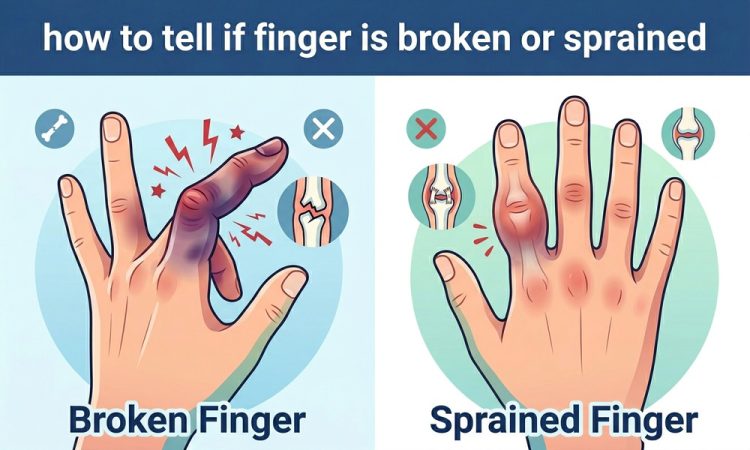
A fracture usually causes rapid swelling that develops directly over the broken bone, while a sprain causes softer, more diffuse swelling that spreads around the joint. The bruising pattern also differs — a fracture results in dark, concentrated spots, while a sprain shows lighter discoloration across the finger joint.
Key Warning Signs That Point to a Break
While both injuries can look similar, certain red flags strongly suggest a fracture rather than a sprain.
1. Visible Deformity or Misalignment
Symptoms that are unique to a broken finger include the finger being disfigured, bent in a strange position, or misaligned. If your finger looks like it is pointing in an unnatural direction or has a visible bump along the bone, treat it as a fracture until proven otherwise.
2. Inability to Move the Finger
Mobility is a key distinguishing factor — a broken finger typically cannot be moved, while a sprained finger usually still can. That said, this is not a perfect test. Some fractures retain limited mobility early on, especially hairline fractures.
3. A Grinding or Crunching Sensation
A grinding sensation when trying to move the finger straight or up and down is a common symptom of a broken finger. This is caused by broken bone fragments rubbing against each other — a sprain does not produce this sensation.
4. Hearing a Crack at the Time of Injury
It is also possible to hear one’s own bones cracking when there is severe trauma. If you think you heard a crack, it was not your imagination — get to an orthopedic doctor as soon as possible.
5. Numbness or Tingling
Numbness or tingling rarely occurs in a sprain but is more common in a fracture due to nerve irritation. If your finger feels numb or has a pins-and-needles sensation, a bone injury is more likely.
6. Throbbing at Rest
Throbbing, especially when you let your finger rest or hang at your side, is a notable symptom to watch for. Sprains tend to hurt more with movement; fractures can ache even when completely still.
The At-Home “Mobility Test” — Use It Carefully
You may be tempted to try bending your finger to test whether it is broken. With certain fractures, you can have a range of motion with subtle pain — but as inflammation begins to spread, your mobility will decrease.
This is why mobility alone is not a reliable test in the first hour or two after injury. A hairline fracture may still allow some movement early on. The safer approach: if in doubt, immobilize and seek imaging.
Important: Do not force the finger to straighten or bend if there is visible deformity. You could worsen the injury.
Causes: What Leads to Each Injury?
Understanding how the injury happened can also help point you in the right direction.
Common Causes of a Sprained Finger
- Jamming the finger against a hard surface (a ball, a wall, a countertop)
- Hyperextension — bending the finger backward beyond its normal range
- Falls where the hand takes the impact
- Sports like basketball, volleyball, and football
Common Causes of a Broken Finger
- A direct, forceful blow from a heavy or fast-moving object
- Slamming the finger in a door or drawer
- Contact sports with hard collisions (football, rugby, hockey)
- Falls onto an outstretched hand
- Accidents involving tools (hammers, machinery)
Risk factors that increase the chances of a broken finger include participating in contact sports and age — elderly individuals are at greater risk due to weakened bones from age-related osteoporosis and poor balance.
When to See a Doctor Immediately
Some situations require professional evaluation without delay. Do not wait and watch if you experience any of the following:
- Visible deformity — finger appears bent, crooked, or out of place
- Open wound — bone is piercing or near the skin surface
- Numbness or loss of sensation persisting beyond a few minutes
- No improvement in a sprain within 2–3 days using home care
- Severe, unmanageable pain that does not respond to over-the-counter pain relief
- Signs of infection — increasing redness, warmth, or fever (especially with an open wound)
If a broken finger is left untreated, the bone may heal with a malunion — meaning the finger heals in a deformed position. Besides affecting appearance, it may also result in post-traumatic arthritis, causing years of suffering later on.
How Doctors Diagnose the Injury
Physical Examination
A doctor typically starts by examining the injured finger for visible signs of damage, checking for swelling, bruising, tenderness, and range of motion. The examination often involves gently pressing on the injured area to pinpoint pain and detect abnormalities.
For suspected ligament injuries, doctors test for joint stability, grip strength, and sensation, as X-rays do not show soft tissue like tendons and ligaments.
Imaging Tests
X-rays are the most common tool for detecting fractures — they provide a clear image of the bone and help identify breaks, misalignments, or joint damage.
In some cases, an MRI may be ordered if the clinical picture suggests significant ligament or tendon damage that X-rays cannot capture.
| Diagnostic Tool | What It Detects | When It Is Used |
|---|---|---|
| X-ray | Bone fractures, misalignment | First-line for suspected breaks |
| MRI | Ligament, tendon, cartilage damage | Complex sprains, Grade 3 injuries |
| CT Scan | Complex fracture patterns | Severe or multi-fragment fractures |
Treatment Options
Treating a Sprained Finger
For mild to moderate sprains, the RICE method is the standard starting point:
- R — Rest: Limit use of the injured finger; avoid activities that caused it
- I — Ice: Apply ice wrapped in a cloth for 15–20 minutes at a time, several times a day; never directly on skin
- C — Compression: Wrap the finger with an elastic bandage or buddy-tape it to the adjacent finger
- E — Elevation: Keep the hand raised above heart level to reduce swelling, especially in the first 48 hours
Most sprained fingers should not be splinted. The finger can be buddy-taped to the finger next to it to encourage movement and provide some protection. Only Grade 3 sprains may require splinting or surgery.
Over-the-counter ibuprofen is effective for both pain and inflammation. Most mild sprains resolve within 1–2 weeks.
Treating a Broken Finger
Treatment for a fracture depends on its type and severity:
- Stable, non-displaced fracture — a splint or buddy tape; typically worn for 3–6 weeks
- Displaced fracture — the bone must be manually realigned (reduced) before splinting
- Complex or open fracture — surgical intervention may be required, including pins, screws, or plates to hold bone in position
- Physical therapy — often recommended after immobilization to restore strength and range of motion
For a nondisplaced fracture, a provider may splint the injured finger or tape it to the neighboring finger. The splint keeps the finger straight and protects it while it heals — usually worn for several weeks — followed by guided movement to avoid stiffness.
Recovery Timeline: What to Expect
| Injury Type | Typical Recovery Time |
|---|---|
| Mild sprain (Grade 1) | 1–2 weeks |
| Moderate sprain (Grade 2) | 3–6 weeks |
| Severe sprain (Grade 3) | 6–12 weeks; possible surgery |
| Stable fracture | 4–6 weeks in splint + rehab |
| Displaced fracture | 6–8 weeks + possible surgery |
| Surgical fracture repair | 3–6 months for full recovery |
Note that even after the splint comes off, finger stiffness can persist. Following through with physical therapy and home exercises significantly speeds up the return to full function.
What Happens If You Ignore the Injury?
Both injuries, if left untreated, carry real long-term consequences:
- Ignored sprain: Permanent joint instability, recurring sprains, chronic stiffness, or early-onset arthritis in the affected joint
- Ignored fracture: Bone heals in a deformed position (malunion), lasting loss of grip strength, reduced range of motion, and post-traumatic arthritis
If a jammed or sprained finger is left untreated, it can cause a permanent deformity of the joint, damage to veins and capillaries, and permanent stiffness of the finger.
Quick Reference: Should You Go to the Doctor?
You can likely manage at home if:
- Pain is mild to moderate and improving
- Finger looks straight and normal
- You can bend and straighten it (with some discomfort)
- No numbness or tingling
- Swelling is mild and reducing with ice
See a doctor promptly if:
- Finger looks crooked, bent, or deformed
- You heard or felt a crack/crunch
- You cannot move the finger at all
- Numbness or tingling is present
- Swelling is severe or rapidly worsening
- Symptoms are not improving after 3–5 days of home care
Final Word
There is no substitute for a proper medical evaluation when it comes to finger injuries. While the comparison guide above gives you a strong starting point, finger fractures and strains can be difficult to distinguish from one another, as they often present in a similar way — and identifying which injury one has is important for getting proper treatment.
When in doubt, immobilize the finger, apply ice, and get an X-ray. The few minutes it takes to confirm the diagnosis can save months of complications down the road.