There is a moment in every dental appointment that decides the outcome, and it is not the drilling.
It is the two minutes where someone explains what they found, what the options are, what each one costs in money and tooth structure, and what happens if you do nothing.
If that conversation happens in a language you translate rather than think in, the quality of your care drops. Not because anyone did anything wrong. Because meaning leaked.
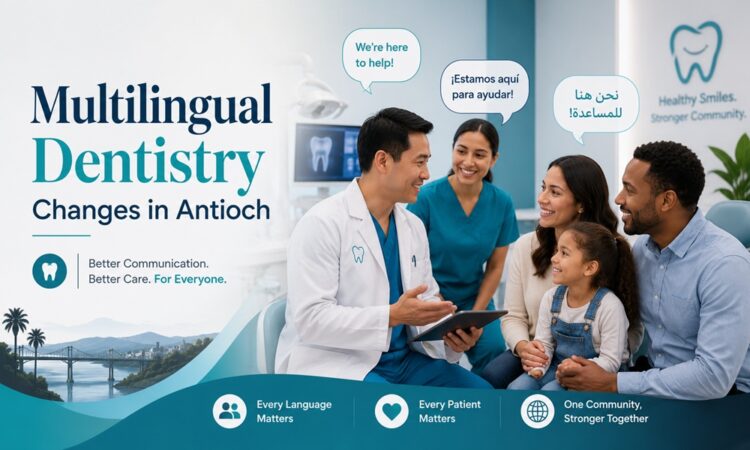
Quick answer: Language-concordant care means the clinician and the patient speak the same language directly, without an interpreter in between. A systematic review in the Journal of General Internal Medicine examined 33 studies and found 25 reported that language concordance improved quality of care. Roughly 25 million people in the United States have limited English proficiency. In a city as linguistically varied as Antioch, an office that offers care in several languages is delivering a clinical feature, not a courtesy.
Where the leak happens in a dental visit
Dentistry is unusually dependent on precise language, and unusually bad at noticing when it fails.
Consider what has to be transmitted accurately in a single visit:
- Medical history. Anticoagulants, bisphosphonates, diabetes control, prior radiation to the head or neck, and every medication that causes dry mouth. Get this wrong and the risk profile of a simple extraction changes completely.
- Allergy history. Latex, penicillin, articaine, chlorhexidine.
- Symptom description. “Sensitive to cold that stops immediately” and “sensitive to cold that lingers for a minute” point to two different diagnoses and two different treatments. That distinction dies in translation constantly.
- Informed consent. Risks, alternatives, and the option of no treatment.
- Post-operative instructions. When to resume rinsing, what a dry socket feels like, when to call.
- Prevention coaching. Technique, interdental cleaning, dietary frequency.
Each one of these is a failure point. A retrospective review of patients undergoing procedures at a hospital with interpreter services found English-speaking patients were nearly twice as likely to have complete informed consent documentation compared to patients with limited English proficiency. Fewer than half of the limited-English-proficiency patients had a consent form in their primary language or an English form signed by an interpreter.
That is not a dental-specific finding, but the mechanism transfers exactly.
What does the evidence actually show?
The research on language concordance is genuinely mixed in places, and worth reporting honestly.
What is well supported:
- Language-concordant primary care is associated with better access to and use of primary care, better diabetes control, and higher likelihood that patients receive and agree with lifestyle counseling.
- Patients who received most of their care from physicians who spoke their primary language had better in-hospital outcomes.
- Trust scores measured on the Health Care Relationship scale are higher with language-concordant physicians than with professional or ad hoc interpreters.
- In diabetes care, patients who had 100% of primary care visits with language-concordant providers were the least likely to have diabetes-related emergency department visits in the following six months.
What is contested:
- Not every study finds an effect, and a few find worse outcomes on specific measures.
- Very few studies assess the actual fluency of the “language-concordant” provider. A clinician who took two years of a language in college and one who grew up speaking it are both counted the same way in most datasets. There is no standardized clinician language proficiency assessment in consistent use.
That second caveat matters for you as a patient. “We speak Spanish here” can mean anything from a fully bilingual dentist to a front desk staffer who can handle appointment times. It is a fair question to ask directly.
Antioch’s specific situation
Antioch sits in East Contra Costa County, at the far end of a long commute corridor, with a population that reflects the broader Bay Area’s linguistic range without the Bay Area’s density of specialty services.
That combination produces a specific problem: the population is diverse, and the number of clinicians who can serve that diversity directly is limited. Patients who cannot find language-concordant care nearby either travel, bring a family member to interpret, or delay.
The family-member workaround deserves its own warning. Using a relative as an ad hoc interpreter is common and understandable, and it introduces real problems:
- Children should never interpret medical information for parents. It is developmentally inappropriate and clinically unreliable.
- Relatives soften bad news. That is human, and it destroys informed consent.
- Relatives edit questions they find embarrassing. Sexual history, substance use, and financial constraint all get filtered.
- Relatives lack vocabulary. There is no reason a bilingual nephew would know the word for “periapical.”
What a multilingual practice actually looks like
Dental care in Antioch at Antioch Dental Care is a useful case study here. The practice, led by Dr. Yiannis Vlahos with Dr. Dia Basha and Dr. Elena Stan, has served the community since the 1970s, and lists services offered in English, Greek, Hindi, Vietnamese, and French.
Note what that list is not. It is not the standard two-language default. It reflects who actually lives in the area rather than who is easiest to serve.
The features to look for, in any practice:
| Feature | Why it matters |
|---|---|
| Clinician speaks the language, not just staff | The diagnostic conversation happens with the dentist |
| Written post-op instructions in your language | You will forget half of a verbal explanation |
| Consent forms translated | Consent that is not understood is not consent |
| Front desk can discuss cost in your language | Financial misunderstanding causes more abandoned treatment than clinical fear |
| Recall reminders in your language | Prevention only works if it repeats |
Comprehensive care and why it compounds the language question
Antioch Dental Care describes itself as offering a full scope of general dentistry for children, adults, and seniors: exams and cleanings, digital and panoramic radiographs, fluoride, sealants, oral cancer screening, composite fillings, crowns and bridges, veneers, whitening, scaling and root planing, extractions, dentures and partials, and implant-supported restorations including implant crowns, bridges, and dentures.
Breadth interacts with language in a way that is easy to miss.
If a single office handles your prevention, your restorative work, your periodontal therapy, and your implant restorations, you have one language relationship to establish. If those four things happen at four offices, you need four.
For a household where the grandparent speaks one language, the parents speak two, and the children speak English at school, a single multilingual practice is not a convenience. It is the only version of the arrangement that actually functions.
What prevention looks like when the coaching lands
The practice’s stated approach is prevention-first, with education delivered in plain language. This is where language concordance pays its clearest dividend, because prevention is entirely behavioral.
Nobody prevents a cavity in the chair. It gets prevented at home, twice a day, for years, based on instructions given once.
The instructions that need to survive translation:
- Brushing is about the gumline, not the tooth. Angle the bristles into the sulcus.
- Frequency of sugar exposure beats quantity. One dessert is safer than six sips of soda across an afternoon.
- Interdental cleaning is not optional. A toothbrush cannot reach the two surfaces where most adult decay starts.
- Bleeding gums are a sign of disease, not of brushing too hard. This one is misunderstood in every language.
- Fluoride is dose-dependent and topical. It works by sitting on the tooth, which is why you spit and do not rinse.
- Dry mouth is a medical emergency for teeth. Dozens of common prescriptions cause it.
Every one of those is a sentence. Every one of those is worthless if it arrives garbled.
Questions worth asking before you book
- Which languages does the dentist speak, as opposed to the office?
- Are written instructions and consent forms available in my language?
- Who explains the treatment plan and the cost, and in what language?
- If I need something you do not do, where do you refer, and do they have the same capability?
- Can my whole household be seen here, across ages?
- What happens if I have a problem after hours?
Frequently asked questions
Is a professional interpreter as good as a bilingual dentist? Professional interpretation is far better than nothing and far better than a family member. The evidence generally favors direct concordance over interpreted care on trust and some outcome measures, but a trained interpreter with a good clinician is a legitimate model. An untrained relative is not.
Does language really change dental outcomes, or just satisfaction? Both, based on current evidence, with the caveat that the dental-specific literature is thinner than the medical literature. The mechanisms, comprehension, adherence, and follow-through, are the same.
Should I ask about language before booking or when I arrive? Before. Discovering the mismatch in the chair means you have already taken the day off.
My English is fine, but not for medical vocabulary. Does that count? Yes. Conversational fluency and clinical fluency are different skills. Plenty of people who work entirely in English still want a diagnosis explained in the language they grew up in. That is a legitimate preference, not a weakness.
What if there is no practice in my language nearby? Then ask for professional interpretation, ask for written materials in your language, and bring a written list of questions. Do not bring a child.