Quick answer: Invisalign straightens teeth using a series of clear, removable plastic trays that you swap every one to two weeks. You wear each set 20–22 hours a day. It works best for mild-to-moderate crowding, gaps, and bite issues, usually takes 12–18 months, and costs roughly $3,000–$8,000 depending on your case. The result depends less on the aligners and more on how consistently you wear them.
A few things the brochures skip
The marketing shows perfect, invisible trays and a flawless smile. Here’s the fuller picture before you commit:
- Most people need attachments. Small tooth-colored bumps get bonded to your teeth so the trays have something to grip. They’re subtle, but they make Invisalign less “completely invisible” than ads suggest.
- You’ll probably snack and sip less. Because you must remove the trays to eat or drink anything but water — then brush before putting them back — you become very aware of grazing. Many people cut back without trying.
- Compliance, not the trays, sets your timeline. Aligners only move teeth while they’re in your mouth. Falling short of 20–22 hours a day is the most common reason treatment stalls.
- A lisp is normal at first. It usually fades within a few days as your tongue adjusts.
- All clear aligners shed trace microplastics during wear. It’s a newer area of research; one study found Invisalign released fewer than several competing brands. Worth knowing, not worth panicking over.
- “Mail-order” aligners skip the exam. The industry has shifted back toward doctor-supervised care, because a home kit can miss cavities, gum disease, or a complex bite.
- A cheap quote and a high quote aren’t the same product. Invisalign comes in tiers (Express, Lite, Full). A minor touch-up and full bite correction sit at very different prices.
Keep these in mind as you read on.
What Invisalign actually is
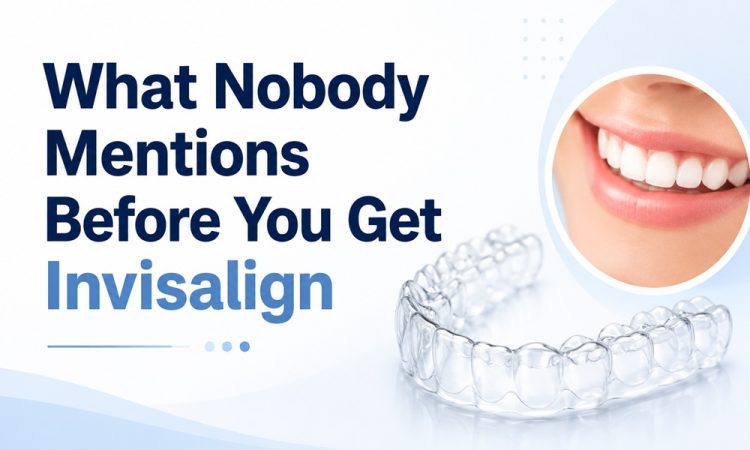
Invisalign is a brand of clear aligner — a custom-made, removable tray that fits snugly over your teeth and nudges them into place.
The trays are made from a patented material called SmartTrack. Its maker says this multi-layer plastic delivers gentler, more consistent force than older aligner material, which can mean more comfort and more predictable movement.
You don’t wear one tray the whole time. You move through a series, each slightly different from the last, swapping to the next set every week or two.
How Invisalign works, in plain terms
The science is simpler than it sounds.
Each tray applies gentle, constant pressure to specific teeth. That pressure signals the bone around the tooth to remodel — dissolving slightly on one side and rebuilding on the other — so the tooth can shift. Each aligner moves teeth only a fraction of a millimeter, which is why the process is gradual.
Here’s the typical journey:
- Consultation and scan. A 3D digital scanner captures your teeth (no goopy molds in most offices).
- Digital plan. Your provider maps every movement in software and can often show you a preview of the final result.
- Attachments, if needed. Small tooth-colored shapes are bonded on to give trays better grip for trickier movements.
- Wear and switch. You wear each set 20–22 hours daily, then move to the next.
- Check-ins. Periodic visits (or remote monitoring) confirm you’re on track.
- Refinements. Extra trays at the end to fine-tune are common — not a sign anything went wrong.
- Retainers. Once you’re done, retainers hold the result.
Some cases also need IPR (interproximal reduction) — lightly polishing tiny amounts of enamel between teeth to create room. Your provider will explain if that applies to you.
What Invisalign can — and can’t — fix
Invisalign handles a wide range of cases, but it isn’t right for every mouth.
Usually a good fit:
- Crowded teeth
- Gaps and spacing
- Mild-to-moderate overbite, underbite, or crossbite
- Minor relapse after childhood braces
Often harder — and sometimes better with braces:
- Severe rotations
- Large jaw or bite discrepancies
- Complex cases involving extractions
Attachments and modern techniques have widened what aligners can treat, but a complex case may still call for braces. An honest provider will tell you which camp you’re in rather than forcing aligners onto a case that needs more.
Invisalign vs. braces at a glance
| Factor | Invisalign | Traditional braces |
|---|---|---|
| Visibility | Nearly invisible (attachments are subtle) | Visible; ceramic is subtler |
| Removable? | Yes — but must wear 20–22 hrs/day | No, fixed on |
| Best for | Mild-to-moderate cases | Complex bite and alignment |
| Treatment time | 12–18 months typical | 18–24 months |
| Eating | Remove to eat; no food restrictions | Avoid hard/sticky foods |
| Discipline | High — easy to under-wear | Low — always working |
| Comfort | Smooth plastic; many report less irritation | Brackets/wires can rub |
The short version: aligners win on discretion and lifestyle; braces win on complex cases and require no willpower.
How much does Invisalign cost?
Nationally, Invisalign generally runs $3,000 to $8,000+, with an average around the low-to-mid five figures of hundreds — roughly $5,000. In Florida specifically, the all-in cost typically falls between $3,500 and $8,500, with a state average near $5,600.
Price depends heavily on the tier and your case:
| Treatment tier | Typical use | Rough cost |
|---|---|---|
| Express | Minor corrections, few trays | $1,800–$3,500 |
| Lite | Moderate cases | $3,500–$5,500 |
| Full / Comprehensive | Most teeth, complex bite | $5,000–$8,500 |
What usually drives the number: case complexity, how many aligners you need, treatment length, and the provider’s experience.
Ways to bring the cost down:
- Dental insurance with orthodontic benefits often covers a fixed amount (commonly $1,500–$3,000).
- HSA/FSA dollars can be used pre-tax.
- Monthly payment plans, sometimes with little or no down payment.
A few questions worth asking up front: Are retainers included? Are refinements included? What’s the fee for a lost or damaged tray? The answers change the real cost more than the headline price does.
How long does Invisalign take?
For most people, 12 to 18 months. Simple spacing fixes can finish faster; complex bites take longer.
Two things move the timeline most: the severity of your case and — again — how faithfully you hit that 20–22 hours a day.
Your first week with Invisalign
The first few days are the biggest adjustment. Here’s what’s normal:
- Tightness and mild soreness, strongest in the first 24–48 hours. It means the trays are working.
- A slight lisp that fades as your tongue adapts.
- Extra saliva for a day or two.
- Snug fit — tighter than people expect if they’re picturing a mouthguard.
Tips that genuinely help:
- Put each new set in at night so you sleep through the tightest hours.
- Stick to soft foods the first day or two — smoothies, eggs, soup, yogurt.
- Use chewies (small foam cylinders) to seat the trays fully.
- Practice reading aloud to clear the lisp faster.
- Keep ibuprofen or acetaminophen handy for the first days, if your provider approves.
- Don’t pop them out constantly — it prolongs soreness and slows progress.
By the end of week one, most people barely notice the trays.
Life with aligners, day to day
Once you settle in, the routine is simple but real:
- Wear them 20–22 hours; take them out only to eat, drink (anything but water), and clean your teeth.
- Brush before reinserting so you don’t trap food or sugar against your teeth.
- Clean the trays daily with lukewarm water and a soft brush — hot water can warp them.
- Carry a small kit (case, travel toothbrush) so you’re never stuck after a meal out.
- You can pop them out briefly for a wedding photo or a big presentation — just don’t make a habit of it.
After treatment: retainers matter
Finishing your last tray isn’t the finish line. Teeth drift back without retention — a process called relapse.
Expect to wear retainers, often full-time at first and then nights long-term. It’s the only reliable way to protect the result you paid for.
What real wearers say
For an unfiltered take, communities like Reddit’s r/Invisalign, Quora threads, and first-person Medium posts circle the same lessons:
- The 22-hour rule is the whole game. The most repeated regret is simple: “I wish I’d worn them more consistently.”
- Attachments surprise people. Several wearers note their aligners were less invisible than expected once the bumps went on — but say it stopped mattering quickly.
- The lisp is real but brief. Almost everyone reports it clears within days.
- Snacking drops off. Many mention eating less and drinking fewer sugary coffees simply because re-inserting trays is a hassle.
- The verdict skews positive. Once it’s done, satisfaction runs high — especially among adults who put it off for years.
Treat these as context, not medical advice. Your case is your own.
How to choose an Invisalign provider
The provider matters as much as the product. Look for:
- Real experience with aligners. Higher-volume Invisalign providers tend to handle tricky cases more smoothly.
- A thorough in-person exam, not just a quick scan.
- Honesty about candidacy — including telling you when braces would serve you better.
- Clear, all-in pricing with refinements and retainers spelled out.
If you’re in the Sarasota–Manatee area, choosing an experienced provider for Invisalign in Lakewood Ranch means a proper evaluation and a plan built around your bite — not a one-size-fits-all mail-order kit.
Frequently asked questions
Does Invisalign really work as well as braces? For mild-to-moderate cases, yes. Braces still have the edge for complex bites, severe rotations, and some extraction cases.
Is Invisalign painful? Expect mild pressure or soreness for a day or two with each new tray, especially the first. Most people describe it as a dull ache, not sharp pain.
Can people tell I’m wearing Invisalign? The trays are clear and hard to spot. The small attachments are more noticeable up close, but most people won’t realize you’re in treatment.
How much does Invisalign cost without insurance? Commonly $3,000–$8,000 depending on case complexity and tier. Payment plans, HSA/FSA, and partial insurance coverage can ease the cost.
What happens if I don’t wear my aligners enough? Treatment slows or stalls, and trays may stop fitting properly. Consistent 20–22 hour wear is essential.
Do I need a retainer after Invisalign? Yes. Without one, teeth gradually shift back. Retainers protect your results, usually nightly for the long term.
The bottom line
Invisalign is a discreet, flexible way to straighten teeth — but it rewards discipline. Know your case, ask what’s included in the price, and commit to the wear time, and the results can rival braces for the right kind of misalignment.
If you’re weighing your options, a consultation for Invisalign in Lakewood Ranch is a practical first step to learn whether clear aligners fit your smile, your timeline, and your budget.