

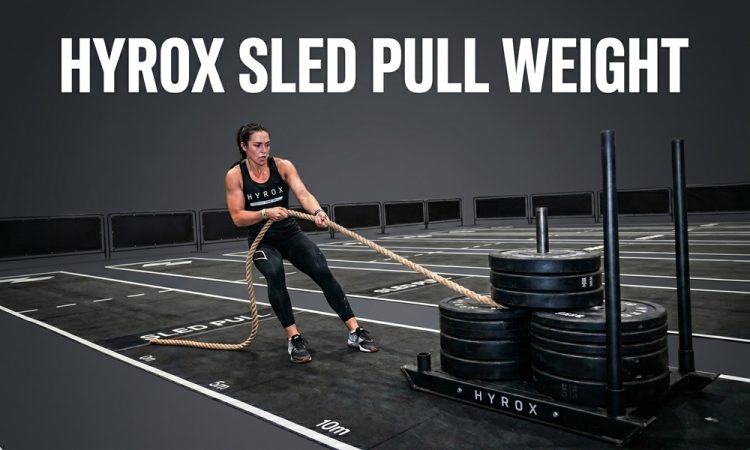
Quick answer: The HYROX sled pull weighs 78 kg for Women (Open), 103 kg for Men (Open) and Women Pro, and 153 kg for Men Pro. All weights include the sled itself and are pulled over 50 m (4 × 12.5 m).
Before the standard chart, here are three things most guides skip — and they matter more than the number on paper:
- The race sled often feels lighter than your gym sled. HYROX runs on a specific carpet. Many home and commercial gym floors create more friction, not less. One coach reports needing to add ~35 kg in training just to match race-day feel.
- The sled gets harder as the event goes on. As runners heat up under load, friction rises. Your fourth pull can feel heavier than your first — even though the weight never changed.
- In Doubles, your partner cannot touch the rope. Only the working athlete pulls. A hand on the rope to “help” can cost you a penalty.
Now, the full breakdown.
How Much Does the HYROX Sled Pull Weigh? (Full Chart)
Every figure below is the total weight you are dragging, sled included — not the plates added on top. The base sled alone is roughly 30–40 kg.
| Division | Sled Pull Weight (incl. sled) | In Pounds (approx.) |
|---|---|---|
| Women (Open) | 78 kg | ~172 lbs |
| Women Pro | 103 kg | ~227 lbs |
| Men (Open) | 103 kg | ~227 lbs |
| Men Pro | 153 kg | ~337 lbs |
| Women’s Doubles | 78 kg | ~172 lbs |
| Men’s Doubles | 103 kg | ~227 lbs |
| Mixed Doubles | 103 kg | ~227 lbs (Men’s Open standard) |
A simple pattern to remember: Men’s Open and Women’s Pro share the same weight (103 kg). If you train across categories, that overlap is useful.
Note on units: HYROX uses metric plates. The pound figures above are conversions, so don’t expect an exact lbs match on the floor.
What’s Actually Included in the Weight
This trips up a lot of first-timers. The number in the rulebook is the loaded total, not the load you add.
- The base sled weighs around 30–40 kg empty.
- The listed weight (e.g., 103 kg) = sled plus plates.
- So a Men’s Open sled isn’t “103 kg of plates.” It’s roughly 65–70 kg of plates on a ~35 kg sled.
When you set up your own sled in the gym, work backward from the total — don’t just load 103 kg of plates on top.
Sled Pull vs Sled Push: Why the Pull Is Lighter
Both stations use the same sled over the same 50 m distance. But the pull is lighter in every division. Here’s the side-by-side:
| Division | Sled Pull | Sled Push |
|---|---|---|
| Women (Open) | 78 kg | 102 kg |
| Women Pro | 103 kg | 152 kg |
| Men (Open) | 103 kg | 152 kg |
| Men Pro | 153 kg | 202 kg |
The reason is mechanical. When you push, you fight friction with your own force. When you pull, you can drop your hips, lean back, and let body weight act as an anchor. Pulling is more efficient, so HYROX loads it lighter.
Translation: the pull tests your grip, lats, and posterior chain under fatigue more than raw leg drive.
Sled Pull Distance and Format
The weight is only half the story. You also need to know what you’re pulling it through.
- Total distance: 50 m
- Format: 4 × 12.5 m (pull, reset, repeat)
- Position in the race: Station 3 of 8 — right after the sled push and a 1 km run
By the time you reach the rope, you already have 2 km of running and a heavy sled push in your legs. That fatigue is exactly why the pull catches people out.
The Hidden Variable: Why Race Weight Feels Different
This is the insight that separates a smooth station from a disaster.
The number is fixed. The feel is not.
Floor and friction. HYROX uses a consistent competition carpet. Your gym might have rubber matting, turf, or a smoother surface — each changes resistance dramatically. As one experienced coach notes, smoother gym flooring can make race weight feel easy in training, then brutal on the day. To bridge the gap, he adds extra load (around 35 kg) so practice matches reality.
Heat build-up. Under heavy load, the sled runners warm the carpet. The hotter it gets, the more it grips. Coaches describe each successive pull feeling slightly heavier — the station literally fights back the longer you’re on it.
The rope itself. HYROX ropes have some stretch. First-timers describe the initial pulls feeling strange because the rope is long and slightly elastic. Take out the slack before you commit.
What to do about it:
- If your floor is smooth, add weight in training to replicate race resistance.
- Don’t pace off raw kilos alone. Pace off effort and time under tension — aim for a hard, sustained pull for the duration you expect on race day.
- Practice on the grippiest surface you can find at least once before competing.
How to Train for the HYROX Sled Pull Weight
You don’t need a fancy sled. You need the right movement patterns and grip endurance.
The Three Techniques (Pick One Before You Start)
| Technique | How It Works | Best For |
|---|---|---|
| Hand-over-hand | Stand tall, reel the rope in arm-over-arm | Lighter loads, strong upper body — fatigues forearms fast |
| Hip drive (CrossFit-style) | Squat low, drive hips back explosively, then reset | Short, powerful athletes |
| Walk-back | Straight arms, lean back, walk backward using body weight | Heavy Pro loads — most energy-efficient |
Most coaches recommend a hybrid: start each rep with a hip drive to break inertia, then switch to the walk-back as the sled moves. As the sled gets closer it feels lighter, so many athletes finish with continuous arm pulls.
The takeaway from the HYROX community is near-unanimous: hand-over-hand alone burns your grip and arms too quickly. Use your legs, lats, and body weight — the big muscles — to do the work.
Strength & Grip Accessories
If you want to get stronger at the pull specifically, train these:
- Heavy sled drags — nothing replaces the real movement
- Seated cable rows and ring/inverted rows — back and lat strength
- Pull-ups — overall pulling power
- Dead hangs and farmer’s holds — grip endurance (grip usually fails before your back does)
- Backward sled drags / backward treadmill walks — mimic the walk-back pattern if you have no sled
- TRX straps anchored to a sled — a solid home substitute
Field-tested grip hack: Lifting straps are banned in HYROX. To fight rope and handle slip under fatigue, some hybrid coaches use cheap gardening gloves for better friction without slowing transitions. Test them in training first.
Rules and Penalties That Affect Your Time
Knowing the weight is useless if you eat a penalty. Here are the rules tied directly to the sled pull.
- Stay standing. You cannot pull from a seated or kneeling position.
- Stay in your box. Step over the lines before the rep is complete and you risk a penalty.
- Manage your rope. If your rope leaves your lane, that’s a time penalty. Feed it to one side so it doesn’t bunch up and trip you.
- Complete all four lanes. Falling short can mean roughly a 3-minute penalty per missing lane.
- Doubles rule: only the working partner touches the rope. The resting partner must stay behind and cannot help.
A common rookie mistake: stepping backward into a pile of loose rope and tripping. Keep the slack to your side and move with control.
What Real Athletes Say About the Sled Pull
For all the talk of weight, the lived experience is consistent across race recaps and community forums:
- Grip goes first. Your forearms are already cooked from the SkiErg and sled push. The pull, then the row and farmer’s carry, keep hammering them. Many athletes lose time here not because their back fails, but because their hands open up.
- It feels harder than it looks. First-timers repeatedly describe the pull as deceptively tough — “it seemed very hard too” is a recurring theme even from people who train hard.
- It’s a place to make up time. Because completion times vary so widely on this station, nailing your technique can move you up the field more than most other stations.
The pattern is clear: it’s not a max-strength test. It’s a fatigue-management and technique test.
HYROX Sled Pull Weight: Quick FAQ
How much does the HYROX sled pull weigh? 78 kg for Women, 103 kg for Men and Women Pro, and 153 kg for Men Pro — all including the sled, pulled over 50 m.
Is the sled pull heavier than the sled push? No. The pull is lighter in every division because pulling lets you use body weight as an anchor, while pushing fights friction directly.
What weight should I train the sled pull with? Match or slightly exceed your division weight, and add load if your gym floor is smoother than competition carpet. Focus on sustained effort, not just the number.
How long is the HYROX sled pull? 50 metres total, split into four 12.5 m segments.
What weight is the Mixed Doubles sled pull? 103 kg, following the Men’s Open standard.
Can I wear gloves for the sled pull? Yes. Lifting straps are banned, but gloves are allowed and some athletes use them to reduce rope slip.
Which muscles does the sled pull work? Mainly the posterior chain — lats, upper back, arms, core, glutes, and hamstrings — plus heavy demand on grip.
Weights reflect the current official HYROX singles and doubles rulebooks. Always confirm against the latest HYROX rulebook before your event, as standards can be updated between seasons.





. Get the full kg/lbs chart, rules, and training tips to nail it.)