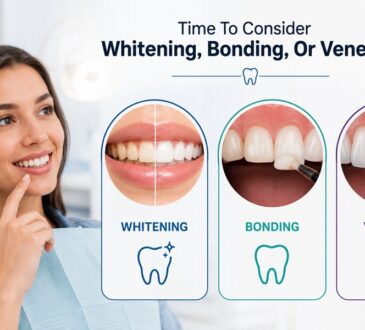
Whitening, Bonding, or Veneers: A Simple Guide to Upgrading Your Smile

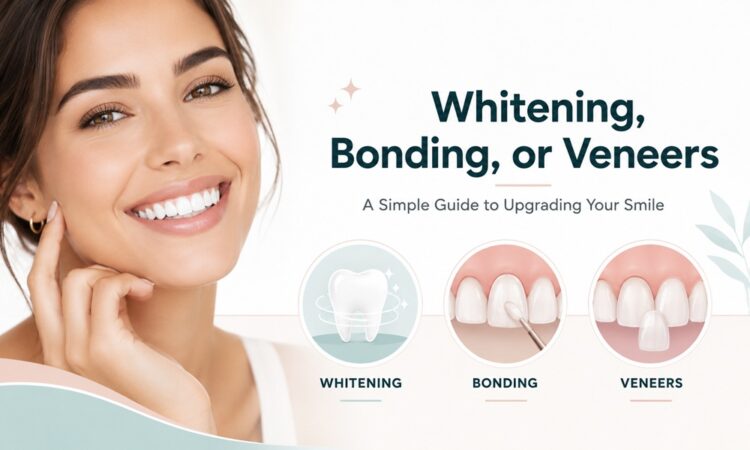
More than half of adults feel self-conscious about their smile. The good news is that three popular treatments cover almost every concern, from a coffee-stained grin to chips, gaps, and uneven edges.
The trick is matching the treatment to the problem. Here is how whitening, bonding, and veneers compare, and how to decide.
Teeth whitening: the simplest upgrade
Whitening lifts stains from your enamel using a peroxide-based gel. It is non-invasive, removes no tooth structure, and delivers fast results.
You have two main routes. In-office whitening uses a stronger gel, often with light, for noticeable change in a single visit. At-home trays from your dentist work more gradually. Drugstore strips cost the least but produce milder results.
One limit to remember: whitening only brightens natural enamel. It does nothing for crowns, bonding, or veneers. It also fades over time, so expect periodic touch-ups.
Best for: surface and age-related stains on otherwise healthy, well-shaped teeth.
Dental bonding: the quick, affordable fix
Bonding uses a tooth-colored composite resin. Your dentist shapes it onto the tooth, then hardens it with a light. The whole thing usually takes 30 to 60 minutes per tooth in a single visit.
It is minimally invasive and often reversible, since little or no enamel is removed. That makes it a great “test drive” before committing to anything permanent.
The trade-offs: composite stains more easily than porcelain, and it is less durable. It also cannot be whitened later, so brighten your natural teeth first if you plan to do both.
Best for: small chips, minor gaps, slightly misshapen teeth, and localized fixes on a budget.
Veneers: the lasting transformation
Veneers are thin shells bonded to the front of your teeth. They correct color, shape, length, and minor alignment all at once, which makes them the go-to for a full smile makeover.
Porcelain veneers are custom-made in a lab. They mimic the light-reflecting quality of natural enamel and resist staining well. The process takes two to three visits and removes a thin layer of enamel, which makes it permanent.
Composite veneers are sculpted directly onto the tooth in one visit. They cost less but do not last as long.
No-prep veneers like Lumineers remove little to no enamel and are often reversible, though they may not hide heavy staining as fully.
Best for: a comprehensive, long-lasting change across several visible teeth.
Side-by-side comparison
| Treatment | Best for | Typical cost per tooth | Lifespan | Reversible? |
|---|---|---|---|---|
| Teeth whitening | Stains only | A few hundred dollars per course | Months to a few years, fades | Not applicable |
| Dental bonding | Small chips, gaps, quick fixes | About $100 to $700 (avg ~$430) | 3 to 10 years | Yes |
| Composite veneers | Budget transformation | About $250 to $1,500 | 5 to 7 years | Partly |
| Porcelain veneers | Full, durable makeover | About $900 to $2,500 (avg ~$1,765) | 10 to 20 years | No |
A full porcelain set across the front six to eight teeth often lands between $10,000 and $20,000. Most plans treat cosmetic work as elective, so insurance rarely covers it unless the procedure is also restorative.
Which should you choose?
Match your main concern to the right path:
- Staining is your only issue? Start with whitening. It is the cheapest, easiest entry point.
- A small chip, gap, or single flaw? Bonding fixes it fast and keeps your enamel intact.
- Several concerns at once, and you want it to last? Veneers handle color, shape, and minor alignment in one plan.
- Heavy internal staining that whitening cannot lift? Porcelain veneers are usually the answer.
- Want to preview a new look first? Bonding or no-prep veneers let you test the idea before going permanent.
Can you combine treatments?
Often, yes, and the order matters. Whiten first, reach your target shade, then add bonding or veneers so the new material is matched to your brighter smile.
This avoids a two-toned result and gives you the most uniform finish. Many people whiten as a standalone step, then revisit bonding or veneers later.
What affects the price
Several factors move your final number:
- Material. Porcelain and zirconia cost more than composite.
- Number of teeth. Billing is per tooth, so a full set adds up fast.
- Dentist expertise. Cosmetic specialists who design smiles artistically charge more.
- Location. High-cost cities run higher than smaller towns.
- Prep work. Whitening, gum contouring, or fixing decay first adds to the total.
Frequently asked questions
Does whitening damage enamel? No. Peroxide gels pass through enamel to lift stains underneath without stripping the surface.
Can bonding be whitened later? No. Composite resin does not respond to whitening gel. Whiten your natural teeth before bonding so the shades match.
How long do porcelain veneers last? With good care, 10 to 20 years. A nightguard, regular cleanings, and avoiding hard objects all extend their life.
Are veneers worth the higher cost? For the right candidate, yes. Spread over their lifespan, the yearly cost is modest, and they fix several issues at once that would otherwise take multiple treatments.
Which is the least invasive option? Whitening, since it removes nothing. Bonding is next, followed by no-prep veneers. Traditional porcelain veneers are the most permanent.
The bottom line
There is no single best treatment, only the best fit for your goals, budget, and the health of your teeth. Whitening brightens, bonding repairs, and veneers transform.
The smartest next step is a professional opinion. If you are near the Gulf Coast, booking a consult for cosmetic dentistry Fairhope is a good way to see which option, or combination, suits your smile.