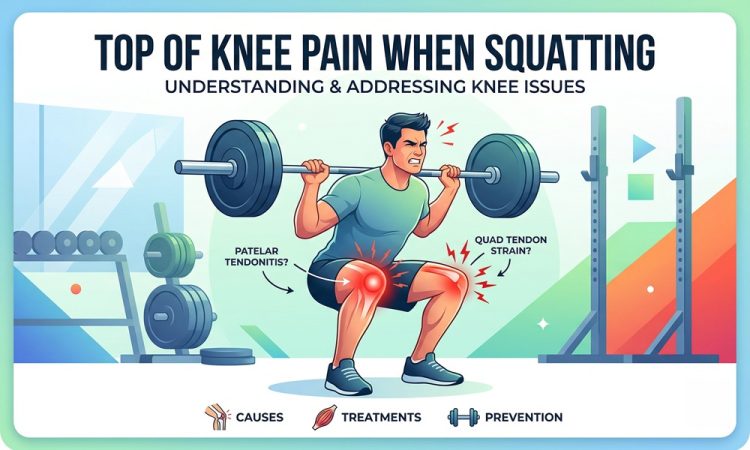
Pain on top of the knee when squatting is one of the most frustrating complaints among athletes, gym-goers, and even everyday people simply bending to pick something up. It stops you mid-rep, makes climbing stairs uncomfortable, and can quietly worsen if ignored. The good news? In most cases, this pain is treatable — and often preventable — once you understand exactly what’s behind it.
This guide breaks down every major cause of pain specifically at the top of the knee (above or around the kneecap), how to identify which condition you’re dealing with, evidence-based treatments, corrective exercises, and when it’s time to see a doctor.
Understanding the Anatomy: Why the “Top of the Knee” Area Is Vulnerable
Before diving into causes, it helps to understand what structures sit at the top of your knee.
The knee is built from four primary bones — the femur (thigh bone), tibia (shin bone), patella (kneecap), and fibula — held together by a system of ligaments, tendons, cartilage, and muscles. At the top of the kneecap sits the quadriceps tendon, a thick band of fibrous tissue that connects your four quadriceps muscles to the patella. Just below the kneecap is the patellar tendon, which runs to the shinbone.
When you squat, the quadriceps contract forcefully to control your descent and power your ascent. This places significant compressive and tensile load on the quadriceps tendon and the superior pole (top edge) of the patella. If that load repeatedly exceeds what the tissue can handle — or if your biomechanics are off — pain develops right there, on top of the knee.
What Does “Top of Knee Pain When Squatting” Feel Like?
Pain in this specific zone can present in several ways:
- A dull ache just above the kneecap that builds gradually during a workout
- A sharp, burning sensation when pushing out of the bottom of a squat
- Tenderness to touch directly at the top edge of the kneecap
- Morning stiffness that eases with movement, then returns after exercise
- Pain that worsens when going from sitting to standing, climbing stairs, or lunging
- A feeling of weakness or instability when the knee is under load
Key distinction: Pain above or at the top of the kneecap typically points to quadriceps tendon involvement. Pain below the kneecap usually signals patellar tendonitis. Pain around or behind the kneecap is more characteristic of patellofemoral syndrome. Identifying the location is the first step toward the right treatment.
Top Causes of Pain on Top of the Knee When Squatting
1. Quadriceps Tendinopathy (The #1 Cause)
This is the most direct cause of pain at the top of the knee. The quadriceps tendon attaches to the superior pole of the patella — meaning when it becomes inflamed or degenerates from overuse, pain lands precisely at the top edge of the kneecap.
Quadriceps tendinopathy occurs when the intensity, frequency, or volume of loading on the tendon exceeds the tissue’s capacity to recover. At a microscopic level, repeated stress causes tiny tears in the tendon’s collagen fibers. If loading continues without adequate recovery, these tears don’t heal properly, and a degenerative cycle sets in.
Who is most at risk?
- Athletes in basketball, volleyball, soccer, CrossFit, and weightlifting
- People who increase training volume too quickly
- Individuals over 40, as tendon elasticity declines with age
- Those with muscle imbalances (weak VMO, tight hip flexors)
Symptoms specific to quad tendinopathy:
- Pain and tenderness directly at the top of the kneecap (superior pole of patella)
- Pain that worsens as squat load increases — a single-leg squat hurts more than a two-legged squat
- Dull ache after workouts that progresses to pain during workouts if left untreated
- Burning or stiffness the morning after exercise
2. Patellofemoral Pain Syndrome (Runner’s Knee)
Patellofemoral Pain Syndrome (PFPS) occurs when the kneecap doesn’t track smoothly in its groove on the femur. This creates friction and pressure, especially during knee-bending activities like squatting. While the pain is often described as around or behind the kneecap, it can radiate to the top of the knee as well.
It’s driven by uneven pull from the quadriceps muscles — particularly a weaker VMO (vastus medialis oblique, the inner quad muscle) allowing the kneecap to drift laterally, creating abnormal contact forces.
3. Knee Bursitis (Suprapatellar Bursitis)
The suprapatellar bursa is a small, fluid-filled sac located just above the kneecap. When this bursa becomes inflamed — from repetitive squatting, direct impact, or prolonged kneeling — it causes swelling and pain directly above the knee. Unlike tendinopathy, bursitis often produces visible swelling and a softer, boggy feeling when pressed.
4. Patellar Tracking Issues
If the kneecap doesn’t glide smoothly in its groove during knee flexion, each squat repetition generates friction and irritation across the top of the kneecap. This is often caused by weak hip abductors or glutes, allowing the knee to cave inward (valgus collapse), which alters how the patella sits and moves.
5. Osteoarthritis of the Knee
In older adults, cartilage wear under and around the kneecap can cause diffuse anterior knee pain that worsens with squatting. As cartilage deteriorates, bones begin to rub against each other, particularly under load. Squatting compresses these worn areas, triggering a deep aching sensation that may be felt at the top of the knee.
Quick Comparison: Common Causes at a Glance
| Condition | Pain Location | Key Trigger | Typical Age Group |
|---|---|---|---|
| Quadriceps Tendinopathy | Top/above kneecap | Loaded squats, jumping | 20–50 (athletes) |
| Patellofemoral Syndrome | Around/behind kneecap | Deep squats, stairs | Any age |
| Suprapatellar Bursitis | Above kneecap (swollen) | Repetitive kneeling/squatting | Any age |
| Patellar Tracking Issues | Diffuse front of knee | Squats with knee valgus | Any age |
| Knee Osteoarthritis | General front/top area | Any knee-bending | 50+ |
Why Poor Squat Form Amplifies Top-of-Knee Pain
Even a healthy knee can develop pain at the top if squatting mechanics are consistently poor. Here’s how common form breakdowns specifically overload the quadriceps tendon and superior patellar region:
Knees caving inward (valgus collapse): When the knees drift toward each other during a squat, the kneecap is pulled laterally. This shifts load unevenly onto the quadriceps tendon and patellar structures, creating friction and irritation at the kneecap’s top edge.
Excessive forward lean: Leaning too far forward during a squat increases the moment arm at the knee, forcing the quadriceps — and by extension the quad tendon — to work harder than necessary to control descent.
Squatting too deep too soon: Deeper squats (below 90°) require greater knee flexion, which significantly increases load on the quadriceps tendon. For someone with early tendinopathy, this quickly tips the scale from manageable to painful.
Heels rising off the ground: Poor ankle dorsiflexion forces the heels to lift, shifting weight onto the forefoot and causing the knees to travel excessively forward — placing enormous strain on the front of the knee, including the quad tendon insertion.
Diagnosing Top-of-Knee Pain When Squatting
If you’re experiencing persistent pain above the kneecap during or after squats, proper diagnosis is essential. A clinician will typically assess:
- Clinical examination — checking for tenderness, swelling, range of motion, and alignment
- Functional testing — observing squat mechanics, single-leg squat tests, and step-down tests
- Imaging — ultrasound is preferred for tendon assessment; MRI provides detail on structural damage; X-ray helps rule out bone spurs or OA
Self-assessment tip: Press firmly just above the top edge of your kneecap. If this produces a sharp, recognizable pain that matches what you feel during squats, quadriceps tendinopathy is a likely culprit. This is called the “superior pole tenderness test.”
Treatment: From Immediate Relief to Full Recovery
Stage 1 — Acute Management (First 48–72 Hours)
The current evidence-based standard has shifted away from complete rest toward the PEACE & LOVE framework (introduced in the British Journal of Sports Medicine, 2019):
PEACE (first 1–3 days):
- Protect — reduce activity that causes pain, but don’t completely stop moving
- Elevate — elevate the leg to reduce swelling
- Avoid anti-inflammatories — short-term, as inflammation is part of healing
- Compress — use an elastic bandage to manage swelling
- Educate — understand that movement is key to recovery
LOVE (ongoing):
- Load — gradually reintroduce loading through the tendon
- Optimism — a positive mindset improves recovery outcomes
- Vascularisation — low-pain cardiovascular activity like cycling maintains fitness
- Exercise — targeted rehab exercises rebuild tendon capacity
Stage 2 — Rehabilitation Exercises
The following exercises are clinically supported for quadriceps tendinopathy and top-of-knee pain. Progress from isometric (no movement) to isotonic (with movement) as pain allows.
Isometric Wall Sit
Hold a seated position against the wall with knees at roughly 60–90° for 30–45 seconds. Perform 3–5 sets. Isometrics provide immediate pain relief by calming sensitized tendons and building load tolerance without joint movement.
Leg Press (Controlled)
Use a leg press machine at a comfortable range. Start with low weight and a partial range of motion. Gradually increase depth and load over weeks. This isolates the quad tendon with controlled, measurable loading.
Spanish Squat
Anchor a resistance band around a rack and sit back into a squat with an upright torso. This reduces shear force at the front of the knee and allows quad tendon loading at a manageable level.
Heel-Elevated Goblet Squat
Placing small weight plates or a wedge under the heels reduces the demand on ankle dorsiflexion, allowing a more upright torso and more controlled knee loading — ideal for those rebuilding squat mechanics.
Glute Bridges and Hip Abduction
Strengthening the glutes and hip abductors improves knee alignment during squats, reducing the valgus collapse that overloads the top of the knee. Perform 3 sets of 15 reps each.
Rule of thumb: Pain during rehab exercises should stay at or below a 4/10 on a pain scale. Check your pain level the next morning — if it’s higher than the day before, reduce volume or intensity.
Stage 3 — Medical and Advanced Treatments
If conservative rehabilitation (6–12 weeks) doesn’t provide sufficient relief, a doctor may recommend:
| Treatment | Description | When Used |
|---|---|---|
| NSAIDs (e.g., ibuprofen) | Reduces inflammation and pain | Early-stage, short-term |
| Corticosteroid injection | Reduces tendon inflammation | Moderate cases not responding to PT |
| Prolotherapy / PRP | Stimulates tendon repair | Chronic tendinosis cases |
| Shockwave therapy | Promotes healing in degenerated tendon | Chronic, non-responsive cases |
| Knee taping / bracing | Offloads the tendon during activity | Acute-to-subacute management |
| Arthroscopic surgery | Removes damaged tissue | Rare, last resort |
Most acute cases of quadriceps tendinopathy resolve within 4–6 weeks with proper management. Chronic tendinosis may take 3–6 months. Early treatment is critical — delay allows the condition to progress from simple inflammation to structural degeneration, significantly extending recovery time.
How to Squat Correctly to Prevent Top-of-Knee Pain
Correcting squat form is arguably the most powerful long-term strategy for preventing anterior knee pain. Here’s a step-by-step technique guide:
- Foot position: Stand shoulder-width apart, toes pointing slightly outward (10–30°)
- Brace your core: Take a breath, brace your abdomen before descending
- Push knees out: Actively drive knees in line with or slightly outside the toes — no caving inward
- Sit back and down: Hinge at the hips slightly while bending the knees; avoid letting knees travel excessively in front of toes
- Keep heels flat: If heels rise, work on ankle mobility or use a heel wedge temporarily
- Maintain an upright torso: The more upright your torso, the less shear force on the front of the knee
- Drive through the heels: On the way up, push from your heels to activate glutes and reduce quad dominance
Prevention: Building Knee Resilience for the Long Term
| Prevention Strategy | Why It Works |
|---|---|
| Progressive overload (not rapid) | Prevents tendon overload from sudden increases in training |
| Warm up before every session | Increases blood flow and tendon pliability |
| Strengthen glutes and hips | Reduces knee valgus and distributes load more evenly |
| Improve ankle dorsiflexion | Allows proper squat depth without heel rise or forward lean |
| Foam roll quads and IT band | Reduces tension that alters patellar tracking |
| Wear appropriate footwear | Supports alignment and reduces joint stress |
| Manage training volume | Avoid sudden spikes in frequency or intensity |
When to See a Doctor
Most top-of-knee pain from squatting can be managed conservatively. However, seek medical evaluation if:
- Pain is severe, sudden, or accompanied by significant swelling
- You heard or felt a “pop” at the knee during squatting
- The knee locks, gives way, or feels unstable
- Pain persists beyond 6–8 weeks despite rest and rehab exercises
- You notice visible deformity above the kneecap
- Pain disrupts normal daily activities like walking or climbing stairs
These signs may indicate a more serious structural issue such as a partial or complete quadriceps tendon tear, meniscus injury, or ligament damage — all requiring prompt assessment.
Frequently Asked Questions
Q: Is it safe to continue squatting if I have top-of-knee pain? Not through sharp, severe pain — but complete avoidance isn’t ideal either. Staying active with modified loading (reduced depth, lower weight, isometric holds) actually promotes tendon healing better than prolonged rest. Use a pain scale: if squatting keeps pain at or below 4/10 and you feel no worse the next morning, it’s generally safe to continue with modifications.
Q: How long does it take for quadriceps tendinopathy to heal? Acute cases: 4–12 weeks with proper treatment. Chronic tendinosis: 3–6 months. The earlier you begin targeted rehab, the faster the recovery.
Q: Can tight quads cause top-of-knee pain when squatting? Yes. Overly tight quadriceps increase the tension on the quad tendon, particularly under load. Regular quad stretching and foam rolling can help relieve this tension, but strengthening is equally important.
Q: Should I use a knee brace for top-of-knee pain? A patellar tendon strap or knee sleeve can help unload the tendon during activity and allow you to stay active with less pain. It’s a supportive tool — not a cure — and should be used alongside rehabilitation exercises.
Final Thoughts
Pain on top of the knee when squatting is common, but it’s not something you have to simply live with. In the vast majority of cases, the culprit is quadriceps tendinopathy — an overuse injury that responds well to load management, targeted exercise, and patient progression. Understanding where your pain is, what aggravates it, and why your tissues are struggling gives you a roadmap to full recovery.
Start conservative: modify your squat, reduce painful loading, begin isometric exercises, and progressively rebuild. See a physiotherapist or orthopedic specialist if symptoms persist beyond 6–8 weeks or if the pain is interfering with daily life. With the right approach, most people return to pain-free squatting — often stronger than before the injury.