Carpal Boss vs Ganglion Cyst: How to Tell the Difference (Symptoms, Causes & Treatment)

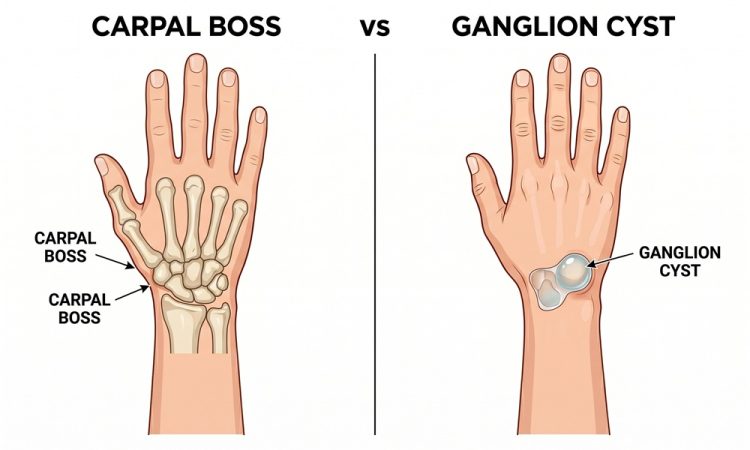
Most articles online only tell you “one is hard, one is soft.” We go deeper with these often-missed insights:
- Yoga and pickleball connection: A rising number of yoga practitioners and pickleball players are showing up with painful carpal bosses due to repeated wrist hyperextension — a trend that’s growing fast.
- They can coexist: A carpal boss and ganglion cyst can occur together on the same wrist. Recent case reports document overlying ganglion cysts forming directly on top of a carpal boss, complicating diagnosis.
- MRI bone marrow edema is the real pain marker: New imaging research shows that bone marrow edema around the quadrangular joint — not just the bony bump itself — correlates with painful carpal bosses (P < 0.001).
- Surgery recurrence is lower than you think: A recent study with 4.8-year follow-up found wedge excision of carpal boss has only a 13% recurrence rate, busting the old myth that carpal boss surgery always fails.
- The “Bible bump” home remedy is dangerous: The folk method of hitting a ganglion cyst with a heavy book can damage tendons, nerves, and surrounding tissues. Doctors universally warn against it.
- Up to 58% of ganglion cysts resolve on their own — making “watchful waiting” a scientifically valid treatment option.
Quick Comparison Table: Carpal Boss vs Ganglion Cyst at a Glance
| Feature | Carpal Boss | Ganglion Cyst |
|---|---|---|
| What it is | Bony overgrowth (bone spur) | Fluid-filled sac (jelly-like) |
| Texture | Hard, like bone | Soft, rubbery, sometimes firm |
| Movability | Fixed, immovable | Can roll slightly under skin |
| Size change | Stays the same | Can grow, shrink, or disappear |
| Location | Back of wrist, base of index/middle finger (CMC joint) | Anywhere on wrist, hand, fingers |
| Pain | Usually painless; can hurt with movement | Usually painless; can press nerves |
| Transillumination (light test) | Does NOT glow | GLOWS (light passes through) |
| Most affected age | Adults in their 40s | Women aged 20–40 |
| Spontaneous resolution | No — it stays | Yes — up to 58% resolve on their own |
| Diagnosis | X-ray, CT, MRI | Physical exam, ultrasound, aspiration |
| Treatment first-line | Observation, splint, NSAIDs | Observation, aspiration |
| Surgery recurrence rate | ~5–13% (modern data) | 5–10% (excision) or 50–70% (aspiration) |
What Is a Carpal Boss?
A carpal boss — also called carpometacarpal (CMC) bossing — is a bony lump on the back of your wrist. It forms where your second and third metacarpal bones (under your index and middle fingers) meet the carpal bones of your wrist.
The term comes from “boss,” a medical word meaning a rounded prominence. It was first described by Dr. Fiolle in 1931. Cadaveric studies suggest a prevalence of up to 19% in the general population, though most people never notice it.
What Does a Carpal Boss Feel Like?
- A hard, immovable bump — similar to feeling your knuckle bone
- Does not change in size
- Often more visible when you bend your wrist down
- May be painless or cause aching with wrist movement
- Some people feel a snapping sensation as tendons slide over the bump
Carpal Boss Causes
Doctors don’t know the exact cause, but several factors contribute:
- Osteoarthritis — cartilage breakdown causing bone-on-bone friction and spur formation
- Repetitive wrist strain — common in typists, manual laborers, and athletes
- Past wrist injury or trauma — even old injuries can trigger bone overgrowth
- Os styloideum — an accessory bone that fails to fuse during development
- Genetic predisposition — abnormal bone formation at birth
Activities That Trigger Carpal Boss Pain
- Yoga (especially poses with wrist hyperextension like downward dog and plank)
- Racquet sports (tennis, pickleball, racquetball)
- Golf
- Weightlifting
- Repetitive typing or manual work
What Is a Ganglion Cyst?
A ganglion cyst is a fluid-filled lump that grows out of a joint capsule or tendon sheath. It’s the most common soft tissue mass in the hand and wrist, accounting for 50–70% of all hand tumors.
The cyst contains thick, jelly-like synovial fluid — similar to joint lubricant. It’s often nicknamed:
- Bible cyst or Bible bump
- Gideon’s disease
These names come from an old (and now strongly discouraged) practice of hitting the cyst with a heavy book to burst it.
Where Ganglion Cysts Appear
- Dorsal wrist (back of wrist) — 60–70% of cases; usually from the scapholunate joint
- Volar wrist (palm side) — near the radial artery
- Base of fingers
- Top of the end finger joint (mucous cysts)
- Foot, ankle, knee — less common
What Does a Ganglion Cyst Feel Like?
- A soft to firm rubbery lump — like a small water balloon under the skin
- Usually 1–2 cm in size, but can grow larger
- Changes size — may swell with activity, shrink with rest
- Can be slightly moved under the skin
- Smooth, round shape
- Translucent — light passes through it (transillumination test)
Ganglion Cyst Causes
The exact cause remains unclear, but common theories include:
- Joint or tendon irritation — repetitive stress causes fluid to leak out
- One-way valve theory — fluid escapes but can’t return, forming a sac
- Mucinous degeneration of connective tissue
- Previous joint injury or arthritis
- Genetic factors
Who Gets Ganglion Cysts?
- Most common in women aged 20–40
- Female-to-male ratio is roughly 1.35:1
- Often appears in people with wrist arthritis
- Common in gymnasts and athletes with repetitive wrist stress
Carpal Boss vs Ganglion Cyst: The 7 Key Differences Explained
1. Texture (The Biggest Clue)
- Carpal boss: Feels hard, like pressing on bone. Cannot be compressed.
- Ganglion cyst: Feels soft, rubbery, or like a firm grape. Slight give when pressed.
2. Movability
- Carpal boss: Completely fixed. It IS the bone.
- Ganglion cyst: Can be rolled slightly between your fingers.
3. Size Changes
- Carpal boss: Stable. Doesn’t grow or shrink day-to-day.
- Ganglion cyst: Fluctuates with activity. May vanish temporarily.
4. The Transillumination Test (Try This at Home)
In a dark room, shine a small flashlight or phone light against the lump:
- Carpal boss: No light passes through — it stays dark (solid bone).
- Ganglion cyst: Lights up like a small glowing bulb (fluid inside).
This test isn’t 100% accurate but offers a strong clue.
5. Location
- Carpal boss: Very specific — only at the base of the index or middle finger where it meets the wrist.
- Ganglion cyst: Can appear anywhere — wrist, fingers, palm, even feet.
6. Pain Pattern
- Carpal boss: Pain on wrist extension or flexion; tendon snapping sensation.
- Ganglion cyst: Pain if pressing on a nerve; aching after activity; weakness in grip.
7. Age and Demographics
- Carpal boss: Adults in their 30s–40s, dominant hand, slight male predominance.
- Ganglion cyst: Women aged 20–40 most affected.
Can a Carpal Boss and Ganglion Cyst Occur Together?
Yes — and this is often missed. Recent case reports document patients with a carpal boss that has an overlying ganglion cyst sitting on top of it. The bony abnormality causes joint irritation, which triggers the body to form a fluid cyst above it.
This is why imaging is critical when symptoms persist. Doctors may treat the cyst, only to find pain continues because the underlying boss was never addressed.
How Doctors Diagnose These Conditions
Physical Examination
- Visual inspection
- Palpation (feeling the texture, size, mobility)
- Transillumination test
- Range of motion checks
- Tenderness assessment
Imaging Tests
| Test | Best For |
|---|---|
| X-ray | Confirming carpal boss; ruling out fractures or arthritis |
| Ultrasound | Differentiating fluid-filled cyst from solid bone; dynamic assessment |
| MRI | Best for occult cysts, soft tissue detail, and detecting bone marrow edema |
| CT scan | High-resolution bony anatomy of carpal boss |
| Aspiration | Confirms ganglion cyst — drawing out jelly-like fluid is diagnostic |
A dynamic ultrasound during wrist hyperextension is now considered one of the best ways to detect symptomatic carpal boss, especially in yoga practitioners.
Treatment Options
Treatment for Carpal Boss
Non-Surgical (First-Line):
- Observation — if painless, no treatment needed
- Wrist splint — immobilization reduces strain
- Ice — shrinks blood vessels and reduces swelling
- NSAIDs — ibuprofen, acetaminophen for pain
- Activity modification — avoiding aggravating motions
- Steroid injections — for stubborn inflammation
Conservative measures provide relief in 70–80% of cases.
Surgical (When Conservative Fails):
- Wedge excision or simple resection of the bony bump
- Outpatient procedure, takes about an hour
- Performed under local, regional, or general anesthesia
- May involve excision of associated ganglion cyst, tendons, or joint fusion in severe cases
Recovery and Outcomes:
- Most patients return to work within 3 months
- Modern wedge excision shows a 13% recurrence rate
- Some studies report up to 94% complete symptom relief
- Pressure dressing post-surgery is now preferred over plaster splints
Treatment for Ganglion Cyst
Non-Surgical:
- Watchful waiting — up to 58% resolve spontaneously
- Wrist splint — limits joint movement to reduce fluid production
- Aspiration — drawing fluid with a needle (recurrence rate 50–70%)
- Steroid injection — sometimes combined with aspiration
- Hyaluronidase injection — emerging option for stubborn cysts
Surgical:
- Excision — complete removal of cyst and stalk
- Arthroscopic removal — minimally invasive option
- Surgery recurrence rate: 5–10% when the stalk is fully removed
⚠️ The “Bible Thump” Warning
Do NOT try the old method of hitting your wrist with a Bible or heavy book. This can:
- Damage tendons and nerves
- Cause significant pain and bruising
- Fail to provide lasting relief (cyst returns)
- Potentially fracture small wrist bones
Home Care Tips for Both Conditions
While you wait to see a doctor or recover from treatment:
- Rest the wrist — avoid repetitive motions
- Apply ice for 15–20 minutes, several times daily
- Wear a wrist brace or splint at night
- Modify activities — limit yoga poses, racquet sports, heavy lifting
- Use over-the-counter pain relief — ibuprofen or acetaminophen
- Strengthen forearm muscles with gentle physical therapy exercises
When to See a Doctor
Visit a hand specialist if you notice:
- A lump that’s growing rapidly
- Increasing pain or weakness in the wrist
- Numbness or tingling in fingers
- Skin changes (redness, warmth) over the lump
- Difficulty performing daily tasks
- Pain that doesn’t improve after 2 months of home care
- Visible deformity or restricted motion
Sudden changes in a wrist lump should always be evaluated — while both carpal boss and ganglion cysts are benign, other conditions like giant cell tumors, lipomas, or rare malignancies can mimic them.
Prevention: Can You Avoid These Lumps?
You can’t completely prevent them — especially if genetics play a role — but you can reduce your risk:
- Take frequent breaks during typing or repetitive tasks
- Use ergonomic equipment — wrist rests, vertical mice
- Modify yoga poses that strain the wrist (use fists or yoga wedges)
- Warm up before sports involving wrist movement
- Strengthen forearm and wrist muscles through targeted exercises
- Wear protective gear during contact sports
- Address minor wrist pain early before chronic changes set in
Frequently Asked Questions (FAQs)
Are carpal boss and ganglion cyst dangerous?
No. Both are benign (non-cancerous) and don’t spread. They only require attention if they cause pain, restrict movement, or affect your appearance significantly.
Can a ganglion cyst turn into a carpal boss?
No. They are completely different — one is fluid, the other is bone. However, a ganglion cyst can form on top of a carpal boss because of the chronic joint irritation.
Does massaging a ganglion cyst help?
Gentle massage won’t help — and forceful pressing or hitting it (the “Bible thump”) can cause more harm than good. Massage cannot make bone shrink in carpal boss either.
How long does carpal boss surgery recovery take?
Most patients return to light activities within 2–3 weeks. Full recovery and return to work typically takes 3 months. Heavy manual work or sports may require longer.
Is a ganglion cyst always on the wrist?
No. While the wrist is the most common location (60–70%), ganglion cysts can also form on fingers, palms, feet, ankles, and knees.
Can I prevent a ganglion cyst from coming back after aspiration?
Recurrence after aspiration is high (50–70%). Surgical excision with removal of the stalk lowers recurrence to 5–10%. Wearing a splint for 2–4 weeks after aspiration may improve outcomes.
Does a carpal boss show up on X-rays?
Yes — X-rays usually show the bony prominence clearly, especially in lateral or oblique views. However, MRI is needed to assess soft tissue and bone marrow edema for painful cases.
Are carpal boss and ganglion cyst hereditary?
There may be a genetic predisposition for both, but neither follows a strict inheritance pattern. Lifestyle, occupation, and joint health play larger roles.
Can children get carpal boss or ganglion cysts?
Ganglion cysts can occur in children, though they’re more common in adults. Carpal boss is rare in children and usually develops after the bones have matured in adulthood.
Will my insurance cover surgery for these conditions?
Most insurance plans cover surgery if it’s medically necessary (pain, functional impairment). Purely cosmetic removal may not be covered. Check with your insurance provider.