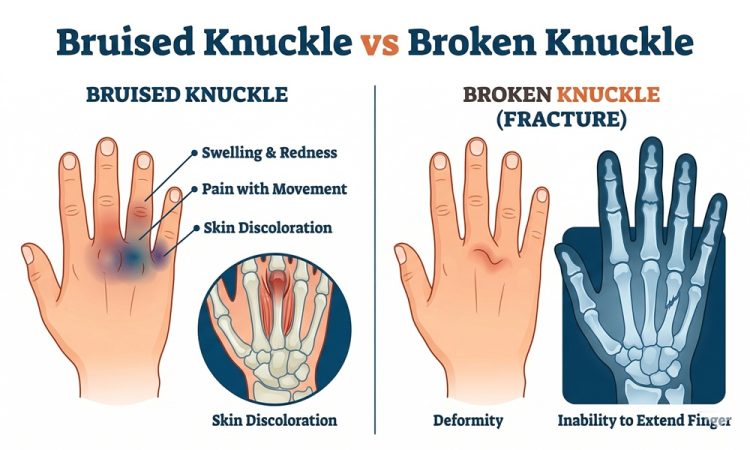
Knuckle injuries are more common than most people realize. Whether it happened during a contact sport, an accidental fall, or a moment of frustration with a hard surface, the result — pain, swelling, and stiffness — can look almost identical whether the knuckle is bruised or broken. That similarity is exactly what makes self-diagnosis so tricky, and why so many people delay getting the care they need.
As health advisors, we want to help you understand the difference between these two injuries clearly and confidently — because the way you treat them matters enormously. A bruised knuckle managed at home heals fine. A broken knuckle left untreated can lead to chronic pain, permanent deformity, and lifelong loss of hand function.
What Exactly Is a Knuckle?
Your knuckles are the bony joints that connect your fingers to your hand. Medically, they are called the metacarpophalangeal (MCP) joints. Each knuckle is formed by the rounded end of a metacarpal bone (the long bones in your palm) meeting the base of a finger bone (phalanx). These joints are surrounded by tendons, ligaments, cartilage, and a thin layer of skin — making them both essential to hand movement and vulnerable to impact.
What Is a Bruised Knuckle?
A bruised knuckle, medically known as a contusion, occurs when a direct blow or blunt force trauma ruptures small blood vessels (capillaries) beneath the skin. The blood leaks into the surrounding soft tissue, causing the characteristic discoloration, swelling, and tenderness — but importantly, no bone is fractured.
Common Causes of a Bruised Knuckle
- Punching a hard surface (wall, floor, equipment)
- Contact sports such as boxing, MMA, baseball, or basketball
- Accidental falls where the hand takes impact
- Jamming or twisting a finger
- Repeated impact to the hands over time
Symptoms of a Bruised Knuckle
- Mild to moderate pain that is duller and more tolerable than fracture pain, and typically improves with rest
- Discoloration — the skin turns blue, purple, or yellowish as the bruise progresses through the healing stages
- Localized swelling around the injured joint, generally less pronounced than in a fracture
- Maintained mobility — the finger can still be moved, though it may be uncomfortable to do so
- Tenderness to touch concentrated around the point of impact
- Pain that typically peaks in the first 48–72 hours and gradually subsides
Recovery Time: Most bruised knuckles heal within 1 to 3 weeks with simple home care. Mild cases may resolve within just a few days.
What Is a Broken Knuckle?
A broken knuckle is a fracture of the metacarpal bone — the bone just below the knuckle — or of the proximal phalanx at the knuckle joint itself. These injuries are also called metacarpal fractures and are classified among the most common hand fractures seen in emergency and orthopedic settings.
Because a fracture involves structural damage to the bone itself, it is a more serious injury that requires proper medical evaluation and, in many cases, professional treatment to heal correctly.
Common Causes of a Broken Knuckle
- Punching a hard surface — the most frequent cause
- Physical altercations (commonly called a “boxer’s fracture” when the 4th or 5th metacarpal is involved)
- Contact sports: football, hockey, rugby, martial arts
- Accidental falls with the hand absorbing the impact
- Direct trauma from a heavy object dropping on the hand
Symptoms of a Broken Knuckle
- Severe, sharp pain — intense and persistent, often not relieved by rest or over-the-counter medication
- Significant swelling that may extend beyond the injured knuckle to adjacent fingers or the back of the hand
- Visible deformity — the knuckle may appear sunken, depressed, crooked, or out of alignment
- Limited or absent finger movement — significant difficulty or complete inability to bend the affected finger
- Numbness or tingling — caused by swelling compressing nearby nerves
- Rapid bruising — bruising may appear almost immediately due to rapid blood loss around the fracture site
- Rotational deformity — fingers may appear to overlap or point in the wrong direction when making a fist
Recovery Time: Broken knuckles typically take 4 to 6 weeks to heal with immobilization, and full strength and function can take several months to restore, especially when therapy is required.
Bruised Knuckle vs Broken Knuckle: Side-by-Side Comparison
| Feature | Bruised Knuckle | Broken Knuckle |
|---|---|---|
| Pain Level | Mild to moderate; dull and manageable | Severe and sharp; persistent |
| Swelling | Localized; moderate | Significant; may spread to adjacent fingers |
| Discoloration | Gradual; blue/purple, localized | May appear immediately; more widespread |
| Deformity | None | Possible; sunken, crooked, or misaligned knuckle |
| Finger Mobility | Uncomfortable but maintained | Severely limited or impossible |
| Numbness/Tingling | Rare | Common (due to nerve compression from swelling) |
| Tenderness | Localized tenderness | Intense; painful even to light touch |
| Healing Time | 1–3 weeks | 4–6 weeks (or longer) |
| Medical Imaging Needed? | Not always | Yes — X-ray required for confirmation |
| Treatment | RICE method at home | Splint, cast, buddy taping, or surgery |
How Are These Injuries Diagnosed?
Physical Examination
A doctor or specialist will begin by visually inspecting the knuckle for swelling, discoloration, deformity, and any open wounds. They will assess the range of motion and check for rotational misalignment by asking the patient to form a fist. Any overlapping or scissoring of the fingers is a strong indicator of a fracture.
Imaging
- X-ray — the primary and most important diagnostic tool for confirming a fracture. Multiple angles are taken to fully assess the break.
- CT Scan — used when X-rays are inconclusive or when a more detailed cross-sectional view is required.
- MRI — less common for knuckle injuries, but useful for evaluating soft tissue damage such as tendon or ligament injuries that may accompany a fracture.
Important: Never assume a knuckle is only bruised without ruling out a fracture. A missed fracture that heals improperly can cause permanent stiffness, chronic pain, and joint deformity.
Treatment Options
For a Bruised Knuckle
Bruised knuckles generally respond well to home management using the RICE method:
- Rest — Avoid activities that stress the injured hand. Give it time to heal.
- Ice — Apply a cloth-covered ice pack for 15–20 minutes every hour during the first 48 hours to reduce swelling and numb the pain.
- Compression — Wrap the hand with a soft bandage to reduce swelling and provide mild stabilization.
- Elevation — Keep the hand raised above heart level, especially in the first 24–48 hours.
Additional measures include:
- Over-the-counter anti-inflammatories (ibuprofen, naproxen) for pain and swelling
- Natural anti-inflammatory supplements such as turmeric and curcumin
- A soft splint to rest the finger in proper position during healing
- Gradual return to movement once the acute pain resolves
For a Broken Knuckle
Treatment depends on the type, location, and severity of the fracture.
Non-Surgical Treatment
- Buddy taping — taping the injured finger to an adjacent finger for support (used for minor, non-displaced fractures)
- Splinting or casting — immobilizes the bone to allow proper alignment during healing; the most common treatment for stable fractures
- Closed reduction — the doctor manually realigns the bone without surgery, followed by splinting or casting
- A follow-up X-ray is typically scheduled 1–2 weeks later to confirm proper healing
Surgical Treatment
Surgery is required when the fracture is displaced, unstable, or involves bone fragments that cannot be repositioned manually.
- Internal fixation — an incision is made, and the bone is stabilized using pins, wires, screws, or plates
- External fixation — a metal frame with pins is secured outside the hand to hold the fracture in place while it heals
Rehabilitation
Physical and occupational therapy are essential after a broken knuckle to restore grip strength, flexibility, and full hand function. Without rehabilitation, stiffness and weakness can persist well beyond the initial recovery period.
Complications of an Untreated Broken Knuckle
This is where many people make a costly mistake — assuming a painful, swollen knuckle is “just bruised” and waiting for it to heal on its own. If a fracture goes untreated, the consequences can be significant:
- Malunion — the bone heals in a misaligned position, causing permanent deformity
- Chronic pain — unresolved joint instability leads to ongoing discomfort
- Reduced grip strength — difficulty with everyday tasks such as gripping, typing, or lifting
- Post-traumatic arthritis — joint damage from an improperly healed fracture accelerates cartilage breakdown
- Rotational deformity — the finger may permanently point in the wrong direction
- Infection risk — particularly dangerous in open fractures where bone breaks through the skin
When Should You See a Doctor?
See a doctor promptly if you experience:
- Pain that is severe and does not improve with rest or over-the-counter medication
- Swelling that spreads beyond the injured knuckle to other fingers
- A knuckle that appears sunken, crooked, or visibly out of place
- Inability to straighten or bend the affected finger
- Numbness or tingling in the hand or fingers
- Fingers that overlap or appear rotated when you try to make a fist
- An open wound or cut near the injury site
- Symptoms that worsen after 48–72 hours instead of improving
Seek emergency care immediately if:
- There is bone visible through the skin (open fracture)
- You experience sudden loss of sensation in the hand
- The injury was caused by a bite (human or animal) — this carries a high infection risk
Frequently Asked Questions
Can you move a broken knuckle? Yes — surprisingly, some people can still bend a broken knuckle. The ability to move the finger does not rule out a fracture. Only an X-ray can confirm whether the bone is intact.
Does bruising your knuckles make them stronger? No. Bruising is a sign of tissue trauma — small blood vessels breaking under the skin. Repeated impact does not strengthen the knuckle; it can contribute to ongoing stiffness, joint irritation, and cumulative damage over time.
Can a broken knuckle heal without a doctor? While minor, non-displaced fractures may heal on their own, doing so without medical guidance risks malunion — where the bone heals in an incorrect position. This can cause permanent deformity and long-term loss of hand function. Always seek evaluation for suspected fractures.
How long does a bruised knuckle hurt? Pain from a bruised knuckle is usually most noticeable in the first few days and gradually improves. Most bruises resolve fully within 1–3 weeks. If pain persists or worsens beyond two weeks, seek medical evaluation.